


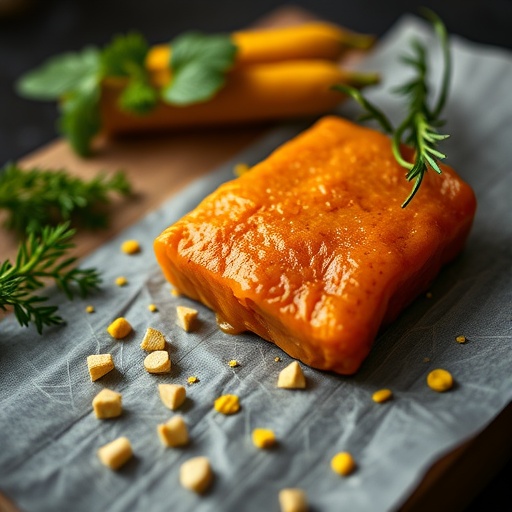
In a groundbreaking step toward revolutionizing sustainable food production, researchers have developed innovative curcumin-incorporated edible hydrogel films utilizing a composite of potato starch, κ-carrageenan, and poly(vinyl alcohol) (PVA) designed as scaffolds for cultured meat cultivation. These polymeric composite films, referred to as CSCP, harness the synergistic properties of natural polysaccharides and synthetic biocompatible polymers to provide a multifunctional platform that not only supports cell growth but also incorporates antioxidant and coloring properties via curcumin. This advance addresses critical global challenges in meat sustainability while offering a novel biomaterial conducive to cultured meat tissue engineering.
The integration of potato starch, a naturally abundant and renewable polysaccharide, with κ-carrageenan and PVA results in a composite material with unique mechanical and biochemical characteristics tailored for tissue scaffolding. Starch functions as a cost-effective and sustainable matrix, while κ-carrageenan, a sulfated polysaccharide derived from red seaweed, helps enhance the gel’s structural integrity. PVA, recognized as a generally safe ingredient per food regulatory authorities, provides additional film-forming and mechanical reinforcement capacities. Together, these polymers create an edible scaffold that synergistically balances strength, flexibility, and biocompatibility.
Preparation of these films involves sophisticated solvent casting and thermal treatment techniques. Plasticization is achieved using glycerol, which softens the film by interfering with intermolecular forces in the polymer matrix. Meanwhile, succinic acid acts as a crosslinker, facilitating covalent bonds among polymer chains through interactions between hydroxyl and carboxyl functional groups. This controlled crosslinking enhances the network stability of the hydrogel, reducing solubility while maintaining elasticity critical for cell adherence and growth.
Extensive physicochemical characterization was undertaken to delineate the morphology, crystallinity, chemical composition, and mechanical performance of the CSCP hydrogels. Field-emission scanning electron microscopy reveals the nano-to-microscale porous architecture fundamental for cell infiltration and nutrient exchange. X-ray diffraction patterns illustrate the crystalline and amorphous domains within the polymeric scaffold, which influence mechanical durability and flexibility. Fourier-transform infrared spectroscopy confirms successful functional group interactions arising from crosslinking and plasticization, indicating the molecular integrity of the composite film.
Mechanical testing highlights an intriguing balance modulated by potato starch content; increasing starch concentration disrupts the crystalline regions within the polymer matrix, thereby diminishing tensile strength but enhancing flexibility and elasticity. This microstructural remodeling produces an amorphous configuration more favorable for accommodating dynamic cellular movements and mechanical stresses encountered during tissue cultivation. However, this trade-off necessitates careful optimization to maintain scaffold robustness critical for three-dimensional cultured meat constructs.
Swelling behavior studies illuminated how polymer-hydrophilic interactions and network density govern water uptake. The CSCP-2 hydrogel demonstrates a slight reduction in swelling ratio with increased starch content, attributed to the starch’s limited hydrogen bonding capability relative to other polysaccharides. This reduced swelling is beneficial because it preserves scaffold dimensional stability during prolonged culture periods, thus enabling consistent support for muscle satellite cells.
Biological evaluations confirm the superior cytocompatibility of the CSCP scaffolds, demonstrated by the adhesion and proliferation of bovine muscle satellite cells over 21 days. The composite films not only underpin cell viability but also provide a microenvironment that promotes cellular functions essential for myogenic differentiation. Despite a minor decline in metabolic activity observed in some samples, which may result from nutrient limitations or oxygen diffusion constraints in multilayered cultures, the overall results underline the films’ potential to serve as conducive matrices for complex tissue development.
This research unfolds promising implications for cultured meat technology by merging edible, bioactive, and mechanically competent materials into a single scaffold system. The antimicrobial and antioxidant properties inherent to curcumin also potentially enhance the shelf life and safety of cultured meat products while adding a natural pigmentation effect, reducing the necessity for synthetic additives. These attributes collectively elevate consumer acceptance and align with clean-label trends in the food industry.
Further, the environmentally benign nature of all components underscores sustainability at multiple levels. The reliance on renewable polysaccharides and FDA-approved polymers minimizes ecological footprints and assures food-grade safety standards, critical for scaling lab-grown meat production toward commercial viability. The use of edible scaffolds also simplifies downstream processing, as no toxic residues or non-consumable materials must be removed before product consumption.
Future investigations are likely to delve deeper into optimizing polymer ratios and crosslinking densities to fine-tune mechanical properties and swelling behaviors suited to different cultured meat applications. Moreover, integrating bioactive molecules or engineering scaffold architectures that mimic native extracellular matrices could refine cell differentiation pathways and tissue maturation kinetics, further advancing functionality. The modularity of the CSCP composite system promises extensive customization potential.
This study not only contributes valuable insights into biomaterial science for cultured meat but also exemplifies how interdisciplinary approaches—combining polymer chemistry, food engineering, and cell biology—can catalyze innovations addressing urgent societal needs such as climate mitigation and food security. As cultured meat gains traction, platforms like the CSCP hydrogel are poised to become foundational in fabricating ethical, nutritious, and environmentally friendly proteins that could redefine global food systems.
In conclusion, the development of curcumin-incorporated edible hydrogel films based on potato starch, κ-carrageenan, and PVA represents a significant leap forward in scaffold materials for cultured meat. Through meticulous design and characterization, this composite material demonstrates the ability to provide a nurturing, sustainable, and biofunctional environment for bovine muscle satellite cell culture. This progress paves the way for efficient large-scale production of three-dimensional cultured meat, aligned with consumer safety and environmental stewardship imperatives.
Cite Scienmag News
Ophelia Keating. (November 3, 2025). Curcumin-Infused Edible Films for Cultured Meat. Scienmag. https://scienmag.com/curcumin-infused-edible-films-for-cultured-meat/
Ophelia Keating. "Curcumin-Infused Edible Films for Cultured Meat." Scienmag, 3 November 2025, https://scienmag.com/curcumin-infused-edible-films-for-cultured-meat/. Accessed 5 September 2026.
Ophelia Keating. "Curcumin-Infused Edible Films for Cultured Meat." Scienmag. November 3, 2025. https://scienmag.com/curcumin-infused-edible-films-for-cultured-meat/


