


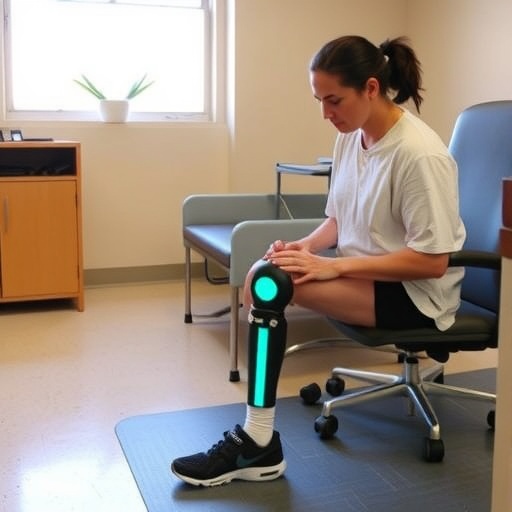
A cutting-edge study conducted at the University of Colorado Anschutz Medical Campus has made a significant advancement in the field of prosthetics, particularly for lower-limb amputees. The research focuses on the Colorado Limb Donning-Timed Up and Go (COLD-TUG) test, a novel method that evaluates both the efficiency of prosthetic donning and the mobility of patients using bone-anchored prostheses as compared to traditional socket-style options. This groundbreaking finding indicates that bone-anchored prostheses, which attach directly to the bone, allow patients to don their prosthetics more quickly than those who use conventional socket-rested alternatives.
The study’s lead author, Dr. Mohamed Awad, articulated the fundamental purpose of the research: to develop a reliable and valid test that serves as a performance measurement for lower-limb amputees. The COLD-TUG test effectively combines two essential components – the time required for patients to put on their prosthesis and the time taken to complete a modified Timed Up and Go (TUG) test, which gauges their mobility. By integrating these two crucial elements, the test aims to provide a comprehensive evaluation of the performance of amputees within the community.
Previous anecdotal evidence suggested that bone-anchored limb (BAL) prostheses yield superior physical activity, enhanced balance, increased comfort while seated, a greater range of motion, and efficient donning practices than traditional socket prostheses. However, until this significant study, there lacked a concrete, population-specific, performance-based assessment to substantiate these claims, leaving a gap in understanding the profound ways in which these advancements impact the quality of life for amputees.
The research team utilized the COLD-TUG test with the intent to fill this knowledge void. Dr. Jason Stoneback, who is an orthopedic trauma surgeon and associate professor at the CU School of Medicine, noted that the test has been designed to be straightforward, allowing practitioners to easily implement it into clinical practice. The elegance of the COLD-TUG test lies in its specification; it measures critical metrics that are directly pertinent to lower-limb amputees, enhancing its utility as a tool in assessing the efficacy of BAL prostheses for users across various settings.
The test fundamentally requires subjects to time how long it takes them to don a prosthesis, rise from a standard chair, navigate approximately ten feet—turning around midway—return to the chair, and sit down. Importantly, the study enrolled a total of thirty-one patients coping with unilateral lower-extremity amputation; among them, fifteen used traditional socket-style prostheses while sixteen utilized BAL prostheses. This structured comparison provides a robust framework for evaluating the differences in performance outcomes.
Upon analysis, the researchers discovered a remarkable outcome: subjects with BAL prosthetics could don their prostheses significantly faster—by an average of sixty-one seconds—than those utilizing traditional socket-style devices. This seemingly small time saving compounds significantly across multiple donning and doffing events during a patient’s daily life. As noted by Dr. Awad, an individual equipped with a prosthesis might repeat the act of donning and doffing as many as fifteen times a day. When factoring in the cumulative nature of these moments, the potential for expansive time savings becomes evident. For those individuals who are awake for approximately twelve hours daily, saving an average of nearly one minute each time can translate into hours reclaimed over days, weeks, and months.
This recalibrating of time management has broader implications, as it potentially enhances the overall motivation and confidence of individuals managing limb loss. The ease afforded by more efficient prosthesis usage could translate into greater physical activity levels, allowing amputees to engage more fully with their surroundings and participate actively in daily life. Given that mobility is a core aspect of independence and quality of life, these findings highlight an essential shift in care and rehabilitation practices concerning prosthetic technology.
The results of the COLD-TUG test support longstanding patient testimonials proclaiming the advantages of BAL prosthetics in terms of mobility, stability, and overall confidence. These insights underscore a critical transition in living with limb-loss—emphasizing the importance of patient-validated outcomes that resonate deeply within healthcare practices. As Dr. Stoneback observed, this test goes beyond simple speed assessments; it captures various dimensions of the amputee experience, affirming that healthcare providers equipped with this knowledge can play a transformative role in prescribing the best prosthetic options tailored to the individual’s lifestyle.
The COLD-TUG test represents a major advancement not just in testing methodologies but in how healthcare professionals address the unique challenges faced by amputees. Implementing evidence-based tools such as this into clinical settings will ensure that patients have access to the most suitable interventions, ultimately facilitating smoother transitions back to active living. Healthcare providers worldwide can look towards utilizing validated outcome measures such as the COLD-TUG as a basis for refining their practice based on the expanding field of orthopedic and rehabilitative medicine.
As more patients demonstrate preference for BAL prosthetics, the demand for standardized practices and measures will likely continue to grow, underpinning the value of further research in this arena. The findings from this study are expected to propel future investigations into the efficacy of prosthetic technologies while enhancing our understanding of the patient experience. A renewed focus on research-driven, patient-centric care will likely transform the standards of practice and attract attention from both academic and practitioner sectors alike.
In conclusion, the COLD-TUG test stands as a reflection of ongoing innovations that improve the care for those who have lost limbs. Studies such as this provide a pathway for advancing the field and offer a new lens through which to view the effectiveness of modern prosthesis technologies. The foundational findings of this work serve as a reminder that true progress in medicine comes from marrying cutting-edge research with the lived experiences of patients; this symbiosis is part of what propels transformative health outcomes and inspires confidence for those navigating life after amputation.
Keywords
Prothesis, Prosthetic limbs, Biomedical engineering, Biotechnology, Medical technology
Cite Scienmag News
Denise Maddox. (May 23, 2025). CU Anschutz Unveils Groundbreaking Tool for Assessing Performance in Bone-Anchored Prosthesis Users Post-Amputation. Scienmag. https://scienmag.com/cu-anschutz-unveils-groundbreaking-tool-for-assessing-performance-in-bone-anchored-prosthesis-users-post-amputation/
Denise Maddox. "CU Anschutz Unveils Groundbreaking Tool for Assessing Performance in Bone-Anchored Prosthesis Users Post-Amputation." Scienmag, 23 May 2025, https://scienmag.com/cu-anschutz-unveils-groundbreaking-tool-for-assessing-performance-in-bone-anchored-prosthesis-users-post-amputation/. Accessed 4 September 2026.
Denise Maddox. "CU Anschutz Unveils Groundbreaking Tool for Assessing Performance in Bone-Anchored Prosthesis Users Post-Amputation." Scienmag. May 23, 2025. https://scienmag.com/cu-anschutz-unveils-groundbreaking-tool-for-assessing-performance-in-bone-anchored-prosthesis-users-post-amputation/


