


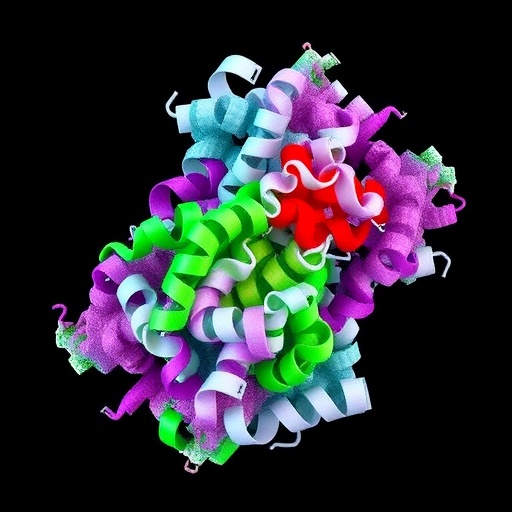
In a groundbreaking advancement for molecular biology and cancer research, scientists have unveiled high-resolution cryo-electron microscopy (cryo-EM) structures of the CRAF/MEK1/14-3-3 protein complexes. These structures illuminate the elusive autoinhibited and open-monomer conformations of RAF kinases, a pivotal class of proteins implicated in cell growth and proliferation pathways. The intricate assembly and regulation features revealed by these complexes open new avenues for targeted therapies in oncology and deepen our understanding of RAF kinase signaling dynamics at an unprecedented structural level.
RAF kinases, including CRAF, function as key regulators in the RAS-RAF-MEK-ERK signaling cascade, a pathway essential for transmitting extracellular growth signals to the nucleus. Aberrations in this pathway frequently contribute to tumorigenesis, making RAF proteins critical targets in cancer treatment research. Despite their importance, the detailed molecular configurations governing RAF activity—especially the autoinhibited states that prevent unintended signaling—have remained largely elusive due to the structural complexity and dynamism of these complexes.
This scientific endeavor employed cryo-EM technology to capture exquisite snapshots of these large protein assemblies. The researchers successfully resolved the CRAF/MEK1/14-3-3 complexes in two distinct states: an autoinhibited conformation, which maintains signaling silence, and an open monomer configuration, suggesting transitions toward activation. These dual conformations provide a snapshot into the molecular switch mechanisms that finely tune RAF kinase functions in cellular contexts.
Deep in the autoinhibited state, the cryo-EM maps reveal a configuration whereby 14-3-3 dimers bind phosphorylated serine residues on CRAF, effectively stabilizing the kinase in a repressed conformation. This structural locking mechanism forestalls premature downstream signaling by sequestering critical regions responsible for kinase activation and interaction with MEK1, the immediate downstream substrate. Such molecular brakes are vital to ensure signaling fidelity and prevent aberrant activation associated with oncogenic transformations.
Intriguingly, the open monomer structure portrays a more relaxed spatial arrangement of CRAF protein segments, hinting at a poised yet inactive state ready for rapid activation upon the appropriate cellular cues. The interactions between MEK1 and CRAF in this state suggest a preparatory step preceding full kinase stimulation and complex dimerization, processes known to enhance RAF’s catalytic output and propagate signal transduction. Understanding this intricate choreography advances our grasp of how RAF kinases respond dynamically to cellular environments.
The involvement of 14-3-3 proteins as regulatory scaffolds is underscored in these structures. By binding to multiple phosphorylated motifs on CRAF, 14-3-3 dimers exert a dual role: on one hand, they maintain autoinhibition; on the other, they facilitate release into active configurations under specific modifications. This molecular duality emphasizes the delicate balance of kinase regulation by conformational control rather than mere presence or absence of complex components.
From a therapeutic perspective, the detailed visualization of these complexes offers tantalizing prospects for drug development. Agents designed to mimic or disrupt specific interfaces between CRAF, MEK1, and 14-3-3 could prove transformative in modulating aberrant RAF signaling. The structural insights into the autoinhibitory “lock” mechanism, for example, may inspire novel small molecules or biologics that stabilize this inactive conformation, thereby impeding oncogenic activation.
These findings also offer clarity on the controversial models of RAF activation, which traditionally centered around dimerization and phosphorylation events. By dissecting the stepwise conformational changes, the new structures reconcile conflicting biochemical data, unveiling that an initial monomeric open state precedes kinase domain dimer assembly. This nuanced understanding reshapes canonical signaling paradigms and suggests that targeting early-stage conformations could be a more efficacious strategy.
Moreover, this research exemplifies the power of cryo-EM in capturing dynamic protein assemblies at near-atomic resolutions without the need for crystallization, a formidable challenge for flexible complexes like RAF/MEK1/14-3-3. The high-resolution electron density maps presented here enable precise modeling of interactions and post-translational modifications, which are pivotal to understanding regulation mechanism at the molecular forefront.
The study’s methodical approach combined biochemical purification, phosphorylation state analysis, and advanced computational modeling to validate the authenticity of these conformational snapshots. This multi-pronged strategy ensures that the captured states are physiologically relevant and representative of the intracellular milieu, thereby reinforcing their translational potential in medical research.
RAF kinases, especially CRAF, have long been resistant to direct pharmacological inhibition due to their structural plasticity and complex allosteric regulation. These cryo-EM structures, by revealing critical intermediates and scaffolding interactions, offer a rational framework for developing next-generation RAF inhibitors that exploit newly observed vulnerabilities within regulatory interfaces.
Furthermore, the insight into MEK1’s positioning relative to CRAF elucidates how RAF activation leads to precise MEK phosphorylation. This step is fundamental for propagating mitogenic signals and underscores why dysregulated RAF-MEK interactions foster malignancy. Targeting the interface between these kinases might enable more selective interruption of pathological signaling while sparing normal cellular functions.
In addition to oncological implications, understanding RAF autoinhibition bears significance in developmental biology and neurobiology, where regulated growth signaling governs differentiation and adaptive responses. Aberrant signaling in these contexts also contributes to diseases beyond cancer, suggesting that findings from this study may have broad biomedical relevance.
Looking ahead, the research community anticipates that these structural revelations will fuel exploration into related RAF isoforms such as BRAF, which are frequently mutated in cancers like melanoma. Comparative analysis may uncover isoform-specific regulatory strategies or vulnerabilities that can be therapeutically exploited, marking a significant stride toward precision oncology.
In sum, the elucidation of CRAF/MEK1/14-3-3 autoinhibited and open-monomer states presents a landmark achievement in decoding the complex molecular regulation of a central kinase signaling hub. The intricate balance of conformations captured here not only enhances fundamental understanding but also unlocks new potential for clinical translation in combating RAF-driven diseases.
The convergence of cryo-EM structural biology with molecular medicine encapsulated in this work spotlights a future where detailed mechanistic insights dictate the design of innovative therapeutics. This deeper comprehension of RAF regulation heralds a pivotal chapter in targeted cancer treatment and signaling biology, driving forward the frontier of biomedical innovation.
Cite Scienmag News
Nathaniel Bowman. (September 1, 2025). Cryo-EM Reveals RAF Autoinhibition and Activation Structures. Scienmag. https://scienmag.com/cryo-em-reveals-raf-autoinhibition-and-activation-structures/
Nathaniel Bowman. "Cryo-EM Reveals RAF Autoinhibition and Activation Structures." Scienmag, 1 September 2025, https://scienmag.com/cryo-em-reveals-raf-autoinhibition-and-activation-structures/. Accessed 4 September 2026.
Nathaniel Bowman. "Cryo-EM Reveals RAF Autoinhibition and Activation Structures." Scienmag. September 1, 2025. https://scienmag.com/cryo-em-reveals-raf-autoinhibition-and-activation-structures/


