

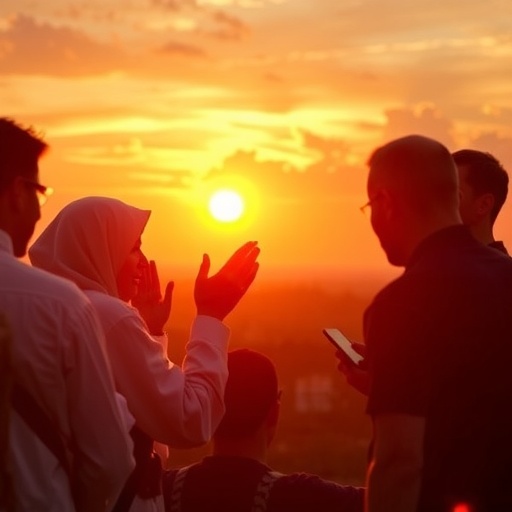
In an enlightening new study published in BMC Psychology, researchers have embarked on an extensive cross-cultural investigation into the intricate interplay between religiosity, gratitude, and happiness, with a seminal focus on the role of self-esteem as a mediating psychological factor. Drawing on a robust sample of Malaysian and Indonesian adults, this groundbreaking research unearths nuanced insights into how deeply rooted cultural and spiritual frameworks shape subjective well-being. The findings not only contribute to the scientific understanding of emotional and cognitive processes but also have profound implications for mental health strategies in culturally diverse societies.
The research team, led by Nor A.M., Kadri N.M., Wahab R., and their colleagues, approached their study by synthesizing theoretical perspectives from positive psychology, cultural psychology, and religious studies. They aimed to disentangle the multifaceted relationships between three variables: religiosity, the extent to which individuals engage with religious beliefs and practices; gratitude, conceptualized as a dispositional virtue influencing social and emotional dynamics; and happiness, operationalized as a subjective state encompassing both hedonic pleasure and eudaimonic fulfillment. The central innovation of their model was the inclusion of self-esteem, a psychological construct reflecting an individual’s evaluative posture toward the self, as a potential mediator influencing the pathways from religiosity and gratitude to happiness.
Culturally, Malaysia and Indonesia share significant historical, religious, and social commonalities, such as large Muslim populations and collectivist social frameworks, yet maintain distinct sociopolitical landscapes and cultural idiosyncrasies. This geographical and cultural divergence provided a fertile context for examining whether the psychological processes that underlie happiness exhibit universal patterns or contingent variations. By comparing participants from these two countries, the researchers were able to appraise the robustness of the mediating role of self-esteem and clarify the contributions of religiosity and gratitude across cultural milieus.
Methodologically, the study employed rigorous quantitative measures, including validated psychometric scales for religiosity, gratitude, happiness, and self-esteem. Participants completed extensive questionnaires designed to capture their dispositions and subjective experiences with high reliability and validity. The data were subjected to advanced statistical modeling, especially structural equation modeling (SEM), which allowed the researchers to test complex mediation hypotheses while accounting for measurement errors. This sophisticated analytical framework provided a powerful lens to elucidate the mechanistic pathways linking spirituality and emotional well-being.
One of the most striking outcomes revealed by the analysis was the significant mediating effect of self-esteem in the relationship between religiosity and happiness. This finding underscores the psychological mechanism whereby religious engagement fortifies an individual’s sense of self-worth, which in turn amplifies their overall happiness. The study proposes that religious practices and beliefs may bolster self-esteem by fostering social belonging, existential meaning, and moral valuation, thereby indirectly enhancing life satisfaction and emotional positivity. Notably, this mediation was consistent across both Malaysian and Indonesian cohorts, suggesting a potentially universal psychological function of religiosity.
Conversely, gratitude was found to have a direct, positive association with happiness that was, intriguingly, only marginally mediated by self-esteem. This suggests that while gratitude contributes robustly to subjective well-being, its effects might operate through both self-focused mechanisms, such as increased self-esteem, and other social and cognitive pathways. Gratitude’s impact might stem from its capacity to cultivate positive interpersonal relations and broaden cognitive perspectives, promoting a more optimistic and resilient stance toward life challenges. This nuanced distinction between religiosity and gratitude pathways highlights the multifaceted nature of the well-being construct.
Delving deeper into cultural nuances, the study noted subtle differences in the strength and pattern of these psychological relationships between Malaysian and Indonesian participants. For example, religiosity appeared to be a stronger predictor of self-esteem in Malaysian adults, whereas gratitude exhibited a more direct link to happiness among Indonesian adults. These differences suggest that while basic psychological mechanisms remain stable, cultural contexts may shape the relative influence of spiritual and emotional resources on well-being. Such insights are invaluable for tailoring mental health interventions to fit specific cultural realities.
The research also addressed the theoretical implications of these findings by integrating with existing models of well-being and personality psychology. The identification of self-esteem as a key mediator aligns with well-established theories emphasizing self-concept clarity and internalized values as essential components of psychological health. Moreover, the study contributes to positive psychology’s exploration of how virtues and spirituality contribute to flourishing, advancing a more culturally sensitive understanding that transcends Western-centric paradigms.
From a practical standpoint, the implications for clinical and community psychology are profound. The evidence supporting the mediating role of self-esteem suggests that therapeutic approaches targeting enhancing self-worth could amplify the benefits of religious and gratitude practices. Mental health programs in Malaysia and Indonesia, and potentially in other similar cultural contexts, might incorporate interventions aimed at strengthening religiosity or gratitude practices, coupled with self-esteem boosting techniques, to promote holistic well-being. The study invites future research to develop and test such integrated interventions.
Furthermore, the study poses important questions for policymakers and educational institutions. Given the apparent positive associations between religiosity, gratitude, self-esteem, and happiness, fostering environments that support spiritual engagement and expressions of gratitude could contribute to national well-being initiatives. Schools, workplaces, and community centers might consider integrating programs that encourage these values, which are clearly linked to psychological resilience and societal harmony. This aligns with global trends emphasizing mental health promotion and preventive care.
On a conceptual level, the work opens avenues to consider how digital and social media platforms could be leveraged to cultivate gratitude and religiosity in increasingly secular and technologically mediated societies. As younger generations encounter changes in traditional religious practice, alternative expressions that maintain connections to spirituality and virtue may help sustain self-esteem and happiness. Researchers could explore how virtual community building, mindfulness apps, or digital gratitude journals impact these psychological constructs and their interaction.
The research methodology also sets a benchmark for future cross-cultural psychological studies. By effectively combining culturally sensitive measurement tools and comparative structural modeling, the study demonstrates how rigorous empirical methods can produce replicable and culturally valid results. This methodological rigor is crucial to advancing psychology as a truly global science that respects and adapts to diverse cultural contexts rather than imposing homogenized frameworks.
In addition, the finding that gratitude maintains a direct relationship with happiness beyond self-esteem mediation opens a dialogue about the cognitive and emotional pathways that gratitude engenders. Gratitude may enhance happiness through mechanisms such as increased social trust, reduced materialism, and greater savoring of positive experiences. These domains provide fertile ground for experimental and longitudinal research that can illuminate how gratitude exercises can create sustainable psychological benefits across different cultures.
Critically, the study also acknowledges limitations, such as cross-sectional design and reliance on self-report measures, which restrain causal inferences. Longitudinal research could more definitively map how religiosity and gratitude influence self-esteem and happiness over time and during life transitions. Moreover, broadening sample diversity to include other cultural groups and age ranges will enhance the generalizability of findings and foster comprehensive theories of culture and well-being.
Despite these inherent challenges, the study represents a milestone in our understanding of the nuanced psychological processes that underpin happiness in culturally rich environments. By illuminating the mediating role of self-esteem, it bridges gaps between spirituality, virtue psychology, and subjective well-being, creating a sophisticated framework that mental health professionals, educators, and policymakers can utilize. It provides a scientifically grounded affirmation that cultural values and spiritual engagement are not merely relics of tradition but vital contributors to human flourishing.
In conclusion, this cross-cultural study exemplifies the power of integrating diverse psychological constructs within a culturally contextually informed research paradigm. Its findings resonate with contemporary calls for more holistic and personalized views of mental health, emphasizing the intertwined roles of spiritual beliefs, emotional virtues, and self-regard. As our global society strives toward enhancing happiness amidst mounting social challenges, such research underscores the timeless and transcultural relevance of inner virtues and self-esteem in fostering resilient and thriving communities.
Subject of Research: Cross-cultural examination of the relationships among religiosity, gratitude, self-esteem, and happiness in Malaysian and Indonesian adults.
Article Title: Cross-cultural study of religiosity, gratitude, and happiness: self-esteem as a mediator among Malaysian and Indonesian adults.
Article References:
Nor, A.M., Kadri, N.M., Wahab, R. et al. Cross-cultural study of religiosity, gratitude, and happiness: self-esteem as a mediator among Malaysian and Indonesian adults. BMC Psychol (2026). https://doi.org/10.1186/s40359-026-04032-4
Image Credits: AI Generated


