


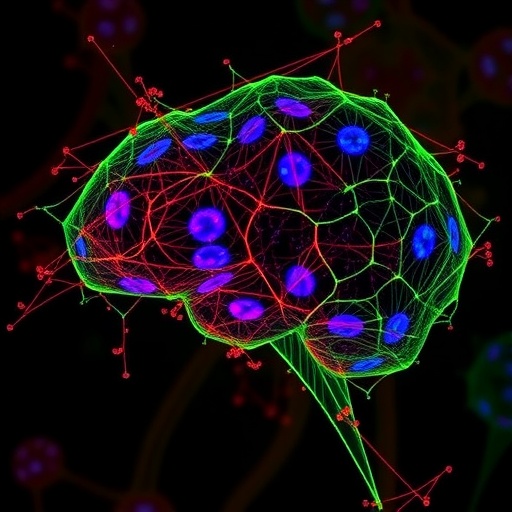
In a groundbreaking leap forward for Alzheimer’s disease research, a team of scientists has employed a novel CRISPR interference (CRISPRi) screening technique in human astrocytes to illuminate hidden layers of gene regulation that could redefine our understanding of this devastating neurodegenerative disorder. This innovative study harnesses the power of gene-editing technology to identify distal enhancers—regulatory DNA elements located far from their target genes—that orchestrate the expression of genes disrupted in Alzheimer’s disease. As astrocytes play critical roles in brain homeostasis and response to injury, deciphering their regulatory networks opens new avenues for targeting disease mechanisms at the genetic level.
Astrocytes, long overshadowed by neurons in neurodegenerative research, have recently gained attention for their multifaceted roles in synaptic support, metabolic regulation, and neuroinflammation. Their dysfunction is increasingly implicated in Alzheimer’s disease pathology, yet the complex transcriptional regulatory networks governing astrocyte gene expression remain poorly understood. The present study leverages CRISPRi technology, which allows for targeted suppression of noncoding regulatory regions without altering the underlying DNA sequence. This approach enables the systematic identification of enhancers that exert control over genes known to be dysregulated in Alzheimer’s-affected astrocytes.
Utilizing cultured human astrocytes as a model system, researchers designed a comprehensive CRISPRi screen that targeted thousands of candidate enhancer elements across the genome. Through these functional genomics experiments, they uncovered multiple distal enhancer regions that exert significant control over the expression of key Alzheimer’s-related genes. Importantly, these enhancers are situated far from the promoters of their target genes, underscoring the importance of long-range gene regulation in astrocytic function and disease pathology.
One of the study’s most compelling revelations is the identification of enhancers that modulate genes involved in amyloid precursor protein processing, tau pathology, and neuroinflammatory pathways. These findings integrate with the growing body of evidence highlighting the centrality of astrocyte-mediated neuroinflammation and protein misprocessing in Alzheimer’s disease progression. By clarifying how these critical genes are regulated at the transcriptional level, the work offers promising targets for therapeutic intervention aimed at correcting aberrant gene expression profiles before irreversible neuronal damage occurs.
Methodologically, the study is distinguished by its rigorous application of state-of-the-art CRISPRi techniques combined with high-throughput sequencing and bioinformatics analyses. This integrative approach allowed the authors to not only pinpoint candidate enhancers but also validate their functional significance in controlling gene expression. The use of epigenomic markers such as histone modifications and chromatin accessibility maps helped delineate the enhancer landscape with remarkable precision, linking chromatin state to regulatory activity in diseased astrocytes.
Furthermore, the application of CRISPRi in astrocytes represents a significant technical advance, as these cells have traditionally been challenging to genetically manipulate. By optimizing delivery systems and screening protocols, the team has set a precedent for future functional genomics studies in glial cells, paving the way for more detailed dissection of astrocytic roles in neurological disorders beyond Alzheimer’s disease.
The study also delves into the spatial organization of enhancers and their three-dimensional chromatin interactions with gene promoters. Advanced chromatin conformation capture techniques revealed that these distal enhancers physically contact their target genes through complex looping mechanisms. Such findings reinforce the paradigm that genome architecture plays a crucial role in the regulation of gene expression and that disruptions to this architecture can contribute to disease states.
Intriguingly, some enhancers identified in the screen overlap with genomic regions previously linked to Alzheimer’s disease through genome-wide association studies (GWAS). This convergence validates the functional importance of these elements and provides a mechanistic explanation for how noncoding genetic risk variants may influence disease by altering enhancer activity rather than protein coding sequences.
The research also emphasizes the dynamic nature of enhancer activity in astrocytes, noting that certain enhancers respond to inflammatory stimuli or amyloid-beta exposure, mimicking disease-relevant conditions. This suggests potential plasticity in the astrocytic epigenome, where environmental and pathological cues could reshape enhancer function, ultimately impacting gene expression programs that dictate cellular behavior in Alzheimer’s disease.
Therapeutically, these insights open the door to novel intervention strategies aimed at modulating enhancer activity using epigenome editing tools or small molecules that selectively target enhancer-associated proteins. By restoring normal enhancer-driven gene expression, it may be possible to temper pathological processes such as neuroinflammation and aberrant protein aggregation, which are hallmarks of Alzheimer’s disease.
This pioneering research, published in Nature Neuroscience in 2025, sets a new benchmark in the field of neurogenetics and astrocyte biology. It elegantly combines cutting-edge molecular biology with functional genomics to unravel the complex regulatory underpinnings of one of the most perplexing and impactful brain diseases. Beyond Alzheimer’s, the approach and findings have broader implications for understanding gene regulation in other neurodegenerative and neuroinflammatory disorders.
Moreover, the study’s emphasis on noncoding genomic elements challenges the traditional gene-centric view, highlighting how vast regions of the genome formerly labeled as ‘junk DNA’ harbor critical regulators of gene expression and cellular function. It underscores an evolving scientific narrative that places enhancer elements at center stage in human health and disease.
The publication has already inspired excitement within the scientific community, as it provides a scalable platform to interrogate gene regulation in diverse brain cell types and conditions. By identifying specific enhancers that control disease-relevant genes, the research offers a treasure trove of targets for drug development and biomarker discovery—key milestones needed to convert molecular insights into clinical applications.
This study not only deepens our understanding of Alzheimer’s pathophysiology but also exemplifies the power of CRISPR-based functional screens to reveal previously hidden layers of biological regulation. As we stand at the frontier of precision medicine, such transformative technologies enable researchers to dissect complex gene regulatory networks with unprecedented resolution, heralding a new era in neurotherapeutics.
In summary, CRISPRi screening in human astrocytes has unveiled a rich enhancer landscape governing genes critically involved in Alzheimer’s disease. By mapping these distal regulatory elements and elucidating their mechanisms, this work provides a foundational framework for future studies aimed at correcting gene dysregulation and ameliorating neurodegeneration through innovative genomic therapies.
The implications of this research extend beyond immediate findings; it challenges researchers to rethink how gene regulation, cell type specificity, and genome architecture converge to shape brain health. Importantly, it empowers the development of next-generation therapeutics targeting the gene regulatory circuitry of astrocytes, offering hope for the millions affected by Alzheimer’s disease worldwide.
With continued advances in gene-editing technologies and functional genomics, the integration of enhancer biology into Alzheimer’s disease research promises to accelerate the discovery of novel diagnostic markers and therapeutic targets, fostering precision interventions that address the disease at its core.
This landmark study by Green, Sutton, Pérez-Burillo, and colleagues marks a pivotal step forward in decoding the complex regulatory genome of astrocytes and opens new horizons for combating Alzheimer’s disease through the manipulation of the noncoding genome.
Cite Scienmag News
Juliet Wilcox. (December 18, 2025). CRISPRi Reveals Astrocyte Enhancers Linked to Alzheimer’s. Scienmag. https://scienmag.com/crispri-reveals-astrocyte-enhancers-linked-to-alzheimers/
Juliet Wilcox. "CRISPRi Reveals Astrocyte Enhancers Linked to Alzheimer’s." Scienmag, 18 December 2025, https://scienmag.com/crispri-reveals-astrocyte-enhancers-linked-to-alzheimers/. Accessed 3 September 2026.
Juliet Wilcox. "CRISPRi Reveals Astrocyte Enhancers Linked to Alzheimer’s." Scienmag. December 18, 2025. https://scienmag.com/crispri-reveals-astrocyte-enhancers-linked-to-alzheimers/


