


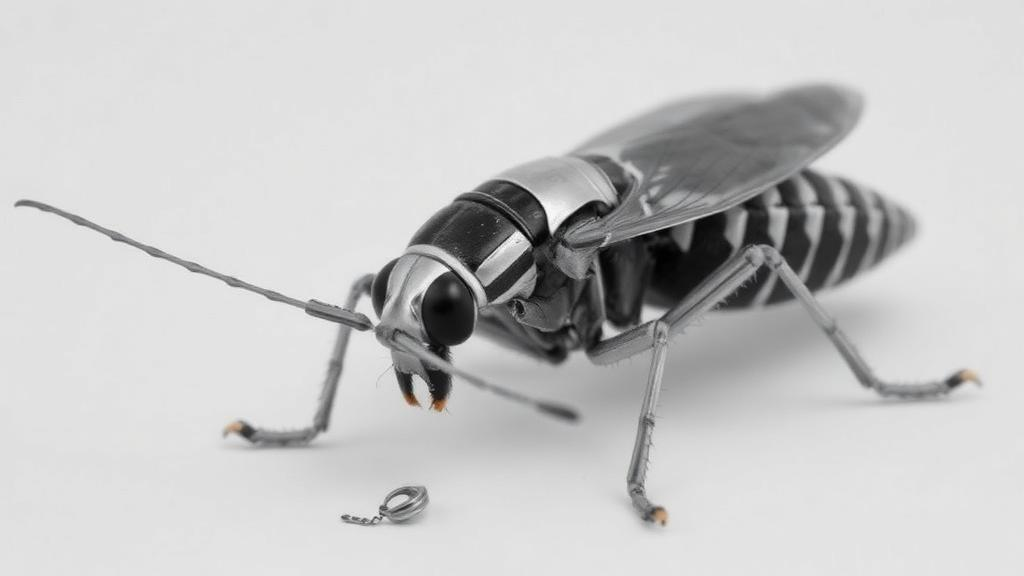
For a female field cricket, hearing is everything. She locates singing males across a darkened field, judges the frequency, duration, and pulse rate of their calls, and commits her reproductive future to the partner she chooses. All of that depends on a pair of ears in an unlikely place: the proximal segment of each foreleg, where a thin, taut membrane vibrates in response to sound. New research now shows that these remarkable structures do not last a lifetime. As female crickets age, their eardrums accumulate cracks, plaques, fungal growths, and even full perforations, raising the possibility that an aging female literally loses her grip on the acoustic world that governs her mating decisions.
The study, published in the Journal of Orthoptera Research, examined the Jamaican field cricket Gryllus assimilis, a widespread species reared for this work under carefully controlled laboratory conditions. Researchers at the Federal University of Rio Grande in Brazil compared the posterior tympanal membranes, or PTMs, of young females at roughly fifteen days after their final molt with those of older females at thirty days or more. Using scanning electron microscopy, they documented a catalog of age-related damage that had never before been systematically described in a cricket’s auditory organ. The work is the first morphological characterization of aging damage in the auditory organs of female crickets.
To appreciate why this matters, it helps to understand just how strange and sophisticated cricket ears are. Each ear contains two tympanal membranes, but only the posterior one, the PTM, serves as the main sound-receiving surface; the smaller, thicker anterior membrane plays little to no role in hearing. Sound does not simply strike the membrane from outside. Instead, the cricket ear operates as a pressure difference receiver connected to an elaborate system of acoustic tracheae that run through the body. Sound enters both the external surface of the PTM and the internal walls of acoustic spiracles in the thorax, reaching the membrane from the same side and the opposite side of the body simultaneously.
This four-channel arrangement gives crickets extraordinary directional hearing. The acoustic trachea acts as an internal delay line, shifting the phase of sound waves before they reach the tympanal membrane, so that the ear responds to the difference in pressure between externally and internally transmitted waves rather than to pressure alone. The system is finely tuned to the carrier frequency of cricket calls, maximizing sensitivity to the songs of the animal’s own species while filtering out background noise. For a female assessing potential mates, this precision is the difference between finding a suitable male and missing him entirely, and it also underpins predator detection, territorial interactions, and general environmental awareness.
Against that backdrop, the damage documented in older females is striking. The research team defined five distinct categories of wear on the PTM. Excrescences are rugged protrusions that rise above the cuticular surface of the membrane, forming visible bumps. Plaque formation involves accumulations of cuticle-enriched material that distort the membrane’s natural morphology. Fungal agglomerates consist of hyphae and spores colonizing the tympanal surface, evidence of infection or colonization on a sensory structure. Cracks appear at the junction between the tympanal cuticle and the tibial cuticle, breaking the structural continuity at the membrane’s insertion point. Most severe of all are perforations, fissures that breach the membrane itself and expose the internal structures beneath.
The scanning electron micrographs make the progression vivid. In young females, the tympanal surface is smooth and uniform, and the surrounding sensory bristles are intact. In older females, the number and integrity of those bristles decline markedly, and in some cases localized melanization appears on the membrane, suggesting an immune response to injury. The developmental story is equally detailed: in fifth-instar nymphs, the microscopic mechanoreceptors called microtrichia that cover the PTM are underdeveloped and poorly defined, but after the imaginal molt they become pronounced and thorn-like, and a tympanal scar marks the structural boundary between tibial cuticle and tympanal membrane. Damage, however, begins surprisingly early, appearing in some females as young as fifteen days old, and worsens progressively through senescence.
The perforations deserve particular attention because of what they expose. Beneath the PTM lie taenidial fibers, the helically reinforced cuticular thickenings that form the wall of the acoustic trachea, providing structural support while remaining flexible enough for gas exchange. When a perforation opens the membrane, these fibers become visible, sometimes with fungal growth already established on them. Earlier electrophysiological work on crickets showed why such breaches are so consequential: perforating the PTM, or even occluding it with Vaseline, significantly reduces the sensitivity of auditory interneurons by diminishing sensory input. As perforations enlarge, the sensitivity threshold of the affected nerve cells rises progressively until a critical point is reached and the ear loses its tuning altogether. Because perforations are irreversible and tend to expand, the researchers consider them the most serious form of tympanal wear, with the added danger that they open a direct route for pathogens and dust into the body, since hemolymphatic channels and tracheae lie close by.
The fungal colonization tells its own story about aging. Although the crickets were reared under controlled temperature, photoperiod, and diet, fungal agglomerates partially or entirely covering the PTM appeared in the older females, and their accumulation appears to be associated with aging. The likely explanation is a decline in grooming behavior. Grooming is essential for keeping sensory surfaces clean, and both locomotor activity and self-cleaning are known to wane as insects age, a decline compounded by immune senescence. A fungal mass draped over an eardrum would be expected to interfere directly with its ability to vibrate and transmit sound. By contrast, excrescences, being superficial lesions, probably have a more limited impact on auditory function when they occur in isolation, though they too became more common with age.
The timing of this deterioration is what gives the findings their ecological bite. The peak of tympanal wear appears to fall in middle-aged females, between fifteen and thirty days after the imaginal molt, which is precisely the window of maximal reproductive activity in this species, including peak oviposition rates. In other words, the sensory equipment a female depends on to find and evaluate mates degrades fastest during the very period when she needs it most. Previous studies had shown that older female crickets discriminate less sharply among male calling songs, but the possible role of tympanal degradation in that decline had gone unexamined. This study cannot yet prove that the structural damage causes the behavioral change, but it establishes the morphological foundation for testing that link directly.
The authors also caution that their laboratory conditions, however carefully controlled, may have been lenient compared with nature. Wild crickets face predation attempts, mechanical stress, adverse climatic conditions, and a host of other stressors that could make tympanal wear even more severe than what appeared in the lab. The next steps, they suggest, are comparative studies pairing behavioral analyses with the morphological data to measure how tympanal damage translates into reduced reproductive success, and ultrastructural investigations using transmission electron microscopy to reveal the cellular and tracheal changes that accompany insect senescence. For now, the message is clear and a little poignant: even an ear built as a precision instrument, tuned by evolution to the faintest love song on a summer night, is not exempt from the wear of simply growing old.
Subject of Research: Age-related structural degradation of the tympanal auditory organs in female field crickets
Article Title: Ticking time: How does aging affect tympanal organ integrity in female crickets? A descriptive study
Article References: Limberger, G. M., & Fonseca, D. B. D. (2025). Ticking time: How does aging affect tympanal organ integrity in female crickets? A descriptive study. Journal of Orthoptera Research, 34(2), 257-264. https://doi.org/10.3897/jor.34.148250
Image Credits: AI Generated
Keywords: crickets, tympanal organ, aging, hearing, scanning electron microscopy, Gryllus assimilis, orthoptera, acoustic communication, mate selection, sensory senescence, fungal colonization, insect ears
Cite Scienmag News
Beatrice Stafford. (October 17, 2026). Cricket Ears Wear Out With Age, Scanning Electron Microscopy Reveals. Scienmag. https://scienmag.com/cricket-ears-wear-out-with-age-scanning-electron-microscopy-reveals/
Beatrice Stafford. "Cricket Ears Wear Out With Age, Scanning Electron Microscopy Reveals." Scienmag, 17 October 2026, https://scienmag.com/cricket-ears-wear-out-with-age-scanning-electron-microscopy-reveals/. Accessed 17 October 2026.
Beatrice Stafford. "Cricket Ears Wear Out With Age, Scanning Electron Microscopy Reveals." Scienmag. October 17, 2026. https://scienmag.com/cricket-ears-wear-out-with-age-scanning-electron-microscopy-reveals/


