

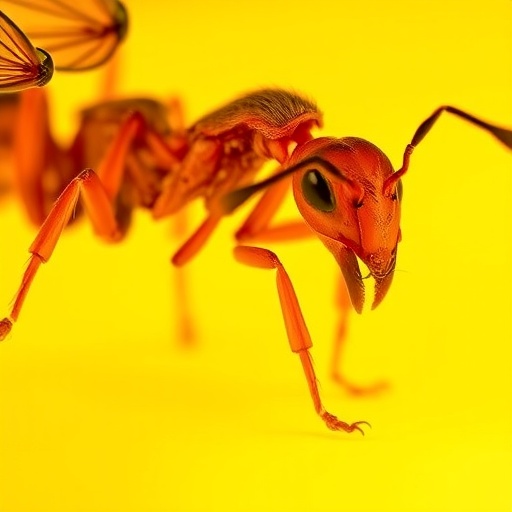
Ancient Amber Reveals Intricate Ecological Interactions of Long-Extinct Insects
The study of tiny insects preserved in amber offers an extraordinary window into ancient ecosystems, allowing researchers to peer into the intricacies of predator-prey relationships, parasitism, and symbiosis from millions of years ago. Recently, a team of scientists based in Spain undertook an in-depth investigation of six remarkable amber specimens, each containing a diverse cast of extinct insects. Their goal was to unravel the ecological dynamics that shaped life during the age of the dinosaurs, focusing particularly on the ants, whose evolutionary history is essential to understanding terrestrial ecosystems.
Amber, fossilized tree resin, serves as a natural time capsule, preserving insects and other small organisms with astonishing detail. However, deciphering whether insects trapped together actually interacted during their lifetimes or were entombed together by happenstance remains a complex challenge. Dr. Jose de la Fuente and his colleagues at the Institute for Game and Wildlife Research employed advanced microscopy to examine these ancient inclusions. By meticulously identifying species and measuring spatial relationships within the amber, they aimed to reconstruct probable behaviors and ecological interactions among these ancient organisms.
The research centered on a rare phenomenon known as syninclusion—the preservation of multiple species together in a single amber piece. Each piece containing ants was particularly prized, as ants are critical ecosystem engineers. The six amber samples span distinct geological periods: four from the Cretaceous (approximately 99 million years ago), one from the Eocene (56–34 million years ago), and one from the Oligocene (34–23 million years ago). Through their survey, the scientists identified representatives of both Stem ants—primitive ants with no modern descendants—and Crown ants, ancestors of present-day species. Additionally, the enigmatic Hell ants, which evolved from Stem ants, were found among the inclusions.
A striking observation emerged from three of the six amber samples: ants were positioned in close proximity to mites. These spatial associations could hint at behavioral interactions such as phoresy, where mites hitch rides on ants, or parasitic relationships where mites feed on their ant hosts. For instance, in one Cretaceous sample labeled Case 1, a Crown ant was found near a wasp and two mites close enough to suggest travel companionship. Case 4 revealed a Stem ant resting mere millimeters from a mite, and Case 5 contained a complex assemblage of three ant species near mites and termites, supplemented by traces of mosquitoes and winged insects.
Intriguingly, Case 6 featured a Stem ant accompanied by a likely parasitic wasp and a spider. The ant appeared to be feeding, and while resting against another vague insect inclusion possibly representing a worm or larva, no definitive evidence points to a biological interaction between them. Meanwhile, Case 2 paired a Stem ant with a spider, and Case 3 housed a Hell ant alongside a snail, a millipede, and indistinct insects. These diverse juxtapositions underscore the complexity of disentangling ecological relationships within fossilized snapshots.
Dr. de la Fuente emphasized caution in interpreting these ancient scenes, noting that proximity in amber might sometimes be serendipitous rather than indicative of behavior. The tiniest spatial distances between ants and mites are more likely to reflect genuine interactions during life, such as mutualistic or parasitic associations. In particular, mite attachment to ants may have facilitated dispersal to new habitats, a behavior observed in modern ecosystems and potentially dating back tens of millions of years.
The identification of potential commensal or parasitic associations in amber inclusions sheds light on the ecological roles of these insects. For example, the presence of mites close to ants in several specimens supports the hypothesis of phoretic or parasitic relationships that play important roles in regulating insect populations and community dynamics. Future research leveraging high-resolution micro-computed tomography (micro-CT) scans could detect minute morphological adaptations in mites that enabled attachment to their hosts, offering more concrete evidence for these ancient behaviors.
Equally fascinating is the discovery of spider species in proximity to ants. Some extinct spiders from these specimens exhibited morphological adaptations that may have allowed them to mimic and camouflage as ants—a survival strategy advantageous for predation or evading predators. The evolutionary roots of such mimicry deepen our understanding of species interactions and coevolution in prehistoric ecosystems.
The study’s insights underscore the significance of using advanced imaging technologies to probe fossilized inclusions. Techniques such as micro-CT scanning allow non-destructive visualization of embedded organisms, revealing structural details invisible to conventional microscopy. Such tools are key to validating hypothesized insect interactions and understanding the ecological implications of the fossil record.
Despite the immense promise, the researchers emphasized that the rarity of ant-inclusive amber and even rarer syninclusions pose challenges for drawing broad ecological conclusions. Each amber specimen represents a singular, serendipitous moment frozen in time, and differentiating ecological interactions from random assemblages requires meticulous data collection and cautious interpretation.
Nevertheless, this research contributes valuable knowledge about the behavior, ecology, and evolutionary history of ants and their contemporaneous arthropods. By piecing together these ancient ecological puzzles, scientists gain a better appreciation of the complexity and dynamism of early terrestrial ecosystems and the roles ants played millions of years ago.
Looking ahead, interdisciplinary approaches combining paleontology, ecology, and cutting-edge imaging promise to uncover further secrets held within amber. These studies not only illuminate the distant past but also enrich our understanding of present-day biological interactions, evolutionary mechanisms, and the origins of biodiversity.
In sum, the Spanish team’s comprehensive analysis of these fossilized amber inclusions offers remarkable new perspectives on the ecological fabric of prehistoric worlds. Their findings highlight the intricate web of life millions of years ago and the enduring legacy of ants as ecosystem architects throughout geological time.
Subject of Research: Fossil amber inclusions and ecological interactions of extinct insects, focusing on ant syninclusions
Article Title: Description of fossil amber with ant syninclusions
News Publication Date: 27-Feb-2026
Web References: 10.3389/fevo.2026.1724595
Image Credits: Dr Jose de la Fuente
Keywords: amber, fossil insects, ants, stem ants, crown ants, hell ants, mite-ant interactions, paleoecology, syninclusion, Cretaceous, Eocene, Oligocene, micro-CT scanning, parasitism, symbiosis


