

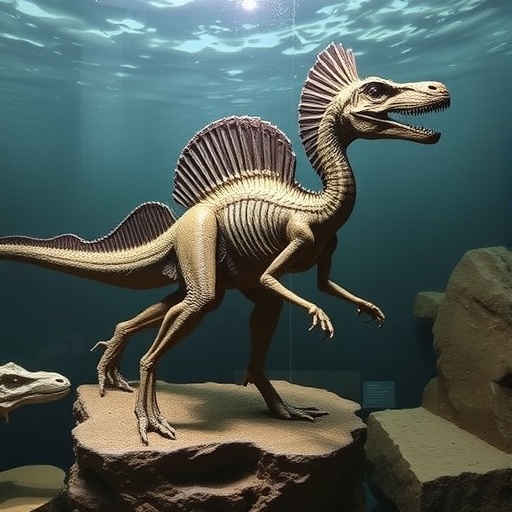
In a groundbreaking discovery that reshapes our understanding of spinosaurid evolution, a newly identified species of Spinosaurus has been unearthed deep within the central Sahara desert of northern Niger, revealing a remarkable chapter in the ecological expansion and adaptive strategies of these colossal, piscivorous dinosaurs. This species, named Spinosaurus mirabilis, exhibits unique morphological traits distinct from its close kin, suggesting a sophisticated evolutionary lineage marked by significant ecological diversification far beyond the coastal habitats traditionally associated with spinosaurs.
The fossils of S. mirabilis were excavated near Sirig Taghat, a remote region whose name intriguingly translates to “no water, no goat” in Tamasheq, the tongue of the local Berber tribes. This inland habitat, situated some 1,000 kilometers away from the Tethys Sea coastline, challenges prevailing narratives that spinosaurids were predominantly coastal or marine-associated predators. Instead, S. mirabilis thrived in a riparian environment approximately 100 to 95 million years ago during the mid-Cretaceous period, living alongside a variety of long-necked dinosaurs and adapting to unique ecological niches within northern Africa’s interior river systems.
Paul Sereno and his team propose that S. mirabilis represents the culmination of a tripartite evolutionary trajectory for the spinosaurid clade. The initial evolutionary phase began in the Jurassic Period, characterized by the development of an elongated, narrow skull finely adapted for piscivory. This morphological specialization laid the groundwork for fish-catching efficiency, a hallmark of the group’s predatory capabilities. The second phase, emerging in the Early Cretaceous, saw spinosaurs spreading extensively along the vast shores of the Tethys Sea, exploiting marine and estuarine ecosystems as dominant coastal predators.
The third evolutionary phase, epitomized by S. mirabilis, is particularly fascinating because it underscores a diversification into freshwater and near-shore habitats far inland. This phase suggests an adaptive radiation where spinosaurs evolved to exploit shallow water environments within continental river systems, incorporating both aquatic hunting and possibly semi-terrestrial foraging. The implications of this adaptation extend the known geographic and ecological range of Spinosaurus, indicating a far more versatile and widespread predator than previously documented.
Anatomically, S. mirabilis shares considerable size and skeletal morphology with the well-known Spinosaurus aegyptiacus, the archetype of spinosaurids distinguished by their massive, sail-like dorsal spines. However, S. mirabilis is marked by a distinctive scimitar-shaped bony crest that arches gracefully over its skull. This crest, diverging from the conventional sail structures, likely served a different purpose. Functional morphology and comparative studies suggest it acted primarily as a visual display feature, possibly utilized in intra-species communication or sexual selection, rather than for locomotion or direct predation efficiency.
The paleoenvironments inferred from the fossil site imply that S. mirabilis inhabited niches abundant in freshwater fish and other aquatic prey, reinforcing the hypothesis of a semi-aquatic lifestyle. This supports earlier functional analyses of spinosaurs possessing snorkel-like nostrils, conical teeth, and robust forelimbs equipped with powerful claws adapted to grasp slippery prey in aquatic contexts. The newly discovered species thus strengthens the evolutionary narrative of spinosaurids as specialized, fish-eating dinosaurs that diversified not only in form but also in habitat exploitation.
Moreover, the inland positioning of S. mirabilis suggests ecological dynamics in the mid-Cretaceous period that facilitated or necessitated movement and adaptation far from the coastal marine environments. This could link to shifting paleo-hydrology and climatic conditions favoring riverine ecosystems in the central Sahara. The dispersal into these habitats underscores the capacity for spinosaurids to colonize and thrive within complex freshwater ecologies, potentially interacting with other large aquatic or semi-aquatic vertebrates.
The discovery carries broader implications for understanding the tempo and mode of dinosaur evolution at critical junctures in Mesozoic ecosystems. By identifying a third, distinct phase in spinosaurid radiation, Sereno and team offer critical insights into how environmental pressures and opportunities drove morphological innovation and species diversification. This phased model outlines a progressive ecological expansion, reinforcing the notion of spinosaurids as highly adaptable apex predators capable of exploiting a continuum of aquatic habitats.
S. mirabilis also expands the biogeographical framework for spinosaurid dispersal, corroborating theories of faunal exchange between northern Africa and South America during the mid-Cretaceous. This transcontinental connection aligns with known plate tectonic configurations and oceanic pathways, providing a paleobiological context for parallel evolution or convergent adaptations in disparate spinosaur populations.
The detailed osteological evaluation of the new species involved high-resolution imaging and comparative skeletal reconstruction, which revealed subtle but significant cranial and post-cranial adaptations. These analyses highlight variations in vertebral morphology and limb proportions suggestive of enhanced swimming capabilities, reinforcing hypotheses of a semi-aquatic predatory lifestyle. The study employed advanced phylogenetic assessments to place S. mirabilis within the spinosaurid clade, elucidating its evolutionary relationships with both earlier Jurassic forms and contemporaneous Cretaceous taxa.
In conclusion, the emergence of Spinosaurus mirabilis from the arid expanses of the central Sahara reshapes paleontological conceptions of spinosaurid ecology and evolution. Far from being mere coastal dwellers, spinosaurs flourished in diverse aquatic environments, demonstrating nuanced adaptations that enabled them to dominate freshwater ecosystems in addition to marine littoral zones. This revelation opens new avenues for research into dinosaur paleoecology, functional evolution, and the complex interplay between anatomy, environment, and survival over millions of years.
Subject of Research: Evolutionary biology and paleoecology of the newly identified Spinosaurus mirabilis species.
Article Title: New scimitar-crested Spinosaurus species from the Sahara caps stepwise spinosaurid radiation
News Publication Date: 19-Feb-2026
Web References: 10.1126/science.adx5486
Keywords: Spinosaurus mirabilis, spinosaurid evolution, Cretaceous paleontology, piscivorous dinosaurs, paleoecology, scimitar crest, semi-aquatic adaptations, evolutionary phases, northern Africa fossils, dinosaur biogeography


