


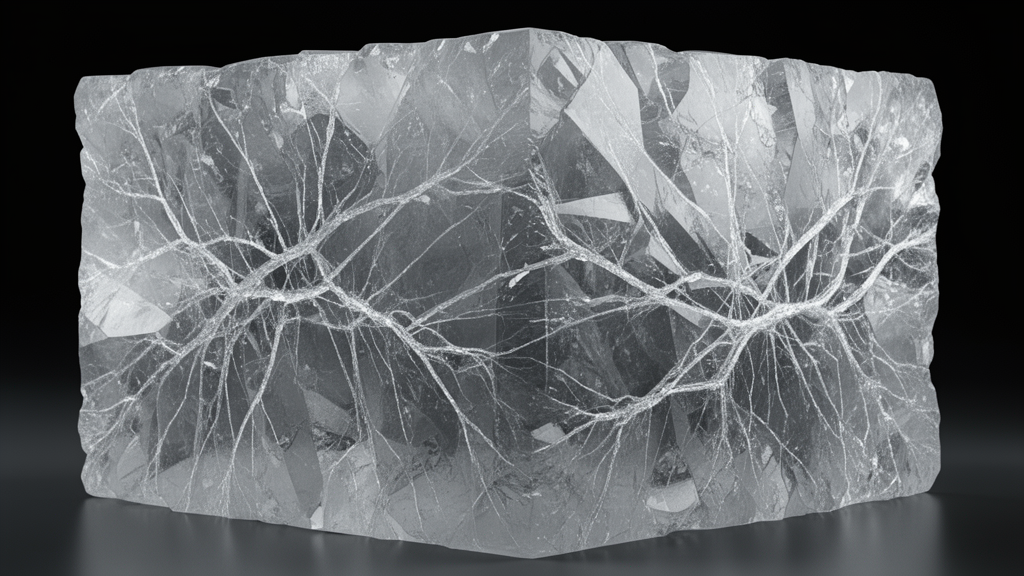
Electrical conductivity serves as a critical transport property for inferring the volume of conductive materials, such as aqueous fluids, within subsurface rocks. This property depends heavily on the backbone fraction, defined as the volume fraction of fractures that actively contribute to the transport of electric charge. To accurately quantify the amount of conductive material and fracture configurations from observed rock conductivity, it is vital to know both the backbone fraction and the percolation threshold, the point at which a non-zero backbone fraction is initiated. In a study published in Earth, Planets and Space, Yoshiya Usui quantitatively evaluated these parameters for circular cracks with transversely isotropic orientation using numerical simulations, addressing a gap where these values have rarely been modeled and are often assumed in previous research.
The research focused on three-dimensional crack networks composed of circular disks, treating the cracks as having zero volume for the purpose of determining intersection and percolation. To account for the anisotropy often observed in real fracture systems, the crack orientation was modeled using the Watson distribution, which allows for transverse isotropy. The hyperparameter kappa controlled the degree of anisotropy, with positive values aligning crack normals along a symmetric axis and negative values aligning them perpendicular to it. Seven different kappa values were employed to cover a range from isotropic to highly anisotropic orientations.
To obtain statistical properties for the percolation threshold and backbone fraction, the study performed 500 simulations for each individual case, varying the stochastic distributions of crack size and orientation. The simulations were conducted in a cubic computational domain with periodic boundary conditions applied to all six faces. The existence of a sample spanning cluster, or SSC, was evaluated every time a new crack was inserted into the domain. The percolation threshold was determined in terms of a dimensionless parameter, rho prime 3, which is the product of the crack number density, the third moment of the crack radius, and a shape factor. This parameter is quasi-invariant for random assemblies of three-dimensional disks, making it a robust metric for comparing different network configurations.
The simulation results confirmed the quasi-invariance of the percolation threshold, even for significantly different stochastic distributions of crack size and anisotropy. The threshold was found to be within the range of 2.1 to 2.5 in terms of the rho prime 3 parameter for both isotropic and anisotropic cases. This range corresponds to a crack density parameter, epsilon, between 0.21 and 0.25. The crack density parameter is a key variable in determining the elastic wave velocity of rocks with cracks, suggesting that transport properties like electrical conductivity may constrain elastic wave velocity, and vice versa. This finding provides a confined range for the percolation threshold that can be used to interpret geophysical data more accurately.
Regarding the backbone fraction, the study found that it does not depend on direction, even when the crack orientation exhibits significant anisotropy. The simulated backbone fraction increased sharply near the percolation threshold, but its rate of increase gradually decreased as the distance from the threshold increased. The power-law exponent of the backbone fraction near the percolation threshold was close to unity, particularly when the probability density of the smallest cracks was significantly higher than that of the largest cracks. This similarity to the exponent of three-dimensional lattice percolation, which is approximately 1.05, implies that the power law for lattice percolation may be applicable to the continuum percolation of crack networks by using rho prime 3 as the independent variable.
The study also revealed a significant dependence of the backbone fraction on the assumption of the crack aspect ratio. Two different assumptions were tested: a constant crack aspect ratio and a constant crack thickness. Under the constant aspect ratio assumption, the crack thickness is proportional to the crack radius, whereas under the constant thickness assumption, the aspect ratio decreases as the radius increases. The results showed that the backbone fractions for constant-thickness cases were notably smaller than those for constant-crack-aspect-ratio cases, except for monodisperse cases. This difference arises because the contribution of each crack to the volume is proportional to the third moment of its radius in the constant aspect ratio case, but only to the second moment in the constant thickness case. Since the backbone consists of relatively large cracks, the former condition assigns greater weight to these large cracks, resulting in higher backbone fractions.
The findings suggest that information on the stochastic distribution of the crack aspect ratio is crucial for accurately estimating the backbone fraction. The study demonstrated that once information on the distributions of crack radius and aspect ratio is obtained, the backbone fraction can be quantified using the methodology presented. By multiplying the resulting backbone fraction by the electrical conductivity of the perfectly interconnected fracture network, the bulk electrical conductivity can be calculated over a range of porosities from near the percolation threshold to far from it. This approach provides a more rigorous framework for interpreting the anisotropic electrical conductivity of rocks, which is often observed in field surveys.
Contrary to previous assumptions, the study found that anisotropy in electrical conductivity is not caused by a directional difference in the backbone fraction. The backbone fraction was found to be nearly insensitive to the anisotropy of the crack orientation, with relative differences among different kappa values being less than 6% when the distance from the percolation threshold was greater than 1. This implies that the anisotropy in tortuosity of crack networks can be directly estimated from the anisotropic bulk conductivity, providing a crucial constraint for quantitative interpretation of geophysical data.
The study utilized a linear system based on Kirchhoff’s current law to calculate the backbone fraction, solving for voltages at the centers of cracks belonging to the SSC. A unit-voltage difference was applied across the opposite faces of the computational domain, and the cracks were determined to belong to the backbone if the voltage difference between a crack and at least one adjacent crack was not sufficiently small. The threshold for this determination was set to 10 to the power of negative 5, which is less than 1% of the expected voltage difference for a hypothetical case of serially connected smallest cracks. This threshold was confirmed to be sufficiently small by comparing results with a smaller threshold of 10 to the power of negative 7, which yielded approximately equal backbone fractions.
The computational cost of the simulations was substantial, particularly for cases with small minimum-to-maximum radius ratios and large domain sizes. For example, achieving a backbone fraction of around 0.9 for a case with a high power-law exponent and large domain size required over 35,000 cracks and took about 18 days to complete on a workstation with two 2.90 GHz Intel Xeon processors. Despite these computational challenges, the study provided detailed statistical properties for the percolation threshold and backbone fraction, filling a significant gap in the understanding of fracture network transport properties. The results are available in the UTokyo Repository, allowing for further analysis and validation by the scientific community.
This study contributes to the field of geophysics by providing a quantitative evaluation of the percolation threshold and backbone fraction for networks of transverse isotropically oriented cracks. The findings have implications for the interpretation of electrical conductivity data in subsurface rocks, offering a more accurate method for inferring the amount of conductive material and fracture configurations. The quasi-invariance of the percolation threshold and the directional independence of the backbone fraction are key insights that can be applied to a wide range of geological settings, from volcanic structures to geothermal resources. By establishing these fundamental properties, the study enhances the ability to model and predict the transport properties of fractured rocks, which is essential for various geophysical exploration and resource management applications.
The research underscores the importance of considering the stochastic distributions of crack size and orientation in modeling fracture networks.
Subject of Research: Quantitative evaluation of the percolation threshold and backbone fraction of networks of transverse isotropically oriented cracks
Article Title: Quantitative evaluation of the percolation threshold and backbone fraction of networks of transverse isotropically oriented cracks
Article References: Usui, Y. (2026). Quantitative evaluation of the percolation threshold and backbone fraction of networks of transverse isotropically oriented cracks. Earth, Planets and Space, 78(1), Article 204. https://doi.org/10.1186/s40623-026-02532-6
Image Credits: AI Generated
DOI: 10.1186/s40623-026-02532-6
Keywords: Quantitative, evaluation, percolation, threshold, backbone, fraction, networks, transverse, isotropically, oriented, cracks, scientific research
Cite Scienmag News
Violet Maxwell. (November 10, 2026). Crack Network Percolation Thresholds Remain Stable Despite Anisotropy. Scienmag. https://scienmag.com/crack-network-percolation-thresholds-remain-stable-despite-anisotropy/
Violet Maxwell. "Crack Network Percolation Thresholds Remain Stable Despite Anisotropy." Scienmag, 10 November 2026, https://scienmag.com/crack-network-percolation-thresholds-remain-stable-despite-anisotropy/. Accessed 18 November 2026.
Violet Maxwell. "Crack Network Percolation Thresholds Remain Stable Despite Anisotropy." Scienmag. November 10, 2026. https://scienmag.com/crack-network-percolation-thresholds-remain-stable-despite-anisotropy/




