

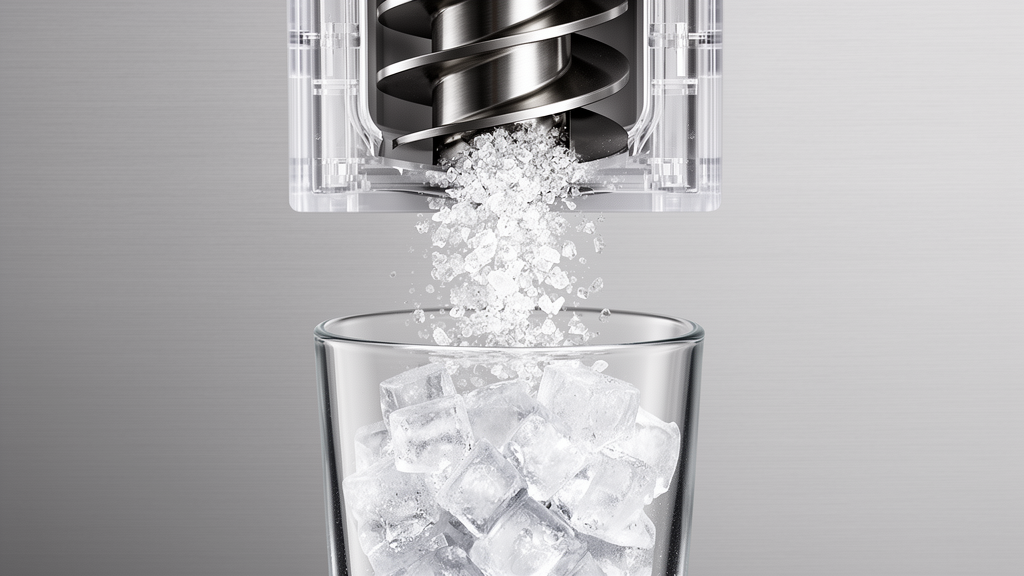
Researchers have developed an experimentally calibrated simulation framework combining multibody dynamics and the discrete element method to predict ice fracture, fragmentation, and dispensing in refrigerator ice makers. Created by a team including Seong Han Park, Su Eul Jeon, and Jae Wook Lee, the computational methodology establishes a virtual testing environment to evaluate ice handling mechanisms before mass production. In the home appliance market, the dispensing and crushing performance of built-in ice makers is a critical quality attribute affecting user satisfaction and product competitiveness.
Conventional product development processes still rely heavily on reactive trial-and-error approaches, which may lead to substantial economic losses during the later stages of mass production.
Simulating ice behavior is particularly demanding because ice exhibits intricate mechanical properties that depend heavily on initial conditions. This study proposes a discrete element method-based modeling methodology for constructing an ice block model that captures realistic mechanical behavior.
To establish an accurate physical foundation, the investigators gathered material property data directly from cubic ice specimens manufactured in an actual refrigerator ice maker.
The formulation was subsequently refined through a systematic parameter validation procedure.
Building upon the validated discrete element methodology, the authors established a coupled simulation framework integrating multibody dynamics with the discrete element method.
The coupled framework was specifically deployed to evaluate the performance of two primary dispenser operational modes: Cube Mode and Crush Mode. In Cube Mode, the system conveys and discharges intact ice blocks without fragmentation. In Crush Mode, the mechanism fragments the blocks into smaller pieces prior to discharge. The developed approach provides a robust analytical basis for improving the design and performance evaluation of ice dispensing and crushing mechanisms.
Subject of Research: Coupled numerical simulation of ice fracture and dispensing in refrigerator ice makers
Article Title: An experimentally calibrated MBD–DEM framework for ice fracture, fragmentation, and dispensing in a refrigerator ice maker
Article References: Park, S. H., Jeon, S. E., Park, J. H., Park, M. H., Kim, Y. H., & Lee, J. W. (2026). An experimentally calibrated MBD–DEM framework for ice fracture, fragmentation, and dispensing in a refrigerator ice maker. Scientific Reports. https://doi.org/10.1038/s41598-026-76767-4
Image Credits: AI Generated
DOI: 10.1038/s41598-026-76767-4
Keywords: discrete element method, multibody dynamics, refrigerator ice maker, ice fracture, ice fragmentation, ice dispensing, home appliances, cube mode, crush mode, numerical simulation, parameter validation, mass flow rate, mechanical behavior, ice mechanics, product design optimization, porosity, trial and error reduction
Cite Scienmag News
Scienmag. (November 12, 2026). Coupled Simulation Framework Predicts Refrigerator Ice Dispensing and Crushing Performance. https://scienmag.com/coupled-simulation-framework-predicts-refrigerator-ice-dispensing-and-crushing-performance/
Scienmag. "Coupled Simulation Framework Predicts Refrigerator Ice Dispensing and Crushing Performance." Scienmag, 12 November 2026, https://scienmag.com/coupled-simulation-framework-predicts-refrigerator-ice-dispensing-and-crushing-performance/. Accessed 20 November 2026.
Scienmag. "Coupled Simulation Framework Predicts Refrigerator Ice Dispensing and Crushing Performance." Scienmag. November 12, 2026. https://scienmag.com/coupled-simulation-framework-predicts-refrigerator-ice-dispensing-and-crushing-performance/




