


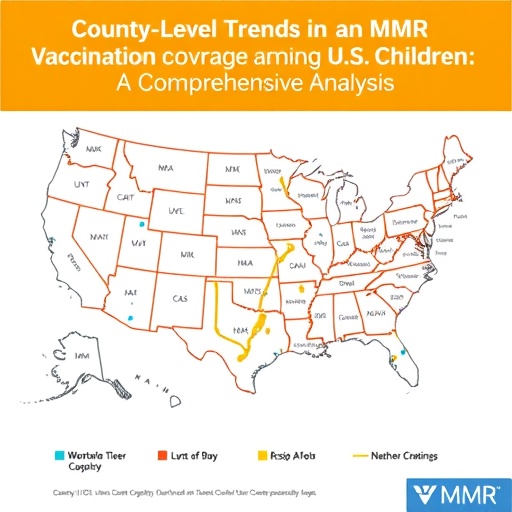
In the aftermath of the global COVID-19 pandemic, a significant and troubling decline in measles-mumps-rubella (MMR) vaccination rates has emerged across the United States, according to a recent comprehensive county-level dataset study. This investigation, augmenting existing state and national Centers for Disease Control and Prevention (CDC) data, reveals not only the widespread nature of this decline but also highlights profound variability in vaccination patterns within and between individual states. The findings underscore the critical importance of localized data in shaping effective public health strategies aimed at combatting the resurgence of vaccine-preventable diseases.
MMR vaccination has long been a cornerstone of pediatric preventive medicine, providing effective immunity against measles, mumps, and rubella—three viral diseases responsible for significant morbidity and mortality before widespread immunization efforts. However, the study reveals that vaccination coverage has suffered a notable downturn since the disruptions caused by the COVID-19 crisis. This trend threatens to reverse decades of progress and raises the specter of renewed outbreaks in vulnerable communities.
The dataset employed in the study comprises granular, county-level information, offering a resolution far superior to aggregated state or national statistics. This level of detail facilitates a nuanced understanding of the demographic, social, and geographic factors influencing vaccination uptake. Spatial analysis of the data demonstrates clusters of low or decreasing MMR coverage, identifying counties where public health interventions may be urgently needed to prevent measles resurgence.
The heterogeneity observed in vaccination rates across U.S. counties likely reflects a complex interplay of factors, including socioeconomic disparities, healthcare access, public health infrastructure, and localized vaccine hesitancy. Importantly, the study suggests that blanket public health policies may be insufficient. Instead, tailored, community-specific strategies—grounded in the local epidemiological context—are essential to bolster immunization rates effectively.
Statistically, the decline in MMR vaccination correlates with disruptions in routine pediatric healthcare delivery during the pandemic, as well as shifts in public attitudes toward vaccines amid widespread misinformation and politicization of public health measures. The temporal relationship between the onset of the pandemic and vaccination trends further supports the hypothesis that COVID-19’s indirect effects on healthcare utilization and vaccine confidence have contributed substantially to this decline.
The resurgence of measles, a highly contagious viral infection preventable by the MMR vaccine, poses a significant public health threat. Measles outbreaks can rapidly overwhelm local healthcare systems and result in serious complications, especially in young children and immunocompromised individuals. The study’s ability to pinpoint counties at elevated risk due to suboptimal vaccination coverage enables health authorities to prioritize resource allocation and deploy targeted outreach programs more efficiently.
Furthermore, the dataset facilitates robust statistical modeling and analysis to identify underlying risk factors associated with vaccine refusal or delay. These include demographic attributes such as age groups, socioeconomic indicators, and local population dynamics. Insights gleaned from such models can inform more nuanced public health messaging and support the design of interventions that address specific barriers experienced by distinct communities.
From a methodological perspective, the integration of spatial epidemiology with advanced statistical techniques represents a powerful approach to understanding vaccine coverage trends. Geospatial mapping combined with time-series analysis enables researchers to track vaccination trajectories and assess the impact of interventions over time, providing a dynamic tool for public health monitoring.
Given the complex interdependence of variables influencing MMR vaccination rates, interdisciplinary collaboration among epidemiologists, statisticians, sociologists, and healthcare practitioners is critical. The study advocates for such partnerships to enable comprehensive analyses and holistic responses to vaccination challenges encountered in diverse American counties.
Crucially, the dataset and findings presented hold relevance beyond the immediate context of MMR vaccinations. They illustrate broader challenges in sustaining routine immunization during public health crises and highlight the potential for spatially resolved data to revolutionize vaccine policy and epidemic preparedness in the United States.
In conclusion, the study paints a sobering picture of declining MMR vaccination rates post-COVID-19, emphasizing substantial geographical disparities and the pressing need for localized, evidence-based public health strategies. As the nation confronts the ongoing threat of vaccine-preventable diseases, harnessing detailed epidemiological data to guide targeted interventions offers a viable path to safeguarding community health and averting outbreaks.
For policymakers, healthcare providers, and public health officials, these insights underscore an urgent imperative to restore and enhance vaccination coverage through tailored outreach, reinforced healthcare access, and combating misinformation. Ultimately, the success of such efforts will determine the trajectory of vaccine-preventable disease control in the coming years.
News Publication Date: Not provided.
Web References: Not provided.
References: (doi:10.1001/jama.2025.8952)
Cite Scienmag News
Kristina Jarvis. (June 2, 2025). County-Level Trends in MMR Vaccination Coverage Among U.S. Children: A Comprehensive Analysis. Scienmag. https://scienmag.com/county-level-trends-in-mmr-vaccination-coverage-among-u-s-children-a-comprehensive-analysis/
Kristina Jarvis. "County-Level Trends in MMR Vaccination Coverage Among U.S. Children: A Comprehensive Analysis." Scienmag, 2 June 2025, https://scienmag.com/county-level-trends-in-mmr-vaccination-coverage-among-u-s-children-a-comprehensive-analysis/. Accessed 6 September 2026.
Kristina Jarvis. "County-Level Trends in MMR Vaccination Coverage Among U.S. Children: A Comprehensive Analysis." Scienmag. June 2, 2025. https://scienmag.com/county-level-trends-in-mmr-vaccination-coverage-among-u-s-children-a-comprehensive-analysis/


