


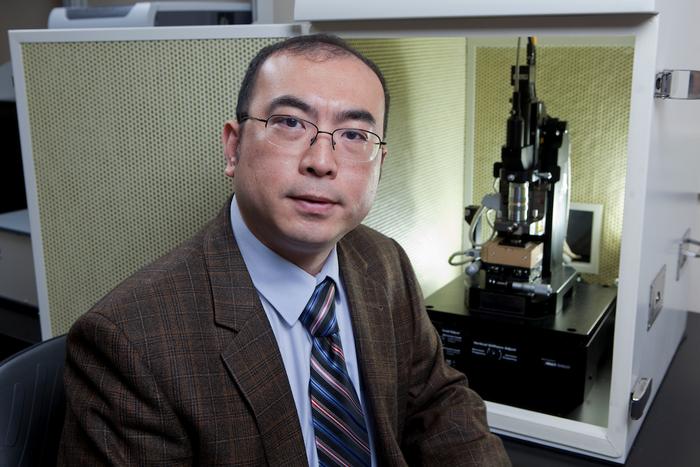
BINGHAMTON, N.Y. — New research from Binghamton University, State University of New York could revolutionize 3D printing and how engineers think about oxidation.

Credit: Binghamton University, State University of New York
BINGHAMTON, N.Y. — New research from Binghamton University, State University of New York could revolutionize 3D printing and how engineers think about oxidation.
When designing a mechanical system that includes metal, the engineer’s biggest enemy can be oxidation. The chemical reaction forms rust or causes other kinds of problems, affecting the efficiency or longevity of the device.
Additively manufactured metals — which have led to advances in aerospace, marine and automotive design, among other areas — are more susceptible to failure in a corrosive environment. The 3D printing process causes increased porousness when compared to conventionally manufactured metal.
What if there were a way to make metals stronger through oxidation? That’s the radical idea behind new research at Binghamton University’s Thomas J. Watson College of Engineering and Applied Science.
Professor Changhong Ke, a faculty member at Watson College’s Department of Mechanical Engineering, recently received a $150,000 grant through the National Science Foundation’s Early-concept Grants for Exploratory Research (EAGER) program. The funding is intended to support untested but potentially transformative research ideas or approaches.
Ke will investigate the potential of building nanotubes into additively manufactured aluminum. He believes that microscopic structures made of boron nitride— a compound commonly used in cosmetics, pencil lead and cement for dental applications — would make the material self-strengthening under corrosive conditions like moisture and seawater.
“You can’t avoid oxidation, so we are trying to take advantage of it by turning it into a new, reinforcing mechanism to make the material stronger,” Ke said. “That would be something really amazing. People could try to design the materials to include these sorts of porosities or even purposely introducing structures that can be more easily oxidized because it becomes something beneficial instead of harmful to the material itself.”
The nanotubes threaded throughout the metal are a few nanometers thick, and a few to hundreds of microns long. To see how the oxidation changes the way that nanotubes bind to metal – a core issue in the self-strengthening mechanism, Ke and his team in the Nanomechanics Laboratory will use a force sensor to pull individual nanotubes out of the oxidized metal inside a high-resolution scanning electron microscope, which allows them to watch what is happening in real-time.
“We designed this as a sandwich structure,” he said. “It’s like a hot dog, with the nanotube as the meat and the metal as the bread.”
Researchers will also test the material on a macro scale, looking at load transfer to learn more about how the oxidation affects the stiffness, strength, and toughness of the nanotube-reinforced metal. Because it’s important to understand how any self-strengthening is happening, collaborators from the University of Illinois will confirm Ke’s experimental findings through computational modeling.
“We’re hoping this will provide a new perspective to the scientific community about how we view metal oxidation in terms of future material design,” he said. “That could change the research landscape for these metal materials, particularly for 3D printed metal. It has so many promising applications in different areas, and it even could revitalize U.S. manufacturing competitiveness.”
Cite Scienmag News
Denise Maddox. (May 23, 2024). Could corrosion actually be helpful? New 3D printing technique might turn oxidation into an advantage. Scienmag. https://scienmag.com/could-corrosion-actually-be-helpful-new-3d-printing-technique-might-turn-oxidation-into-an-advantage/
Denise Maddox. "Could corrosion actually be helpful? New 3D printing technique might turn oxidation into an advantage." Scienmag, 23 May 2024, https://scienmag.com/could-corrosion-actually-be-helpful-new-3d-printing-technique-might-turn-oxidation-into-an-advantage/. Accessed 4 September 2026.
Denise Maddox. "Could corrosion actually be helpful? New 3D printing technique might turn oxidation into an advantage." Scienmag. May 23, 2024. https://scienmag.com/could-corrosion-actually-be-helpful-new-3d-printing-technique-might-turn-oxidation-into-an-advantage/

