


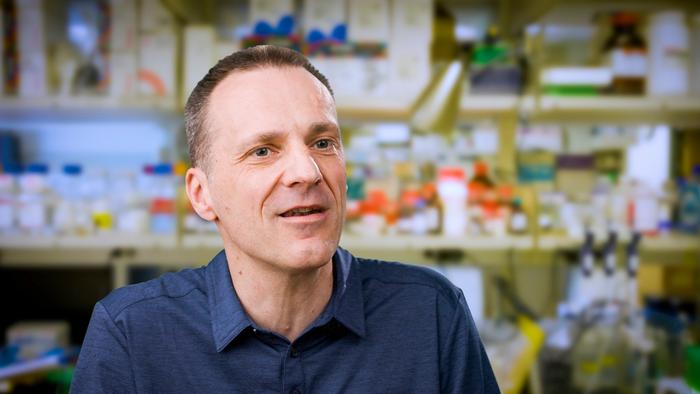
SEATTLE — May 29, 2024 — Foam mixed with medications is already used to treat conditions such as varicose veins, hemorrhoids, wounds on the skin and even hair loss. Now, Fred Hutch Cancer Center scientists have found that foam might also be used as a vehicle to deliver expensive gene therapies.

Credit: Fred Hutch Cancer Center
SEATTLE — May 29, 2024 — Foam mixed with medications is already used to treat conditions such as varicose veins, hemorrhoids, wounds on the skin and even hair loss. Now, Fred Hutch Cancer Center scientists have found that foam might also be used as a vehicle to deliver expensive gene therapies.
Published May 28 in Nature Communications, bioengineer Matthias Stephan, MD, PhD, and his Fred Hutch team report that a foaming liquid worked better than a standard liquid formulation at transferring gene therapy components to cells in laboratory studies.
“Gene therapies are the new wave of medicine, but they are extremely expensive and difficult to make,” said Stephan, a professor in the Translational and Therapeutics Division at Fred Hutch. “Our gene therapy foam shows for the first time that by taking a small amount of an expensive gene therapy drug, increasing its volume by embedding it in a solution that is mostly made of densely packed air bubbles and then applying it to cells, we can achieve a strong and safe transfer of gene therapy agents to cells.”
Gene therapies in development for cancers, infectious diseases, inherited disorders and other diseases hold tremendous promise for providing long-lasting treatments by fixing the underlying biology. However, they also face major barriers including getting the therapies to the parts of the body where they’re needed and the high cost of making laboratory-modified viruses called vectors that deliver therapies to diseased cells. Foam could be the key to delivering gene therapies more simply and cheaply.
While the study is proof-of-concept, Stephan envisions the gene therapy foam as a possible solution for treating cancers that are in confined spaces, such as ovarian, pancreatic and gastrointestinal cancer and autoimmune diseases that affect the digestive system.
Watch video demonstration of the foam:
“The foam could be applied to confined spaces to push again body tissues that have the disease, and the medication in the foam could adhere to those diseased cells,” Stephan explained. “Then as the air bubbles pop, the liquid with the gene therapy can drain away.”
Stephan has used other materials, such as nanoparticles and a tiny implantable sponge, to deliver genetic instructions to fight disease directly to cells. Looking for a new delivery vehicle, he was inspired by shaving foam.
“Foam is mostly gas bubbles separated by thin liquid films and it is already safely used in medicines and the food industry,” Stephan said. “We have not seen foam used with genetic materials, and I wondered if it could help solve the problem of gene therapy delivery.”
In the lab
In a series of lab experiments, Stephan and his team examined whether they could take a small amount of very expensive gene therapy vectors, mix them with gene editing materials and different foaming agents, and then apply the mixture to cells to see if the cells would take up the gene edits.
To test their approach, the team used another immune-based therapy: the mRNA for a COVID-19 vaccine, which teaches the immune system to attack the virus by showing the immune system the biological code for what the virus looks like.
The Fred Hutch team made their own solution of a COVID-19 mRNA vaccine with a biological tweak that allowed it to glow once it was delivered to cells. This way, once the lab-engineered gene therapy product was taken up by cells, the team could see it using a microscope.
To develop the foam, the team determined methylcellulose, a food additive used in ice cream and other products, created the best foam for transferring gene therapy product to cells and stayed in place where it was deposited.
When the team mixed the foam with cells, the foam substantially boosted gene transfer and outperformed liquid formulations. Then, when the team injected a small amount of foam into the abdominal cavity of mice, within one day the gene therapy transferred from the foam to the targeted cells without significant side effects.
Beyond the lab
The technology is many years from being used in people. Stephan hopes to attract external academic and industry collaborators to further develop the approach.
“The goal of my work is to make modern medicines work better for people everywhere,” Stephan said. “I believe that our future medical breakthroughs will arise from our deep understanding of disease biology and our knack for finding innovative solutions in unexpected places.”
Note: Scientists at Fred Hutch played a role in developing these discoveries, and Fred Hutch and certain of its scientists may benefit financially from this work in the future.
###
Media contact:
Molly McElroy
mwmcelro@fredhutch.org
Fred Hutchinson Cancer Center unites individualized care and advanced research to provide the latest cancer treatment options while accelerating discoveries that prevent, treat and cure cancer and infectious diseases worldwide.
Based in Seattle, Fred Hutch is an independent, nonprofit organization and the only National Cancer Institute-designated cancer center in Washington. We have earned a global reputation for our track record of discoveries in cancer, infectious disease and basic research, including important advances in bone marrow transplantation, immunotherapy, HIV/AIDS prevention and COVID-19 vaccines. Fred Hutch operates eight clinical care sites that provide medical oncology, infusion, radiation, proton therapy and related services. Fred Hutch also serves as UW Medicine’s cancer program.
Journal
Nature Communications
Method of Research
Experimental study
Subject of Research
Animals
Article Title
Liquid foam improves potency and safety of gene therapy vectors
Article Publication Date
28-May-2024
COI Statement
Note: Scientists at Fred Hutch played a role in developing these discoveries, and Fred Hutch and certain of its scientists may benefit financially from this work in the future.
Cite Scienmag News
Juliet Wilcox. (May 29, 2024). Could a medicated foam make gene therapies more accessible? Scienmag. https://scienmag.com/could-a-medicated-foam-make-gene-therapies-more-accessible/
Juliet Wilcox. "Could a medicated foam make gene therapies more accessible?" Scienmag, 29 May 2024, https://scienmag.com/could-a-medicated-foam-make-gene-therapies-more-accessible/. Accessed 4 September 2026.
Juliet Wilcox. "Could a medicated foam make gene therapies more accessible?" Scienmag. May 29, 2024. https://scienmag.com/could-a-medicated-foam-make-gene-therapies-more-accessible/

