


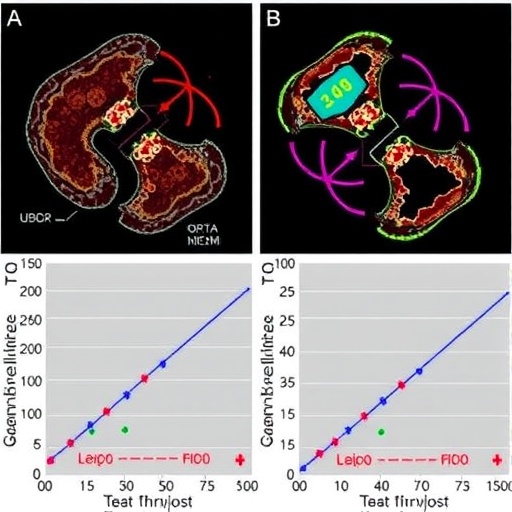
A groundbreaking study has revealed a powerful molecular signature that could revolutionize prognostic assessments in head and neck squamous cell carcinoma (HNSC). Published in BMC Cancer, researchers have identified a correlated overexpression of the genes CDC20 and UBCH10 as a critical biomarker linked to poor patient outcomes. This discovery not only highlights novel mechanistic insights into tumor progression but also paves the way for more precise therapeutic strategies in HNSC and potentially other solid tumors.
The study focuses on the anaphase-promoting complex/cyclosome (APC/C), a vital E3 ubiquitin ligase that meticulously governs mitotic checkpoint execution, ensuring faithful cell division. Functioning with the essential co-factor Cdc20 and the ubiquitin-conjugating enzyme UbcH10, APC/C orchestrates the degradation of key regulatory proteins, thereby driving orderly mitotic progression. Dysregulation of this system, particularly aberrant expression of CDC20 or UBCH10, has been previously implicated in various malignancies, reflecting a crucial vulnerability in the cell cycle control machinery.
Building on prior observations from cultured HNSC models, where Cdc20 was shown to transcriptionally activate UBCH10, the current research sought to examine this relationship within primary tumors. Utilizing patient specimens from a prospective Eastern Indian cohort alongside comprehensive datasets from The Cancer Genome Atlas (TCGA), the team employed quantitative PCR and immunohistochemistry to quantify gene expression, ensuring robust validation of their findings across diverse populations.
Analyses revealed a striking co-overexpression pattern of CDC20 and UBCH10 in a significant subset of the HNSC patient samples. This correlated elevation was not just a coincidental event; it was intimately connected with increased cellular aneuploidy, a hallmark of cancer characterized by abnormal chromosome numbers. Fluorescence in situ hybridization (FISH) assays on tumor and adjacent normal tissue samples affirmed these alterations, reinforcing the link between this gene signature and genomic instability.
Perhaps most compellingly, survival analysis via Kaplan–Meier curves demonstrated that patients exhibiting this dual overexpression endured notably worse prognoses. This correlation underscores the clinical relevance of the CDC20-UBCH10 axis as a biomarker capable of stratifying patients based on expected disease progression and survival odds, an advancement that could meaningfully influence treatment decision-making.
Beyond clinical correlations, functional assays in cultured HNSC cells elucidated the biological consequences of this co-expression. When CDC20 and UBCH10 were simultaneously overexpressed, cancer cells exhibited dramatically enhanced proliferative, migratory, and invasive capabilities. These phenotypes mirror aggressive tumor behavior, substantiating the mechanistic role of this gene pair in driving malignancy.
Importantly, leveraging TCGA’s pan-cancer data, the researchers uncovered that this molecular signature transcends HNSC, appearing in numerous other solid tumors with a similar adverse impact on patient survival. This broad relevance positions CDC20 and UBCH10 not merely as disease-specific markers but as universal indicators of tumor aggressiveness across various cancer types.
At the molecular level, APC/C’s interaction with Cdc20 and UbcH10 facilitates the ubiquitination and proteasomal degradation of securin and cyclins, regulating mitotic exit. Dysregulation through overactive CDC20-UBCH10 expression disrupts this balance, promoting uncontrolled cell division and genomic chaos. These insights unravel a critical oncogenic pathway, offering new avenues for targeted therapeutic interventions.
The study’s methodological rigor, combining high-resolution gene expression profiling, in vitro functional assays, and sophisticated bioinformatics analysis of large genomic datasets, ensures that its conclusions stand on a solid foundation. This integrative approach exemplifies the modern cancer research paradigm, where bench science and big data intersect to decode complex disease mechanisms.
Furthermore, the clinical potential of this biomarker signature is immense. Given the high mortality rate and morbidity associated with HNSC, identifying patients at greatest risk through CDC20-UBCH10 profiling could enable early, aggressive interventions tailored to individual tumor biology, ultimately improving survival outcomes.
The revelation that this co-expression signature correlates with aneuploidy also signals a possible feedback loop where mitotic checkpoint failure accelerates genomic instability, fueling tumor evolution and resistance. Targeting this pathway pharmacologically could disrupt such cycles, hampering tumor growth and metastasis.
Future research directions may focus on developing small molecule inhibitors or RNA-based therapies that selectively downregulate CDC20 and UBCH10, potentially restoring mitotic fidelity. Additionally, longitudinal studies tracking expression changes during treatment could provide insights into therapy resistance mechanisms.
In sum, this seminal work illuminates how the lethal synergy between CDC20 and UBCH10 expression accelerates head and neck cancer progression and reduces patient survival. By bridging molecular biology and clinical oncology, it sets a new standard for biomarker-driven cancer prognostication, with promising translational implications for personalized medicine.
The findings invite oncologists, molecular biologists, and pharmaceutical developers alike to reconsider the mitotic checkpoint not merely as a cellular guard but as a pivotal axis of cancer vulnerability. Harnessing this knowledge may unlock innovative treatments that improve outcomes for thousands battling head and neck cancers worldwide.
This landmark study exemplifies the power of integrating mechanistic insights with patient-derived data, showcasing the future of precision oncology. As scientists continue decoding cancer’s molecular signatures, dual markers like CDC20 and UBCH10 will undoubtedly become critical tools in the oncologist’s arsenal.
By illuminating the dark corners of tumor biology, the research paints a hopeful picture where molecular signatures translate directly into clinical action, saving lives through sharper diagnosis and smarter therapies. The era of one-size-fits-all cancer treatment is ending—with signatures like CDC20-UBCH10 guiding the way forward.
Cite Scienmag News
Nathaniel Bowman. (October 1, 2025). Correlated CDC20, UBCH10 Signal Poor Cancer Prognosis. Scienmag. https://scienmag.com/correlated-cdc20-ubch10-signal-poor-cancer-prognosis/
Nathaniel Bowman. "Correlated CDC20, UBCH10 Signal Poor Cancer Prognosis." Scienmag, 1 October 2025, https://scienmag.com/correlated-cdc20-ubch10-signal-poor-cancer-prognosis/. Accessed 4 September 2026.
Nathaniel Bowman. "Correlated CDC20, UBCH10 Signal Poor Cancer Prognosis." Scienmag. October 1, 2025. https://scienmag.com/correlated-cdc20-ubch10-signal-poor-cancer-prognosis/


