


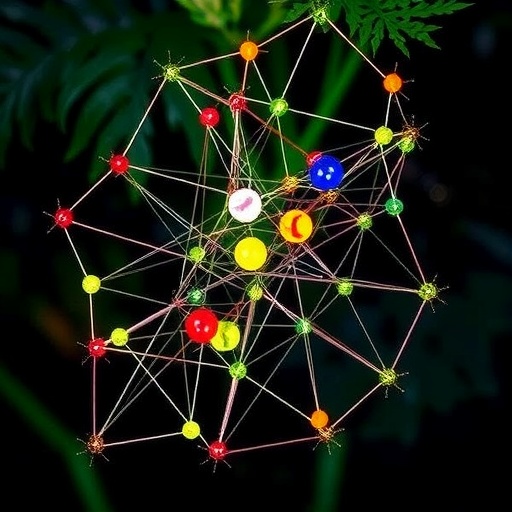
In the ever-evolving landscape of botanical research, the intricate architecture of leaf venation networks has long fascinated scientists seeking to understand plant evolution, physiological function, and ecological adaptation. Recently, a pivotal study authored by Matos, I.S., Vu, B., Mann, J., and colleagues has shed unprecedented light on how leaf venation patterns have evolved across diverse plant clades and at multiple biological scales. This rigorous investigation, published in Nature Plants in 2025, addresses longstanding gaps in our understanding of how vein networks develop, adapt, and influence plant survival strategies through evolutionary timeframes.
At the heart of this research lies the complex structure of leaf veins — the web-like conduits through which plants transport water, nutrients, and photosynthates. These networks not only determine the efficiency of resource distribution within leaves but also contribute substantially to mechanical support and damage mitigation. Previously, studies examining venation patterns have focused largely on isolated species or single taxonomic groups, providing fragmented insight into the evolutionary trajectories that have shaped these networks. The current study embarks on a broad comparative analysis spanning multiple plant clades, from basal lineages to more derived angiosperms, creating an integrative framework that connects micro-scale venation traits to macro-scale evolutionary processes.
Using cutting-edge imaging techniques combined with computational modeling, the researchers mapped variations in vein density, hierarchical organization, and network robustness across hundreds of species representing diverse phylogenetic backgrounds. High-resolution microscopy coupled with 3D reconstruction allowed the team to visualize vein topology in unprecedented detail, enabling precise quantification of network parameters. By correlating these parameters with ecological niches and phylogenetic data, the study elucidates key trends shaping venation evolution. For example, results indicate a consistent increase in vein density and reticulation complexity in angiosperms, features that likely underpin their superior hydraulic efficiency and adaptability in fluctuating environments.
One of the study’s groundbreaking revelations involves the scaling laws that govern venation patterning. Across evolutionary time, leaf vein networks appear to follow universal principles that balance optimal transport efficiency with mechanical resilience. The researchers demonstrate how these scaling relationships manifest differently across taxonomic groups, reflecting diverse evolutionary pressures. Notably, early-diverging plants tend to exhibit simpler, less redundant vein architectures, while advanced angiosperms possess highly reticulate networks that enhance redundancy and damage tolerance. This pattern suggests an evolutionary trade-off whereby increased venation complexity may come at the cost of higher developmental investment but confers greater survival advantages in dynamic environments.
Additionally, the study probes the genetic and developmental mechanisms underpinning venation diversity. Leveraging comparative genomics, the authors identify key regulatory genes involved in vein patterning, such as members of the auxin transport pathway and vascular differentiation networks. These molecular insights underscore the repeated usage of conserved genetic circuits modified through evolutionary innovations to achieve diverse venation outcomes. By linking genotype to phenotype with unprecedented clarity, the research unites molecular biology with ecological and evolutionary contexts, offering a holistic view of leaf venation network evolution.
Importantly, the study also addresses the implications of venation architecture for plant adaptation under climate change scenarios. Vein networks dictate leaf hydraulic conductance, influencing drought tolerance and photosynthetic capacity. As global temperatures rise and precipitation patterns become more erratic, plant species with more efficient and resilient venation are likely to have competitive advantages. The authors argue that understanding the evolutionary basis of venation traits can inform predictions about plant community responses to environmental stress, aiding conservation and crop improvement efforts.
The evolutionary narrative emerging from this research challenges earlier paradigms that viewed leaf venation evolution as a linear progression. Instead, it unfolds as a complex mosaic of convergent adaptations, lineage-specific innovations, and functional trade-offs. For instance, some ferns and cycads, despite their ancient origins, exhibit surprisingly complex venation systems comparable to those of certain angiosperms, a finding that prompts reexamination of the evolutionary pressures driving vein network complexity. The multifaceted dataset presented ignites new hypotheses about the role of ecological factors, such as light availability and herbivory pressure, in shaping venation patterns.
Technically, the researchers’ interdisciplinary methodology stands out for integrating morphometrics, phylogenetics, developmental biology, and functional ecology. Their sophisticated network analyses quantify properties such as loopiness, vein connectivity, and hierarchical branching orders, translating the abstract vascular geometry into measurable functional traits. This quantitative approach enables direct comparison across disparate taxa that vary widely in leaf size, shape, and habitat, bridging gaps between descriptive botany and functional inference.
The study also pioneers the use of machine learning algorithms to classify venation types and predict functional traits from network topologies. By training models on extensive datasets, the authors demonstrate the potential for automated identification of evolutionary patterns and ecological adaptation in plant vascular systems. This technological innovation promises to accelerate future research and broaden the accessibility of venation trait analysis to botanical researchers worldwide.
Further, these findings have profound implications for biomimetics and bio-inspired engineering. Understanding how natural venation networks optimize resource transport while maintaining robustness against damage offers design principles for sustainable fluid distribution systems, resilient infrastructures, and smart materials. The study’s multidisciplinary impact, therefore, spans beyond plant science into broader technological realms.
Importantly, the authors provide a comprehensive resource for the botanical community, including an open-access database of venation network metrics correlated with phylogenetic and environmental metadata. This repository will serve as a foundation for subsequent studies exploring plant vascular evolution, ecosystem functioning, and responses to global change, fostering collaborative advances in plant science.
In sum, this landmark study recalibrates our understanding of leaf venation network evolution by elucidating its complexity across clades and scales through integrative methodologies. It anchors venation diversity in multifactorial evolutionary contexts, connecting molecular regulation to ecological function and evolutionary history. As the botanical sciences advance, this work sets a new standard in linking structural anatomy with evolutionary and environmental dynamics.
As researchers continue to unravel the nuanced relationships between venation architecture and plant adaptation, future avenues may leverage genomic editing tools to experimentally test hypotheses generated from this study. Such functional validations will deepen insight into the evolutionary significance of venation traits and their potential applications in agriculture and conservation under shifting climates.
The expansive scope and technical sophistication of this research underscore how advanced imaging, computation, and genomics can transform classical botanical questions into vibrant fields of cutting-edge science. By demystifying the evolutionary trajectories of leaf venation networks, Matos, Vu, Mann, and their team have opened the door to a host of interdisciplinary explorations that will enrich our understanding of plant life on Earth.
Cite Scienmag News
Gavin Prescott. (July 11, 2025). Correcting Insights: Evolution of Leaf Venation Networks. Scienmag. https://scienmag.com/correcting-insights-evolution-of-leaf-venation-networks/
Gavin Prescott. "Correcting Insights: Evolution of Leaf Venation Networks." Scienmag, 11 July 2025, https://scienmag.com/correcting-insights-evolution-of-leaf-venation-networks/. Accessed 4 September 2026.
Gavin Prescott. "Correcting Insights: Evolution of Leaf Venation Networks." Scienmag. July 11, 2025. https://scienmag.com/correcting-insights-evolution-of-leaf-venation-networks/


