


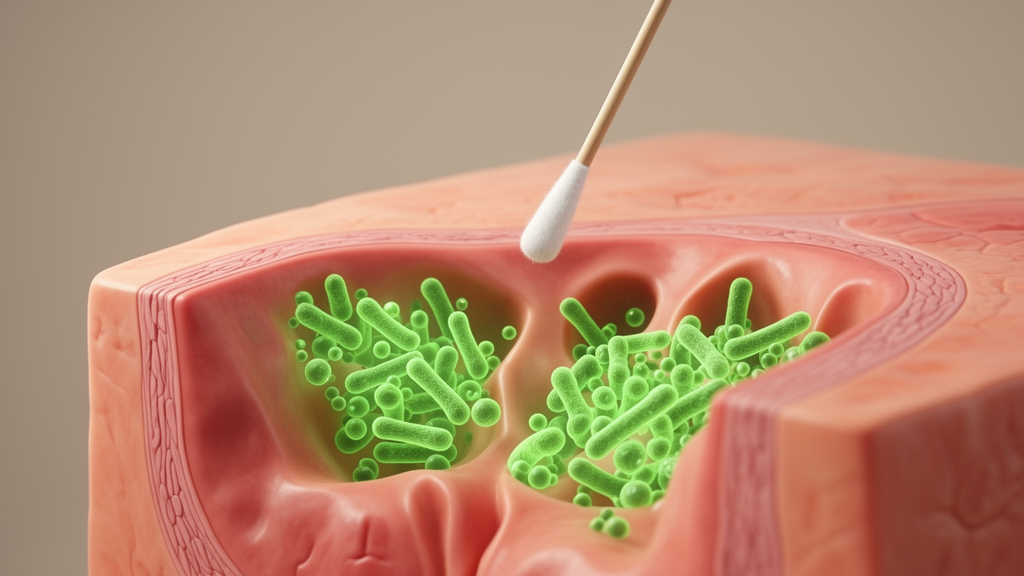
Surface swabs taken from the tonsils of patients with chronic tonsillitis miss most of the bacteria actually living inside the tissue, according to a prospective observational study of 110 patients undergoing tonsillectomy. The researchers collected samples from three sites during surgery: the tonsillar surface under aerobic conditions, the tonsillar core under aerobic conditions, and the core again under anaerobic conditions.
Surface and combined-core findings disagreed in 82.7 percent of patients, and in 21.8 percent of patients pathogens were recovered exclusively from the combined core samples. At least one potentially pathogenic bacterium was confirmed in 108 of the patients, or 98.2 percent. Of the 106 cultured bacterial species, 14 were classified as potentially pathogenic.
Staphylococcus aureus was the most frequently isolated organism, detected in 60.0 percent of patients, followed by Streptococcus pneumoniae at 58.2 percent and Streptococcus anginosus at 44.5 percent. Notably, Streptococcus pyogenes, the classic group A streptococcus often blamed for recurrent tonsillitis, was found in only 9.1 percent of patients.
For four organisms the difference between surface and core sampling reached statistical significance. Combined-core prevalence was significantly higher than surface prevalence for S. aureus, S. pneumoniae, S. anginosus and Haemophilus influenzae, with all comparisons yielding p values below 0.001 after Bonferroni correction.
The study also evaluated whether two widely used blood tests could serve as markers of chronic tonsillitis. Neither antistreptolysin O (ASO) nor anti-DNase B titres predicted fulfilment of the Paradise criteria, the clinical standards often used to justify tonsillectomy, when analysed by logistic regression. Anti-DNase B positivity was, however, associated with recovery of S. pyogenes from the tonsillar surface, suggesting the antibody test retains some value as an indicator of recent streptococcal infection rather than as a universal marker of chronic disease.
Antibiotic susceptibility testing, interpreted according to EUCAST 2025 breakpoints, revealed substantial macrolide resistance among the isolates. Erythromycin resistance was observed in 30.8 percent of S. aureus isolates, 33.3 percent of S. anginosus isolates and 20.0 percent of S. pneumoniae isolates. The authors conclude that this observed macrolide resistance supports susceptibility-guided use of erythromycin, particularly when it is considered as an alternative antibiotic in patients with beta-lactam allergy.
The findings carry practical implications for how chronic tonsillitis is assessed. Because surface swab culture substantially underestimates the bacteriological complexity of the disease, the researchers argue that core sampling combined with anaerobic culture conditions provides a more complete microbiological picture.
The authors caution that ASO and anti-DNase B should be interpreted in the context of clinical suspicion for recent streptococcal infection rather than relied upon as general markers of chronic tonsillitis. The study was conducted in patients undergoing tonsillectomy, so its findings apply to that surgical population, and as a prospective observational design it characterises the microbiota present rather than testing any treatment effect. The work was published open access in BMC Infectious Diseases, with the version shared early as a peer-reviewed, accepted manuscript carrying a permanent DOI ahead of the final version of record.
Subject of Research: Bacterial pathogens in chronic and recurrent tonsillitis comparing surface and core tonsillar microbiota by MALDI-TOF mass spectrometry
Article Title: Bacterial pathogens in chronic and recurrent tonsillitis: surface vs. core tonsillar microbiota assessed by MALDI-TOF mass spectrometry
Article References: Hriseňková, D. H., Čurová, K., Vološinová, D., Cveková, G. Š., Jarčuška, P., & Zahornacký, O. (2026). Bacterial pathogens in chronic and recurrent tonsillitis: surface vs. core tonsillar microbiota assessed by MALDI-TOF mass spectrometry. BMC Infectious Diseases. https://doi.org/10.1186/s12879-026-14731-3
Image Credits: AI Generated
DOI: 10.1186/s12879-026-14731-3
Keywords: chronic tonsillitis, tonsillectomy, MALDI-TOF mass spectrometry, tonsillar core microbiota, surface swab culture, Streptococcus pyogenes, Staphylococcus aureus, macrolide resistance, antistreptolysin O, anti-DNase B, anaerobic culture, EUCAST breakpoints
Cite Scienmag News
Ophelia Keating. (October 27, 2026). Core Tonsil Tissue Hides Bacteria That Surface Swabs Miss in Chronic Tonsillitis. Scienmag. https://scienmag.com/core-tonsil-tissue-hides-bacteria-that-surface-swabs-miss-in-chronic-tonsillitis/
Ophelia Keating. "Core Tonsil Tissue Hides Bacteria That Surface Swabs Miss in Chronic Tonsillitis." Scienmag, 27 October 2026, https://scienmag.com/core-tonsil-tissue-hides-bacteria-that-surface-swabs-miss-in-chronic-tonsillitis/. Accessed 27 October 2026.
Ophelia Keating. "Core Tonsil Tissue Hides Bacteria That Surface Swabs Miss in Chronic Tonsillitis." Scienmag. October 27, 2026. https://scienmag.com/core-tonsil-tissue-hides-bacteria-that-surface-swabs-miss-in-chronic-tonsillitis/


