

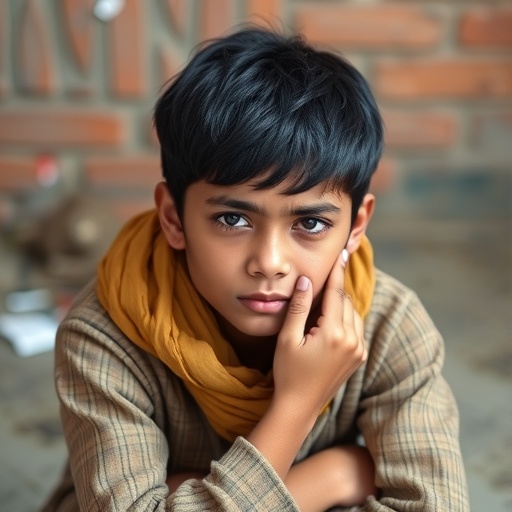
In the remote and economically challenged regions of Nepal, adolescents face unique and harrowing psychological battles that remain scarcely illuminated in global mental health discourse. A recent qualitative study, groundbreaking in its cultural and socioeconomic context, delves into the coping strategies employed by poverty-affected adolescents who are either experiencing or are at significant risk of depression and anxiety. This research sheds new light on the intricacies of adolescent mental health under the strain of poverty, offering technical insights imperative for the expansion of tailored mental health interventions worldwide.
Mental health research traditionally emphasizes the prevalence and treatment of psychiatric conditions within urban or resource-rich settings, often overlooking populations grappling with compounded stressors such as poverty, social instability, and limited access to health services. The study from Nepal shifts this narrative by centering on adolescents — a developmental stage critically sensitive to environmental influences — residing in poverty-stricken areas where mental health resources are scarce or virtually non-existent.
The investigation employed rigorous qualitative methodologies, capturing deeply personal narratives and lived experiences of adolescents through in-depth interviews and focus groups. This approach enabled the researchers to decode not only the manifestations of depression and anxiety among these youths but also the nuanced mechanisms they deploy to navigate emotional distress. These mechanisms, or coping strategies, encompass a complex interplay of individual resilience, familial support systems, and culturally embedded behaviors.
A striking revelation from the study is the dichotomy in coping strategies, split broadly into adaptive and maladaptive categories. Adaptive strategies include seeking social support within immediate family and community circles, engaging in meaningful daily activities, and employing spiritual or religious practices. These methods reflect an intricate mosaic of traditional wisdom and natural resilience that enables many adolescents to sustain psychological equilibrium amid adverse conditions.
Conversely, maladaptive coping, often spurred by stigma, lack of awareness, or sheer desperation, manifests in withdrawal, substance use, and even self-harm. The prevalence of such detrimental behaviors underscores the critical gaps in accessible mental health education and support systems. These findings urge a re-evaluation of existing frameworks for pediatric mental health, especially considering the socio-cultural contexts that shape and sometimes hinder effective coping.
An essential contribution of this study lies in its exploration of the role of poverty as not just a background condition but as a direct catalyst exacerbating psychological distress. Economic hardship imposes relentless stress on familial stability, access to nutrition, education, and healthcare — all factors known to interplay with mental health outcomes. The researchers emphasize that coping cannot be fully understood without acknowledging this socio-economic dimension, which acts as both a barrier and a defining context.
Technically speaking, the study enriches the discourse on psychosocial interventions by integrating ethnographic and psychological paradigms. It advocates for multifaceted programs that address mental health within the broader matrix of social determinants, community engagement, and cultural sensitivity. Such programs would ideally leverage existing communal structures and indigenous knowledge to foster sustainable mental health promotion, moving beyond the limitations of Western-centric models.
Moreover, the research highlights an urgent need for policy-driven facilitation of mental health literacy among adolescents and their caregivers, tailored to the unique challenges of poverty and rural livelihoods. Initiatives incorporating school-based mental health education, peer support groups, and teacher training emerge as promising pathways. These would ideally be embedded within a framework that respects local customs and acknowledges the realities of daily adolescent life in impoverished settings.
Crucially, the study’s findings caution against one-size-fits-all approaches. For instance, while spiritual coping is beneficial for many, it may not suffice or be accessible to all, particularly in increasingly heterogeneous social landscapes. This nuance calls for flexible, context-aware mental health interventions that validate diverse coping practices rather than homogenizing treatment protocols.
Another technical insight pertains to measuring psychological resilience and vulnerability in low-income adolescent populations. Traditional psychometric tools designed in affluent societies may lack relevance or sensitivity in these contexts. Hence, the study’s methodological rigor insists on developing context-specific assessment instruments that capture culturally meaningful expressions of distress and adaptation.
The implications of this research extend beyond Nepal, offering a replicable model for other low- and middle-income countries confronting the dual burdens of youth mental health crises and poverty. The study advocates for collaborative international efforts focusing on capacity building, knowledge exchange, and culturally informed research to close the pervasive mental health treatment gap in vulnerable adolescent populations globally.
Beyond academic circles, this research has profound relevance for non-governmental organizations, healthcare providers, and community leaders striving to initiate or enhance mental health programs in deprived regions. Its findings empower stakeholders with actionable intelligence on fostering resilience and identifying risk factors within adolescent groups facing extreme hardship.
As mental health gains traction on the international development agenda, studies such as this underscore the importance of addressing the social determinants alongside clinical symptoms. By illuminating how adolescents in poverty-afflicted zones cope with their mental health struggles, the research pioneers new frontiers in understanding psychological well-being through the lenses of culture, community, and economic adversity.
In summation, this comprehensive qualitative analysis enriches the global mental health narrative by spotlighting the resilience and vulnerability of poverty-affected adolescents in Nepal. Its technical depth and cultural pertinence not only advance academic knowledge but also galvanize effective, sustainable mental health interventions tailored to the realities of adolescent lives in economically marginalized settings.
Subject of Research:
Coping strategies of adolescents living in poverty who experience or are at risk of depression and anxiety in Nepal.
Article Title:
Coping strategies among poverty-affected adolescents experiencing or at risk of depression and anxiety in Nepal: a qualitative study.
Article References:
Thapa, A., Teli, B., Pillutla, R. et al. Coping strategies among poverty-affected adolescents experiencing or at risk of depression and anxiety in Nepal: a qualitative study. BMC Psychol 13, 1325 (2025). https://doi.org/10.1186/s40359-025-03698-6
Image Credits: AI Generated
DOI:
https://doi.org/10.1186/s40359-025-03698-6


