

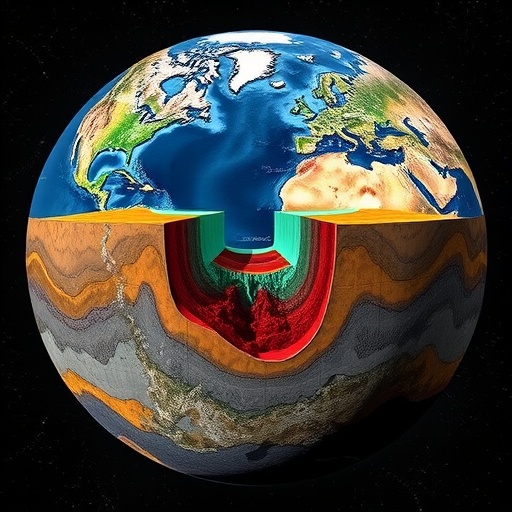
In groundbreaking new research, scientists have unveiled compelling evidence that the mantle sources of rare earth element (REE)-rich alkaline silicate magmas are significantly influenced by the subduction of continent-derived sediments. This revelation provides a critical missing link in our understanding of how economically vital REE deposits form deep within Earth’s geodynamic systems. The study, published in Nature Communications, meticulously traces the geochemical signature of these enigmatic magmas back to sedimentary materials carried down into the mantle by tectonic plates—a process that has far-reaching implications for mineral exploration, geochemistry, and our broader understanding of Earth’s interior.
Alkaline silicate magmas are recognized for their crucial role in hosting rare earth elements, elements that are indispensable to modern technology such as smartphones, electric vehicles, and renewable energy systems. Yet, the origins of the enriched mantle sources supplying these magmas have remained elusive, with competing hypotheses suggesting either intrinsic mantle heterogeneity or external contributions. The newly published work clarifies that subducted sediments originating from continental crustal material introduce valuable geochemical components into the mantle wedge, thereby enriching the source region of these magmas with REEs. This mechanism not only redefines mantle dynamics but also fine-tunes our models for ore genesis.
Leveraging a multidisciplinary approach combining field studies from key geologic provinces, high-precision isotope geochemistry, and comprehensive petrological modeling, the research team could fingerprint the mantle domains influenced by subducted sediments with unprecedented resolution. They focused on isotopes of strontium (Sr), neodymium (Nd), and hafnium (Hf), along with trace element ratios characteristic of continental sediments, to unequivocally demonstrate the sedimentary input. Their data suggest that the interaction between subducted sedimentary materials and the mantle results in the distinctive geochemical traits observed in REE-enriched alkaline silicate magmas, definitively linking surface processes with deep Earth geodynamics.
The study’s implications extend beyond academic curiosity, shedding light on fundamental tectonic processes. Subduction zones, where oceanic plates dive beneath continental plates, serve as critical conduits for transporting sedimentary materials deep into the mantle. Previously, the role of these sediments was thought to be primarily in metasomatizing the mantle wedge to produce arc magmatism. This new evidence shifts the paradigm by demonstrating that they can also bolster the mantle source regions for intraplate alkaline magmatism, a process critical for localized REE enrichment. Such findings underscore the intricate and dynamic nature of chemical exchanges at subduction interfaces.
In addition to revealing the sedimentary fingerprints within the mantle, the researchers probed the thermal and chemical evolution of the magma generation region. Their petrological models indicate that the subducted sediments undergo partial melting and dehydration reactions at depths of 80 to 120 kilometers, releasing fluid phases that metasomatize the mantle peridotite. This metasomatism modifies the mineralogy and geochemistry of the mantle, producing fertile domains capable of generating REE-enriched alkaline magmas upon subsequent partial melting. Such detailed insight into depth-dependent processes enriches our grasp of mantle heterogeneity and magma genesis.
One of the most striking outcomes of the study is the clarification of why certain alkaline magmatic provinces are exceptionally rich in REEs, while others, although compositionally similar, are comparatively depleted. The researchers propose that the variable addition of subducted sediments, affected by factors such as sediment thickness, composition, and subduction rate, governs mantle source enrichment levels. This nuanced understanding challenges previous overly simplistic models and heralds a new era for predictive modeling of mineral resources, empowering geoscientists and exploration geologists to refine targeting strategies for REE deposits.
The researchers also highlight the broader environmental and economic context of their findings. With global demand for rare earth elements skyrocketing due to clean energy transitions and advanced electronic technologies, secure and sustainable sources are paramount. Understanding the deep-earth processes controlling REE enrichment is critical to locating new deposits and minimizing environmentally damaging extraction practices. By elucidating the sedimentary provenance of mantle source enrichment, this study offers foundational knowledge that will influence the future landscape of strategic mineral exploration worldwide.
Advanced isotopic techniques, particularly utilizing in situ laser ablation multi-collector inductively coupled plasma mass spectrometry (LA-MC-ICP-MS), were central to the study’s success. These cutting-edge methodologies allowed precise isotopic composition measurements of mineral phases within the magmatic rocks, isolating subtle geochemical signatures tied to sediment subduction. The fidelity and spatial resolution of these analyses surpass traditional whole-rock studies, revealing complex mixing processes and temporal evolution of the mantle source. Such technological breakthroughs demonstrate how refinement in analytical chemistry drives frontier earth science research.
Furthermore, the integration of high-temperature experimental petrology enabled the team to simulate mantle melting conditions and fluid-rock interactions under controlled laboratory settings. These experiments constrained the stability fields of key mineral phases and elucidated how fluid-mobile elements like REEs are mobilized and incorporated into mantle melts. By reproducing natural processes at elevated pressures and temperatures, experimental data corroborated field observations and isotopic measurements, strengthening the overall model for sediment-induced mantle enrichment.
Geophysical implications cannot be overstated. The subduction of sedimentary packages modifies the density, composition, and rheology of the mantle wedge, potentially influencing melt generation rates and migration pathways. These processes, in turn, affect volcanic activity, crustal growth, and tectonic evolution over geological timescales. This study provides an indispensable geochemical lens through which geodynamicists can reinterpret seismic tomography and mantle convection models, fostering a more integrated view of Earth’s interior dynamics.
From a geochemical standpoint, the identification of sedimentary contributions to the mantle source also informs our understanding of volatile elements such as carbon, sulfur, and water. These elements play critical roles in magma dynamics and volcanic degassing, ultimately impacting surface environments and atmospheric evolution. The research, therefore, bridges deep Earth processes with surface system interactions, highlighting the interconnectedness characteristic of Earth systems science.
This discovery resonates with broader planetary science narratives as well. By understanding subduction processes and mantle-metasomatic enrichment on Earth, scientists gain insight into how other terrestrial planets or moons with tectonic or magmatic activity might evolve chemically over time. Such comparative planetology can inspire new theories regarding planetary differentiation, volatile cycling, and resource potential beyond Earth, pushing the boundaries of geoscience and space exploration.
The study’s comprehensive approach—melding fieldwork, analytical chemistry, experimental petrology, and geodynamic modeling—sets a new benchmark for multidisciplinary Earth science research. It emphasizes the critical importance of considering sediment subduction not merely as a passive process, but as an active driver of mantle geochemical evolution and ore formation. Future research trajectories will undoubtedly explore temporal variations in sediment subduction, the role of subducted terrigenous versus marine sediments, and the interplay with mantle plumes or lithospheric structures.
In summary, this pioneering research revolutionizes our understanding of how rare earth element enrichment occurs in the Earth’s mantle. By demonstrating that continent-derived sediments subducted at convergent margins are instrumental in enriching mantle sources for alkaline silicate magmas, the study opens new vistas for mineral exploration, deep-earth geochemistry, and tectonic processes. The implications span economic geology, environmental stewardship, geodynamics, and planetary science, underscoring the intricate connectivity of Earth’s internal and surface systems.
As global societies pivot toward technologically advanced, sustainable futures, such fundamental discoveries will guide the efficient and responsible extraction of critical raw materials. They remind us that Earth’s deep interior, though inaccessible, holds answers to some of our most pressing challenges. This work represents a significant leap forward in linking surface sedimentary processes with mantle chemistry, highlighting the dynamic dialogue between Earth’s crust and mantle that shapes the planet’s geochemical and mineralogical landscape.
Subject of Research: The geochemical and petrological processes governing the enrichment of rare earth elements in alkaline silicate magmas sourced from mantle domains influenced by subduction of continent-derived sediments.
Article Title: The mantle source of REE-rich alkaline silicate magmas can be enriched by continent-derived sediment subduction
Article References:
Qiu, KF., Long, ZY., Romer, R.L. et al. The mantle source of REE-rich alkaline silicate magmas can be enriched by continent-derived sediment subduction. Nat Commun 16, 11191 (2025). https://doi.org/10.1038/s41467-025-66213-w
DOI: https://doi.org/10.1038/s41467-025-66213-w


