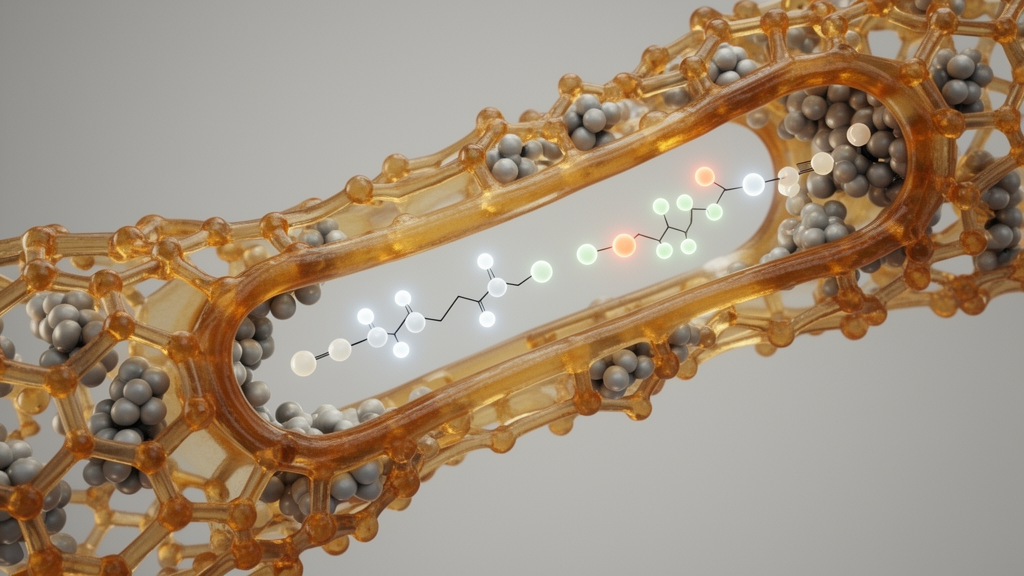
A new open-access study published in Discover Catalysis on 8 June 2026 reports a metal-free alternative built from surprisingly simple parts: a self-assembled molecular capsule, a small ammonium salt, a drop of hydrochloric acid, and water.
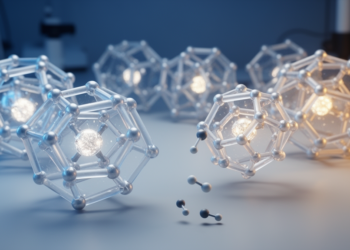
The catalyst’s heart is the hexameric capsule first described by Atwood’s group, assembled from six molecules of 2,8,14,20-tetra-undecyl-resorcin[4]arene and eight water molecules. This macrocyclic assembly is famous for hosting cationic guests, stabilizing them through interactions between positively charged ammonium centers and the aromatic walls of the resorcinarene. The authors’ hypothesis was straightforward: if the capsule can stabilize cationic intermediates, it might allow an ammonium-catalyzed hydrosilylation of alkynes to proceed inside its cavity, concentrating the reactants and shielding polarized transition states in an enzyme-like microenvironment.
The first experiments told a different story. When phenylacetylene was mixed with two equivalents of triethylsilane in the presence of 1-isopropyl-1,4-diazabicyclo[2.2.2]octane-1-ium iodide and 11 mol% of the capsule in water-saturated chloroform at 60 °C, proton NMR analysis revealed no conversion at all after 24 hours. Only when 10 mol% of hydrochloric acid was added did the reaction move, reaching a modest 22% conversion. Crucially, the dominant product was not the anticipated silylated alkene but styrene, the semihydrogenation product. The hydrogen atoms, it turned out, were not coming from the silane alone in the expected way but from the proton-rich interior of the capsule assembly.
Switching to a smaller ammonium, 1-methyl-DABCO iodide, left more room inside the capsule for reagents and raised the conversion of phenylacetylene to 64%, though under these initial conditions the silylated β-(E)-product still accounted for 50% of the mixture, with styrene at 44% and the α-silylated isomer at 6%. Control experiments mapped out exactly which components mattered. Without the ammonium salt, conversion fell to 23% with a messy mixture of silylated products, styrene, and an HCl addition by-product. Without the capsule, no conversion occurred at all. Adding DMSO, which dismantles the supramolecular assembly, dropped conversion to 9% and gave exclusively styrene, confirming that the intact capsule is essential for meaningful activity.
The counter-anion proved remarkably discriminating. Bis-ammonium salts with two methyl groups gave no conversion, and swapping the iodide of the mono-ammonium salt for chloride or tetrafluoroborate eliminated the silylated products entirely. The authors attribute this to the capsule’s halide chemistry: chloride can integrate into the capsule’s hydrogen-bond network, while the larger, more weakly hydrogen-bonded iodide can be co-encapsulated alongside the ammonium cation. Free iodide inside the cavity is then positioned to activate the silicon-hydrogen bond of the silane, polarizing it toward hydride transfer. The acid choice mattered too: hydrobromic acid gave 52% conversion, acetic acid 32%, and tetrafluoroboric acid none, consistent with BF4− having little affinity for the capsule interior.
With optimized conditions in hand—two equivalents of triethylsilane, 10 mol% of the methyl-DABCO iodide, 10 mol% HCl, and 11 mol% capsule at 60 °C in water-saturated chloroform—the team tested nine arylacetylenes, extending the reaction time to 72 hours because conversions were low at 24 hours. Phenylacetylene reached near-quantitative conversion after three days, with silylated products at 52% and styrene at 43% of the formed products, plus 5% of the hydration by-product acetophenone. Extended aromatic systems converted more slowly, at 56% for 2-ethynylnaphthalene and 57% for 9-ethynylphenanthrene, but the share of vinylarene climbed steadily with ring size, from 43% for phenyl to 59% for naphthalene and 69% for phenanthrene.
Electronic effects on the aromatic ring shaped both rates and selectivity. Electron-rich substrates, 4-methylphenylacetylene and 4-ethynylanisole, converted at roughly 42%, with vinylarenes dominating at 84% and 66% of products respectively, though the more electron-rich anisole derivative also generated 12% of an HCl-addition by-product and 10% of the ketone hydration product. The bulky 4-tert-butyl substrate fared worst among the para-substituted series, with only 20% conversion and just 32% of products being the desired vinylarene. Electron-poor substrates behaved differently: 4-chlorophenylacetylene gave 37% conversion with the hydrogenation product at 52%, while 4-fluorophenylacetylene reached 43% conversion with nearly quantitative formation of 4-fluorostyrene. An ortho-fluorine, whose steric bulk impedes alkyne activation and silane approach, cut conversion to 17%, though even there the vinylarene outweighed the silylated product at a ratio of 71 to 29.
A deuterium-labeling experiment pinned down where the hydrogen atoms originate. Replacing water with D2O in the reaction with phenylacetylene shifted the product ratio toward styrene, at 77% versus 23% for the β-(E)-silylated product, and proton NMR revealed 39% deuterium incorporation into the styrene, distributed as 70% deuterated-(E)- and 30% deuterated-(Z)-styrene. The silylated product contained no deuterium. This confirms water as the proton source in the semihydrogenation cycle, echoing mechanisms established for palladium nanoparticle catalysis: hydride from the activated silane adds to the alkyne to form a capsule-stabilized anionic intermediate, which is then protonated by structural water molecules or the phenolic walls of the resorcinarene.
The proposed full mechanism assembles these observations into a coherent cycle. Hydrochloric acid protonates the second nitrogen of the mono-ammonium salt, generating a dicationic bis-ammonium species hosted inside the capsule. This bis-cation activates the alkyne’s triple bond through cation-π and CH-π interactions, while encapsulated iodide polarizes the Si-H bond of triethylsilane. Hydride transfer creates the anionic intermediate, protonation releases the vinylarene, and the triethylsilyl iodide formed along the way reacts with water to regenerate iodic acid and triethylsilanol, closing the loop. Consistent with this picture, the team found that the silylated β-(E)-product itself converts to styrene in the presence of acid and capsule, with the capsule roughly doubling the rate compared with acid alone, explaining why vinylarenes dominate the final product distributions.
The authors are candid about the system’s limitations. Conversions are moderate at best, reaction times are long, and by-products from hydration and acid addition accumulate, particularly with bulky or electron-rich substrates. Compared with the ammonium-catalyzed hydrosilylation reported by Tsuchimoto’s group, which achieved quantitative silylation of phenylacetylene in propionitrile at 90 °C, the capsule system shows diminished activity, a decline the authors attribute to the milder conditions required to preserve the water-dependent supramolecular assembly. NMR binding studies also showed that phenylacetylene is encapsulated less efficiently than triethylsilane, likely contributing to the slow reaction rate. Even so, the study establishes a genuinely new role for ammonium salts as organocatalysts in a transformation previously dominated by metals, and demonstrates that a self-assembled capsule can concentrate reactants, stabilize charged intermediates, and supply protons in a single supramolecular package—a small but instructive step toward enzyme-like control in metal-free synthesis.
Subject of Research: Metal-free organocatalytic semihydrogenation of aromatic alkynes inside a self-assembled supramolecular capsule
Article Title: Harnessing supramolecular confinement for the semihydrogenation of aromatic alkynes
Article References: Steinmetz, M., & Sémeril, D. (2026). Harnessing supramolecular confinement for the semihydrogenation of aromatic alkynes. Discover Catalysis, 3(1), Article 9. https://doi.org/10.1007/s44344-026-00040-z
Image Credits: AI Generated
DOI: 10.1007/s44344-026-00040-z
Keywords: organocatalysis, supramolecular capsule, semihydrogenation, arylacetylenes, resorcinarene, ammonium salts, hydrosilylation, triethylsilane, vinylarenes, deuterium labeling, hydrochloric acid, iodide activation
Cite Scienmag News
Bethany Barker. (October 29, 2026). Confined Ammonium Catalyst Turns Alkynes Into Alkenes Without Metals. Scienmag. https://scienmag.com/confined-ammonium-catalyst-turns-alkynes-into-alkenes-without-metals/
Bethany Barker. "Confined Ammonium Catalyst Turns Alkynes Into Alkenes Without Metals." Scienmag, 29 October 2026, https://scienmag.com/confined-ammonium-catalyst-turns-alkynes-into-alkenes-without-metals/. Accessed 29 October 2026.
Bethany Barker. "Confined Ammonium Catalyst Turns Alkynes Into Alkenes Without Metals." Scienmag. October 29, 2026. https://scienmag.com/confined-ammonium-catalyst-turns-alkynes-into-alkenes-without-metals/