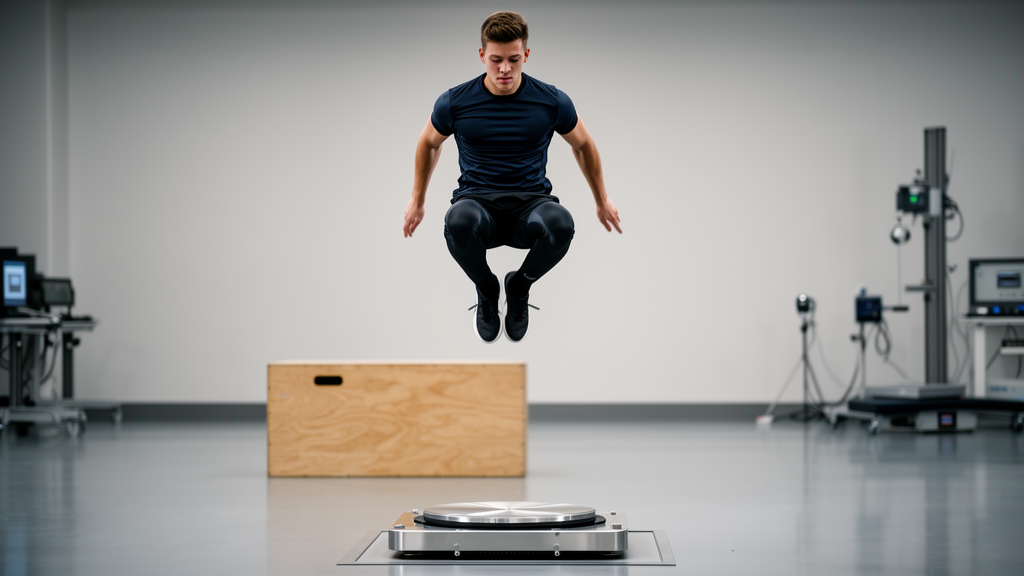
A concurrent cognitive task reduces force production during both the braking and propulsion phases of the drop jump and alters vertical ground reaction force waveforms during the subsequent landing phase in healthy young participants. In an investigation by Huseyin Celik and Pinar Arpinar-Avsar, researchers tested how simultaneous arithmetic calculations affect drop jump force-time metrics. The results showed that completing a cognitive task alongside a drop jump significantly diminishes jump height and reactive strength while lengthening ground contact time.
Physical performance tests are typically conducted with little to no cognitive load to ensure standardization, high reliability, and maximal performance. In training and athletic competition, however, athletes frequently perform physical actions while under the demands of a concurrent cognitive task. To examine how cognitive load affects dynamic performance, the study evaluated the effect of a concurrent cognitive task on drop jump force-time metrics and their reliability under single-task and dual-task conditions.
Thirty-five healthy young participants completed single-task and dual-task drop jump trials in a randomized order. The single-task condition involved performing the drop jump without a cognitive task, whereas the dual-task condition required performing the drop jump with a concurrent cognitive task based on simple arithmetic calculations. The researchers compared nineteen force-time metrics covering the braking, propulsion, and landing phases using paired t-tests with Holm adjustment, Hedges’ gz, Bayesian paired t-tests, and statistical parametric mapping of vertical ground reaction force waveforms.
The investigation also assessed whether force-time metrics remained reliable across conditions. When evaluating three-trial mean scores, seventeen of the nineteen metrics demonstrated within-session intraclass correlation coefficients between 0.812 and 0.930 across both single-task and dual-task conditions. These values indicated that the majority of the evaluated drop jump parameters maintained high within-session reliability regardless of whether participants completed the trials with or without concurrent arithmetic demands.
Under the dual-task condition, participants exhibited substantial reductions in primary performance metrics. Jump height was significantly lower, recording a p-value less than 0.001, a Hedges’ gz of 1.40, and a Bayes factor BF10 of 1.76 × 10^7. The reactive strength index was also significantly reduced, yielding a p-value less than 0.001, a Hedges’ gz of 1.04, and a Bayes factor BF10 of 45,943. Conversely, ground contact time was significantly longer under dual-task demands, showing a p-value of 0.025, a Hedges’ gz of −0.57, and a Bayes factor BF10 of 20.57.
Waveform analysis using statistical parametric mapping revealed specific phases where vertical ground reaction forces differed between conditions. During ground contact, vertical ground reaction force was significantly lower in the dual-task condition during 29.2% to 34.3% of contact within the braking phase and during 52.0% to 79.1% within the propulsion phase. In the landing phase, vertical ground reaction force was significantly lower under the dual-task condition during the initial force rise from 1.3% to 6.3%, but significantly higher during the attenuation of the impact force between 15.5% and 19.6%.
In contrast to these alterations, two metrics demonstrated no significant differences between the single-task and dual-task trials. The spring-like correlation yielded a p-value of 0.462, a Hedges’ gz of 0.20, and a Bayes factor BF01 of 2.79, indicating weak evidence for the absence of an effect. Similarly, vertical time to stabilization showed a p-value of 0.462, a Hedges’ gz of 0.15, and a Bayes factor BF01 of 3.74, providing moderate evidence for the absence of an effect. These findings indicate that a concurrent cognitive task reduces force output during braking and propulsion while altering vertical force waveforms during landing in healthy young participants.
Subject of Research: Effects of concurrent cognitive tasks on drop jump force-time metrics and vertical ground reaction force waveforms
Article Title: Dual-task interference in the drop jump: Frequentist, Bayesian, and waveform analysis of vertical ground reaction force
Article References: Celik, H., & Arpinar-Avsar, P. (2026). Dual-task interference in the drop jump: Frequentist, Bayesian, and waveform analysis of vertical ground reaction force. PLOS One, 21(11), e0362399. https://doi.org/10.1371/journal.pone.0362399
Image Credits: AI Generated
DOI: 10.1371/journal.pone.0362399
Keywords: drop jump, dual-task interference, concurrent cognitive task, vertical ground reaction force, jump height, reactive strength index, ground contact time, braking phase, propulsion phase, landing phase, statistical parametric mapping, intraclass correlation coefficients, Bayesian paired t-tests, Hedges gz, spring-like correlation, vertical time to stabilization, force-time metrics, arithmetic calculations
Cite Scienmag News
Scienmag. (November 12, 2026). Concurrent Arithmetic Tasks Reduce Drop Jump Height and Ground Reaction Forces. https://scienmag.com/concurrent-arithmetic-tasks-reduce-drop-jump-height-and-ground-reaction-forces/
Scienmag. "Concurrent Arithmetic Tasks Reduce Drop Jump Height and Ground Reaction Forces." Scienmag, 12 November 2026, https://scienmag.com/concurrent-arithmetic-tasks-reduce-drop-jump-height-and-ground-reaction-forces/. Accessed 12 November 2026.
Scienmag. "Concurrent Arithmetic Tasks Reduce Drop Jump Height and Ground Reaction Forces." Scienmag. November 12, 2026. https://scienmag.com/concurrent-arithmetic-tasks-reduce-drop-jump-height-and-ground-reaction-forces/