


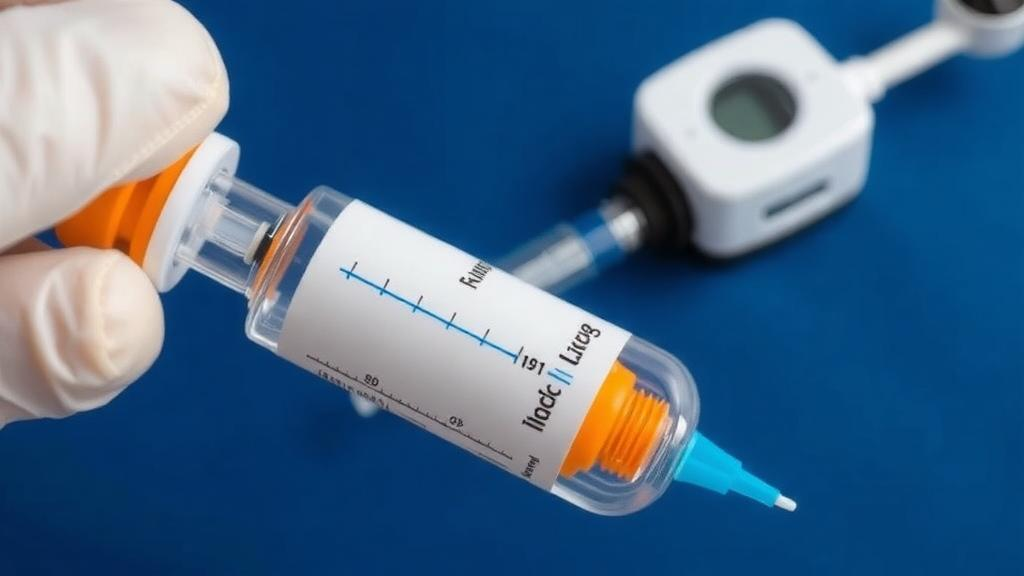
In a striking example of clinical improvisation meeting cutting-edge technology, physicians in France have reported the first detailed case of a person with type 1 diabetes running a concentrated insulin formulation through a fully tubeless automated insulin delivery system for a full year. The report, published in Diabetes Therapy by Bleuenn Dreves and Michael Joubert of Caen University Hospital, describes how a 46-year-old security guard with extreme insulin resistance and dangerous episodes of low blood sugar was safely transitioned from a conventional patch pump to the Omnipod 5 hybrid closed-loop system while continuing to use U-500 regular insulin, a formulation five times more concentrated than the standard insulin the device was ever designed to handle.
The case matters because it sits at the intersection of two stubborn problems in diabetes care. The first is reservoir capacity. Patch pumps like the Omnipod are beloved by patients precisely because they are tubeless, discreet, and waterproof, but their onboard reservoir holds only 200 units of insulin and is meant to last about three days. For people whose bodies demand enormous quantities of insulin, that limit becomes a hard wall. The second problem is hypoglycemia. Automated insulin delivery systems, often called artificial pancreases, use algorithms that continuously adjust insulin dosing based on continuous glucose monitor readings, but those algorithms were built and validated exclusively around rapid-acting U-100 insulin analogs whose pharmacokinetic profiles differ sharply from concentrated regular human insulin.
The patient in this report had been diagnosed with slowly progressive autoimmune type 1 diabetes at age 40, confirmed by positive diabetes-associated autoantibodies and an undetectable C-peptide level. By age 43, his insulin requirements had climbed to roughly 130 units per day, and because local reimbursement rules required pods to be replaced every three days, standard U-100 insulin simply no longer fit within the reservoir capacity. His care team therefore introduced U-500 regular insulin to preserve his preferred tubeless pump therapy. By age 46, his daily requirement had ballooned to approximately 245 units, or 2.6 units per kilogram of body weight, well into the territory clinicians define as severe insulin resistance.
Yet his glycemic control was, on paper, respectable. Continuous glucose monitoring showed a mean glucose of 137 mg/dl and a glucose management indicator of 6.6 percent, with 75 percent of readings in range. The danger lay elsewhere: he spent 9 percent of his time below range, his Gold score of 6 indicated severely impaired awareness of hypoglycemia, and his low-glucose episodes frequently struck during solitary overnight security shifts, where neuroglycopenic symptoms could develop before he even recognized what was happening. For a man working alone through the night, recurrent hypoglycemia was not merely a medical nuisance but an occupational hazard with potentially catastrophic consequences.
The solution his team chose was counterintuitive on its face: put concentrated regular insulin, with its delayed peak and prolonged tail of action, under the control of an algorithm that expects a fast-in, fast-out analog. The transition took place during a four-day hospital admission, and it hinged on a rigorous fivefold conversion of every insulin-related pump setting. Because one pump-displayed unit of U-500 regular insulin corresponds to five actual units, all doses and delivery rates were divided by five, while parameters expressed per displayed unit, such as the insulin-to-carbohydrate ratio and correction factor, were multiplied by five relative to their U-100-equivalent values. An insulin-to-carbohydrate ratio of 1 g/unit thus became 5 g per displayed unit, and a correction factor of 12 mg/dl per unit became 60 mg/dl per displayed unit.
Conservatism was the watchword throughout. The initial correction factor of 60 mg/dl per displayed unit was deliberately chosen as an intermediate between the patient’s previous value on the DASH pump and a more aggressive estimate derived from the 1700 rule. The maximum basal rate was capped at 1.4 displayed units per hour and the maximum bolus at 20 displayed units. Because the patient estimated his carbohydrate intake semi-quantitatively rather than counting grams precisely, he was trained to announce standardized amounts, 40 grams for a light meal, 50 for a standard meal, and up to 70 for a large one, at least 15 minutes before eating. He was explicitly forbidden from modifying pump settings on his own, a safeguard against the arithmetic errors that fivefold concentration changes invite. Activity mode was deployed proactively about an hour before anticipated physical exertion at work.
Over the following twelve months, the patient attended five in-person visits and three teleconsultations, during which settings were progressively refined using continuous glucose monitor and pump-download data. The data revealed a telling pattern: hypoglycemic episodes clustered away from meals, suggesting they were driven by the algorithm’s basal adjustments rather than by meal boluses, while meals were more often followed by post-meal spikes. The team responded by fine-tuning the insulin-to-carbohydrate ratio to 4.8 g/unit at breakfast and dinner and 3.3 g/unit at lunch, raising the correction factor to 65 mg/dl per unit, disabling reverse correction, and setting glucose targets between 120 and 140 mg/dl depending on time of day, with correction thresholds 20 mg/dl above each target. The six-hour active insulin duration stayed fixed, a deliberate acknowledgment of the drug’s lingering activity.
The results were unambiguous. After a year on the automated system, time in range rose from 75.0 to 79.1 percent, while time below range fell from 9.0 to 5.7 percent, with only 0.4 percent of readings dipping below 54 mg/dl. Automated mode was active more than 95 percent of the time, and the patient reported substantially fewer symptomatic hypoglycemic episodes, though occasional lows persisted during overnight shifts. Critically, no severe hypoglycemia, diabetic ketoacidosis, clinically significant ketosis, or unexplained hyperglycemia occurred during the entire follow-up period, and no technical event suggested the concentrated insulin was incompatible with the pump hardware. The handful of pod replacements traced to insulin leakage were attributed to a defective batch later recalled by the manufacturer. His weight dropped by 2 kilograms even as daily insulin requirements edged up to roughly 252 units.
The authors are careful to frame this as a pragmatic workaround rather than an endorsement. The pharmacodynamic mismatch between U-500 regular insulin and algorithms built for rapid-acting analogs means the system’s estimates of insulin on board and future glucose trajectories may systematically misrepresent residual insulin activity, and residual hypoglycemia in this patient shows the risk was reduced, not eliminated. Patient selection, they stress, is essential: candidates must have reliable self-management skills, understand the off-label nature of the treatment, master the fivefold conversion logic, and accept that they cannot independently adjust settings. Safe implementation also demands a clinical team fluent in both concentrated insulin and automated delivery, continuous access to glucose and pump data, and capacity for close, repeated follow-up. The authors also note that strategies to reduce insulin requirements, from lifestyle intervention and weight loss to metformin, GLP-1 receptor agonists, and dual GIP/GLP-1 therapies, should always be considered before or alongside concentrated insulin, and that concentrated rapid-acting formulations now in development may eventually offer reservoir advantages with kinetics far better suited to closed-loop control.
For the patient himself, the change has been transformative. In his own account included in the report, he describes his life as completely changed since switching to the closed-loop system with concentrated insulin, noting that with his previous pump and the same U-500 formulation he never achieved the glycemic results he is reaching now, with a current HbA1c of 6.1 percent. He acknowledges that the journey required patience and repeated setting adjustments, but credits the close collaboration with his diabetology team for getting him there. As a single-patient case, the report cannot establish causality, generalizability, or long-term safety, and several settings changed during follow-up, making it impossible to attribute the improvement to any one intervention. Still, for the growing population of people with diabetes whose insulin needs exceed what conventional pumps can physically hold, the message is quietly revolutionary: with meticulous conversion math, conservative settings, and vigilant supervision, the artificial pancreas may be able to accommodate even the most concentrated tools in the diabetes pharmacopeia.
Subject of Research: Off-label use of concentrated U-500 regular insulin in a tubeless automated insulin delivery system for type 1 diabetes with severe insulin resistance
Article Title: Off-label Use of U-500 Regular Insulin with a Tubeless Automated Insulin Delivery System in Type 1 Diabetes and Severe Insulin Resistance: A Case Report
Article References: Off-label Use of U-500 Regular Insulin with a Tubeless Automated Insulin Delivery System in Type 1 Diabetes and Severe Insulin Resistance: A Case Report. (n.d.). https://doi.org/10.1007/s13300-026-01924-x
Image Credits: AI Generated
DOI: 10.1007/s13300-026-01924-x
Keywords: type 1 diabetes, U-500 regular insulin, automated insulin delivery, Omnipod 5, severe insulin resistance, hypoglycemia, closed-loop system, patch pump, continuous glucose monitoring, off-label use, case report, diabetes technology
Cite Scienmag News
Ophelia Keating. (October 12, 2026). Concentrated Insulin Meets the Artificial Pancreas in a Diabetes First. Scienmag. https://scienmag.com/concentrated-insulin-meets-the-artificial-pancreas-in-a-diabetes-first/
Ophelia Keating. "Concentrated Insulin Meets the Artificial Pancreas in a Diabetes First." Scienmag, 12 October 2026, https://scienmag.com/concentrated-insulin-meets-the-artificial-pancreas-in-a-diabetes-first/. Accessed 12 October 2026.
Ophelia Keating. "Concentrated Insulin Meets the Artificial Pancreas in a Diabetes First." Scienmag. October 12, 2026. https://scienmag.com/concentrated-insulin-meets-the-artificial-pancreas-in-a-diabetes-first/


