


Writer: Bel Huston

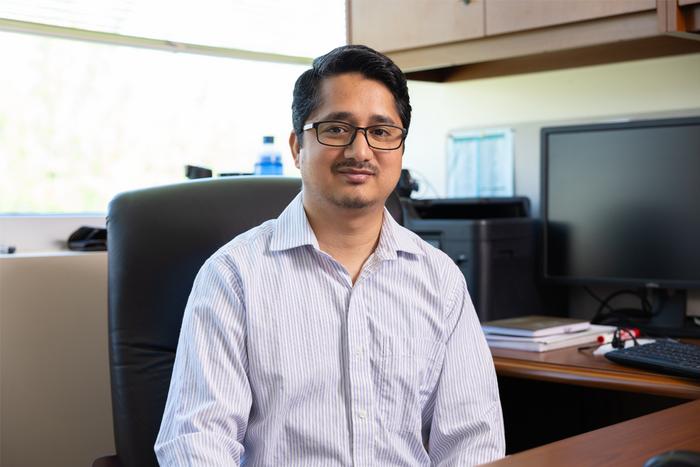
Credit: University of Central Florida
Writer: Bel Huston
ORLANDO, April 25, 2024 – Computer vision can be a valuable tool for anyone tasked with analyzing hours of footage because it can speed up the process of identifying individuals. For example, law enforcement may use it to perform a search for individuals with a simple query, such as “Locate anyone wearing a red scarf over the past 48 hours.”
With video surveillance becoming more and more ubiquitous, Assistant Professor Yogesh Rawat, a researcher at the UCF Center for Research in Computer Vision (CRCV), is working to address privacy issues with advanced software installed on video cameras. His work is supported by $200,000 in funding from the U.S. National Science Foundation’s Accelerating Research Translation (NSF ART) program.
“Automation allows us to watch a lot of footage, which is not possible by humans,” Rawat says. “Surveillance is important for society, but there are always privacy concerns. This development will enable surveillance with privacy preservation.”
His video monitoring software protects the privacy of those recorded by obscuring select elements, such as faces or clothing, both in recordings and in real time. Rawat explains that his software adds perturbations to the RGB pixels in the video feed – the red, green and blue colors of light – so that human eyes are unable to recognize them.
“Mainly we are interested in any identifiable information that we can visually interpret,” Rawat says. “For example, for a person’s face, I can say ‘This is that individual,’ just by identifying the face. It could be the height as well, maybe hair color, hair style, body shape — all those things that can be used to identify any person. All of this is private information.”
Since Rawat aims to have the technology available in edge devices, devices that are not dependent on an outside server such as drones and public surveillance cameras, he and his team are also working on developing the technology so that it’s fast enough to analyze the feed as it is received. This poses the additional challenge of developing algorithms that can process the data as quickly as possible, so that graphics processing units (GPUs) and central processing units (CPUs) can handle the workload of analyzing footage as it is captured.
To that end, his main considerations in implementing the software are speed and size.
“We want to do this very efficiently and very quickly in real time,” Rawat says. “We don’t want to wait for a year, a month or days. We also don’t want to take a lot of computing power. We don’t have a lot of computing power in very small GPUs or very small CPUs. We are not working with large computers there, but very small devices.”
The funding from the NSF ART program will allow Rawat to identify potential users of the technology, including nursing homes, childcare centers and authorities using surveillance cameras. Rawat is one of two UCF researchers to have projects initially funded through the $6 million grant awarded to the university earlier this year. Four more projects will be funded over the next four years.
His work builds on several previous projects spearheaded by other CRCV members, including founder Mubarak Shah and researcher Chen Chen, including extensive work that allows analysis of untrimmed security videos, training artificial intelligence models to operate on a smaller scale and a patent on software that allows for the detection of multiple actions, persons and objects of interest. Funding sources for these works include $3.9 million from the IARPA Biometric Recognition and Identification at Altitude and Range program, $2.8 million from Intelligence Advanced Research Projects Activity (IARPA) Deep Intermodal Video Analysis, and $475,000 from the U.S Combating Terrorism Technical Support Office.
Rawat says his work in computer vision is motivated by a drive to improve our world.
“I’m really interested in understanding how we can easily navigate in this world as humans,” he says. “Visual perception is something I’m very interested in studying, including how we can bring it to machines and make things easy for us as humans and as a society.”
About the Researcher
Yogesh S. Rawat is an assistant professor at the Center for Research in Computer Vision at UCF. He earned his Ph.D. in computer science at the National University of Singapore and completed his postdoctoral training in the Center for Research in Computer Vision at UCF from 2017 to 2019. He obtained his bachelor’s degree in computer science and engineering from the Indian Institute of Technology in Varanasi in 2009.
Cite Scienmag News
Blake Davidson. (April 25, 2024). Computer vision researcher develops privacy software for surveillance videos. Scienmag. https://scienmag.com/computer-vision-researcher-develops-privacy-software-for-surveillance-videos/
Blake Davidson. "Computer vision researcher develops privacy software for surveillance videos." Scienmag, 25 April 2024, https://scienmag.com/computer-vision-researcher-develops-privacy-software-for-surveillance-videos/. Accessed 6 September 2026.
Blake Davidson. "Computer vision researcher develops privacy software for surveillance videos." Scienmag. April 25, 2024. https://scienmag.com/computer-vision-researcher-develops-privacy-software-for-surveillance-videos/

