

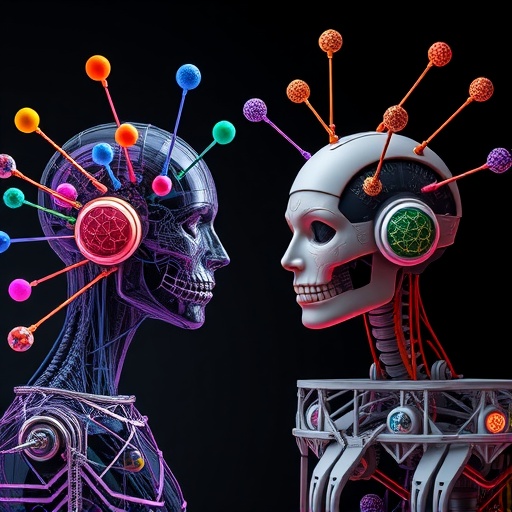
In an era where technological advances have blurred the lines between human and artificial creativity, a recent study presents a fascinating exploration into the comparative strengths of humans and large language models (LLMs) in generating novel ideas. The research, led by prominent scholars Wang, D., Huang, D., and Shen, H., uncovers critical insights into the creative output of individuals versus that of advanced AI systems. By analyzing a substantial dataset comprising over 215,000 observations from LLMs alongside 9,198 instances from human participants, the study redefines our understanding of creativity in the context of collaboration between humans and machines.
Initial findings indicate that human creativity, on average, surpasses that of LLMs. While this may be expected given the complexity of human thought, the implications are profound. Creativity spans unique and unconventional ways of thinking, expressing emotions, and drawing from diverse experiences — facets that AI cannot fully replicate. This study highlights that, on a foundational level, humans retain a inherent advantage when it comes to creative ideation. Such results could impact how we design future collaborations between humans and AI, depending on the nuances of creative tasks at hand.
Interestingly, the research also delves into the variability of creativity within individuals and AI-generated outputs. Humans displayed a higher degree of variability, especially at the extremes of the creativity spectrum. In simpler terms, while most humans produced creative outputs that were somewhat standard, a segment of human participants produced ideas characterized by exceptionally high creativity. This right-hand tail of the creativity distribution, populated by particularly innovative thinkers, challenges the notion that machines can replicate or exceed human output across all ranges. This finding elevates the conversation about the irreplaceable role of human intuition and insight in creative endeavors.
Moreover, the researchers explored attempts to amplify the creativity of LLMs through specific methodologies, such as instructing the models to adopt ‘genius’ personas or various demographic roles. Surprisingly, this approach raised the models’ outputs to a certain level of creativity, yet performance peaked and took a downturn thereafter. This phenomenon raises critical questions about the limits of prompt engineering in eliciting creative responses from AI systems. Instead of fostering creativity, excessive direction seemed to skew the generated outputs in unfavorable directions, essentially leading to results that contradicted typical human patterns.
The implications of these findings extend beyond creative tasks to broader domains of problem-solving and innovation. As we navigate the complexities of societal challenges, understanding the strengths and limitations of humans and machines in creative partnerships becomes crucial. This research encourages us to rethink how we harness human creativity alongside machine intelligence, potentially leading to innovative approaches in various sectors, ranging from business to public policy.
Nonetheless, the study does highlight a growing interest in human-machine collaboration as a dynamic force in tackling grand societal challenges. As LLMs continue to evolve, identifying specific areas where they excel or falter in creative tasks could allow for more tailored applications suited to either human or machine intelligence. Finding harmony in this partnership will arguably be essential to maximizing overall creative output, paving the way for even greater advancements.
In addition, the authors stress the necessity of a nuanced understanding of creativity. While LLMs have demonstrated an ability to generate ideas, distinguishing between novelty and true creativity is important. Creativity entails not only generating seemingly original ideas but also translating them into meaningful context and relevance. This distinction may be a key factor indicating that LLMs, while capable of producing output that appears innovative on the surface, lack the capability to imbue this creativity with personal or cultural significance.
As curiosity continues to grow around the role of AI in creativity, this research spotlights the complexities surrounding AI’s potential in creative tasks. The authors emphasize that while LLMs can aid creativity, they should be viewed as tools rather than replacements for human ingenuity. The strategic integration of AI can potentially lead to enhanced productivity and innovation, provided we remain conscious of the distinct attributes each entity brings to the table.
Despite the promising findings, future research is critical to further delineate the creative capacities of LLMs and refine techniques for human-machine collaboration. The adoption of such advanced technologies poses the question of optimal practices in encouraging creativity while ensuring the output remains relevant and resonant with human experiences. Continued investigation will not only enrich academic discourse surrounding creativity but will also shape practical applications in various industries as the lines between human creativity and artificial intelligence continue to evolve.
As we witness the intersecting realms of human and machine intelligence, the results from this study push us to ask essential questions about the future of creativity. How do we redefine creativity in a world where human and machine outputs coexist, and how do we nurture an environment where both can thrive? Our understanding of these paradigms will undoubtedly influence the trajectory of innovation in the years to come, guiding how society addresses contemporary challenges through creativity, collaboration, and technological advancements.
Ultimately, the pivotal discoveries from this study beckon us to consider the future carefully. While AI-driven models like LLMs present endless possibilities, understanding and facilitating the unique mechanisms underlying human creativity will be instrumental in driving forward-thinking initiatives. In embracing both human intuition and machine efficiency, we can cultivate a new realm of creativity that actively engages both voices in ways that empower, inspire, and elevate the human experience.
The journey toward forging effective human-machine partnerships is only beginning, and as we move forward, we must remain committed to fostering environments where creativity flourishes regardless of the source. Both human ingenuity and machine learning have integral roles to play in shaping the innovative landscape ahead, creating a powerful synergy that can catalyze unprecedented growth, exploration, and discovery.
Subject of Research: Creative output comparison between humans and large language models (LLMs).
Article Title: A large-scale comparison of divergent creativity in humans and large language models.
Article References:
Wang, D., Huang, D., Shen, H. et al. A large-scale comparison of divergent creativity in humans and large language models.
Nat Hum Behav (2025). https://doi.org/10.1038/s41562-025-02331-1
Image Credits: AI Generated
DOI: https://doi.org/10.1038/s41562-025-02331-1
Keywords: Human creativity, AI creativity, large language models, innovation, creative tasks, human-machine collaboration.


