

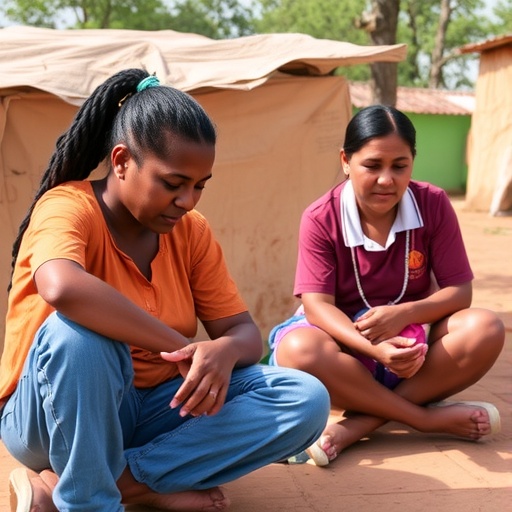
In a groundbreaking stride towards combatting Chagas disease, researchers have unveiled a pioneering community-based approach tailored specifically for migrant populations. This innovative methodology promises to revolutionize how health systems address this often neglected tropical disease by anchoring efforts within the very communities most affected. Chagas disease, a parasitic infection caused by the protozoan Trypanosoma cruzi, predominantly affects impoverished and marginalized groups, with migrants being particularly vulnerable due to their mobility and limited access to healthcare. Addressing this challenge necessitates novel, culturally sensitive, and scalable strategies that transcend traditional clinical settings.
At the heart of this new approach is the recognition that effective coverage requires more than mere distribution of diagnostics and treatments; it demands deep engagement with community members, understanding their unique socio-economic realities, and empowering them to act as active participants in disease management. The research, spearheaded by Gómez i Prat and colleagues, illustrates how leveraging local social networks, community health workers, and migrant leaders can break down barriers to testing and treatment uptake, which have historically hampered efforts to control Chagas disease.
The disease’s transmission pathways, including vector-borne spread by triatomine insects and congenital transmission from mother to child, complicate eradication efforts, particularly in non-endemic countries where awareness is low. Migrant populations often reside in urban environments far removed from traditional vector habitats, yet they remain at risk through congenital routes and blood transfusions. Therefore, healthcare providers in host countries face the difficult task of identifying asymptomatic carriers who might not seek medical attention. By embedding disease control initiatives within community frameworks, this approach enhances early detection and timely intervention.
One of the core technical innovations involves deploying culturally adapted rapid diagnostic tests (RDTs) in accessible settings such as community centers, places of worship, and migrant support organizations. These RDTs, combined with mobile health technologies, enable real-time data collection and monitoring, fostering immediate linkage to care. Moreover, the model incorporates educational campaigns designed in migrants’ native languages, demystifying the disease and dispelling myths that often deter individuals from seeking care.
The researchers deployed a mixed-methods strategy, blending epidemiological surveillance with qualitative assessments of community perceptions, to fine-tune interventions. This iterative process revealed critical insights into mistrust of healthcare systems, stigma associated with chronic infections, and the impact of legal and economic insecurity on health-seeking behaviors. Addressing these psychosocial factors is integral to sustaining long-term engagement and adherence to treatment regimens, which typically involve prolonged antiparasitic therapies that can have substantial side effects.
Crucially, the team’s framework emphasizes collaboration among multidisciplinary stakeholders, including public health officials, NGOs, clinicians, and community representatives. This multi-sectoral collaboration ensures that interventions are comprehensive, addressing social determinants of health alongside biomedical needs. For example, integrating social support services to assist with housing and employment issues enhances the overall wellbeing of migrants, indirectly fostering better health outcomes.
The implications of this research extend beyond Chagas disease, offering a model for tackling other neglected tropical diseases in mobile and underserved populations worldwide. By shifting from top-down to bottom-up health strategies, the approach aligns with global health equity goals, promoting inclusivity and resilience. The research underscores that sustainable disease control is attainable only through genuinely participatory frameworks that acknowledge and incorporate the lived experiences of marginalized groups.
This novel community-based approach was piloted in multiple urban centers hosting significant Latin American migrant populations, yielding promising preliminary outcomes. Screening rates improved markedly, and treatment initiation among seropositive individuals rose substantially compared to traditional facility-based programs. Additionally, the approach facilitated identification of previously unknown cases, enabling early intervention and reducing the long-term burden of cardiac and gastrointestinal complications associated with chronic Chagas disease.
A particularly innovative element is the utilization of community health workers drawn from the migrant population itself. These workers bridge cultural and linguistic divides, fostering trust and ensuring continuity of care. Their role extends beyond health education to advocacy and navigation of complex healthcare bureaucracies, which is pivotal for populations often hindered by legal status concerns and language barriers.
Technological integration also played a vital role. Digital platforms offered multilingual interfaces through which migrants could access testing information, schedule appointments, and receive treatment follow-up reminders. These platforms doubled as data hubs for researchers and policymakers, enabling dynamic tracking of intervention impact and facilitating rapid adjustments to program design.
Nevertheless, challenges remain in scaling this model sustainably. Securing consistent funding, ensuring policy support across multiple jurisdictions, and maintaining community engagement amidst fluctuating migration patterns require ongoing commitment. Future research will need to explore cost-effectiveness analyses, longitudinal health outcomes, and the adaptability of this model to other emerging infectious diseases within migrant cohorts.
The study’s holistic lens, combining biomedical rigor with anthropological sensitivity, represents a significant advancement in global health praxis. It calls for health systems globally to reconceptualize disease control as a collaborative, context-specific endeavor rather than a one-size-fits-all mandate. With migration on the rise worldwide, such personalized community-centric interventions will become increasingly indispensable.
In summary, by melding innovative diagnostics, culturally resonant education, empowered community health workforces, and integrated digital tools, this research delineates a replicable blueprint for overcoming entrenched barriers to Chagas disease care in migrant populations. It challenges health professionals and policymakers to embrace complexity, prioritize equity, and entrust communities as equal partners in the fight against neglected diseases. The ripple effects of this approach promise not only to ameliorate health disparities today but also to fortify resilience against future global health threats rooted in social vulnerability.
As global health moves toward universal coverage and the Sustainable Development Goals, approaches like this community-based strategy illuminate pathways toward more just and effective healthcare delivery. The innovative framework championed for Chagas disease encapsulates a paradigm shift whereby marginalized communities reclaim agency over their health destinies, transforming vulnerability into strength. Such visionary endeavors herald a new era of compassionate, inclusive, and data-driven public health that could well redefine how the world tackles infectious disease burdens in a rapidly globalizing society.
Subject of Research: Community-based approaches for effective coverage and control of Chagas disease in migrant populations
Article Title: Towards effective coverage of Chagas disease: a community-based approach in migrant populations
Article References: Gómez i Prat, J., Fernández-Torres, P., Guiu, I.C. et al. Towards effective coverage of Chagas disease: a community-based approach in migrant populations. Int J Equity Health (2026). https://doi.org/10.1186/s12939-026-02756-8
Image Credits: AI Generated


