


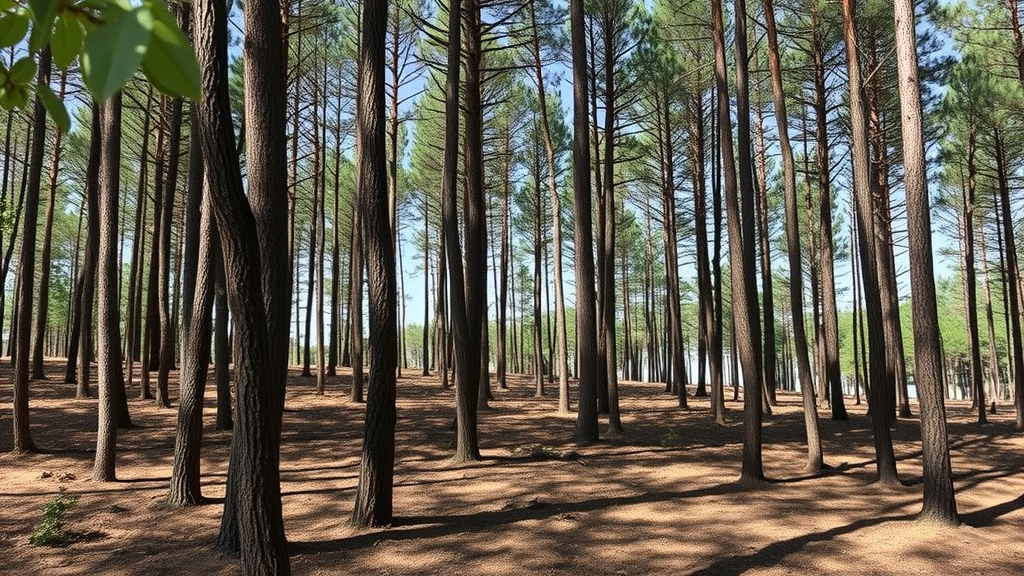
Along the southern shores of the Caspian Sea, the Hyrcanian forests of Gilan Province in northern Iran form one of the world’s most distinctive temperate deciduous ecosystems, rich in endemic species and shaped by heavy rainfall, steep mountain slopes, and a narrow coastal plain that climbs rapidly toward the Alborz Mountains. A new study published in Environmental and Sustainability Indicators has taken the most detailed look yet at decades of reforestation work in the eastern part of this province, mapping every recorded planting site between 1990 and 2025 and then building a computer model that simulates how the forest will respond to different policy choices through 2030 and beyond. The results carry a blunt message: planting trees is not enough, and without the active involvement of local communities, even well-funded reforestation programs are likely to lose ground.
The research team, led by Fatemeh Ahmadloo and Mahmoud Bayat with Pete Bettinger and Saeedeh Eskandari, focused on eight counties in eastern Gilan—Amlash, Astaneh Ashrafieh, Rasht, Rudbar, Rudsar, Siahkal, Lahijan, and Langarud—which together account for more than 85 percent of all reforestation projects recorded by the provincial natural resources administration over the 35-year study period. Using GPS field surveys, the GPS Fields Area Measure application, Google Earth imagery, and ArcGIS processing of Landsat satellite data, the team documented 1,859 individual reforestation plots covering 16,735.2 hectares. Rasht County had the highest number of plots, Rudbar County the largest reforested area, and Astaneh Ashrafieh the highest proportion of its land devoted to plantations, at 2.51 percent of the total area of the eastern counties.
Species selection emerged as one of the clearer success factors in the historical record. Fourteen tree species were used across the planting programs, including native species such as Caucasian alder (Alnus subcordata), velvet maple (Acer velutinum), and European ash (Fraxinus excelsior), alongside introduced pines including Pinus taeda, Pinus nigra, Pinus sylvestris, and Pinus pinaster. The analysis indicated that plantings of suitable native species, combined with careful site selection based on slope and soil assessments, performed substantially better than programs that relied on species poorly matched to local conditions. Yet even the best species choices could not overcome the structural problems that emerged repeatedly in project records and interviews with participants: delayed funding allocations, inflation that eroded the purchasing power of maintenance budgets, inconsistent contractor payments, and gaps in fencing and post-planting care.
To move beyond a static description of these problems, the researchers turned to system dynamics modeling, a technique that represents a system as stocks, flows, and feedback loops rather than as a set of independent variables. Built in Vensim software, the model treats forest area as a central stock, initialized at 565,000 hectares, that increases through reforestation—calculated as planting rate multiplied by survival rate—and decreases through degradation driven by livestock grazing, illegal logging, and urban expansion. The survival rate itself is a multiplicative function in which a baseline of 60 percent is modified by climate, grazing pressure, the quality of management and monitoring, and the level of community participation. Under maximum governance deficit, the model’s structure allows seedling survival to fall by as much as 40 percent.
Quantifying abstract social concepts was one of the study’s central methodological challenges. Governance quality was operationalized as a composite index combining patrol deficits, enforcement inefficiency, and protection resource shortages, drawn from administrative and patrol records. Community participation was proxied by reported labor-days in community-based reforestation activities relative to planned targets. Socio-economic conditions combined forestry budget allocations, local livelihood dependency, and regional economic growth from Iranian statistical yearbooks, all normalized to a zero-to-one scale. The team also administered 320 structured questionnaires to professionals across forestry, agricultural extension, and farming sectors, drawn from a target population of 3,138 experts, to ground the model’s social variables in empirical elicitation. Environmental pollution was captured as a composite stress index integrating industrial effluents, agrochemical runoff, and municipal waste leachate from provincial monitoring records.
The model was calibrated against historical forest area data from 1990 to 2015 and then validated on out-of-sample data from 2016 to 2020, producing a root mean square error of 3,210 hectares for forest area, a mean absolute percentage error of 4.8 percent, and a coefficient of determination of 0.89 between simulated and observed values. A paired statistical test revealed a striking historical shift: the mean degradation rate jumped from 124 hectares per year during the 1990s to 598 hectares per year after 2000, a difference the authors attribute to intensified anthropogenic pressures, climate variability, and governance deficits. The model reproduced this shift, and sensitivity analysis showed its outputs were dominated by social and governance variables rather than by climate.
That sensitivity ranking is arguably the study’s most consequential finding. When the researchers perturbed eight key parameters by 20 percent each, community participation had the largest effect on projected forest area in 2030, with an elasticity of 0.45, followed by grazing pressure at 0.38. The planting rate itself, by contrast, showed an elasticity of only 0.10, and the climate modifier had almost no effect, below 0.01. In practical terms, a modest improvement in local engagement moves the needle roughly four times as far as a comparable increase in the number of trees planted. The model also identified a reinforcing feedback loop in which grazing reduces vegetation, which in turn concentrates grazing pressure on remaining cover, a dynamic that currently overwhelms the balancing loop created by reforestation efforts.
The scenario analysis translated these insights into three contrasting futures. Under a business-as-usual trajectory, with participation at 0.20, grazing pressure at 0.45, and a governance deficit index of 0.35, forest area declines from 565,000 hectares in 2025 to roughly 538,200 hectares by 2035, a loss of about 4.7 percent, with the Forest Sustainability Index falling to 0.42. A policy-enforcement-only scenario, which halves the governance deficit but leaves community engagement untouched, slows the decline but still ends below the starting point, with a sustainability index of 0.54. Only the community-based management scenario, which doubles participation, cuts grazing pressure by 30 percent, and reduces the governance deficit by a quarter, reverses the trend, projecting forest area to rise to about 581,400 hectares by 2035 and lifting the sustainability index to 0.78, the only result meeting the study’s benchmark of at least 0.75.
These findings align with a broader international literature on community-based forest management. The authors point to Nepal, where community involvement has produced notable gains in forest density and biodiversity, and to Tanzania, where participatory forest management has contributed to reduced deforestation. In Gilan, the stakes are heightened by the sheer scale of human pressure on the forest: approximately 15,000 households, dependent on roughly one million livestock units, rely on forest resources for their livelihoods. Without alternative income sources and inclusive planning, grazing and resource extraction will continue to undermine plantings regardless of how many seedlings go into the ground. The study acknowledges limitations, including the use of administrative proxies for social variables, a static climate modifier that excludes future warming scenarios, spatial aggregation of the entire province into a single unit, and a deterministic structure without uncertainty bounds.
Nevertheless, the core conclusion is difficult to escape. The Hyrcanian forests of Gilan possess favorable climatic and geographic conditions—heavy orographic rainfall, moderate temperatures, abundant water resources, and diverse ecological niches created by sharp elevation gradients from 90 meters below sea level to over 3,700 meters. What limits restoration is not ecology but governance and society: inconsistent funding, weak enforcement, and the exclusion of local communities from decision-making. The authors argue that sustainable reforestation in the region requires an integrated strategy combining community-based management, targeted policies that balance conservation with the needs of forest-dependent people, and enhanced monitoring using remote sensing and geographic information systems. If degradation continues at post-2000 rates, the ecological stability of the Hyrcanian forests and the livelihoods they support face serious long-term risk. If, however, the leverage points identified by the model are acted upon, the study suggests that one of the world’s most biodiverse temperate forests could yet be steered toward recovery.
Subject of Research: System dynamics modeling of reforestation success and policy scenarios in the Hyrcanian forests of Gilan Province, Iran
Article Title: Toward sustainable reforestation in Gilan Province, Iran: Challenges, opportunities, and system dynamics-based insights for forest restoration
Article References: Ahmadloo, F., Bayat, M., Bettinger, P., & Eskandari, S. (2026). Toward sustainable reforestation in Gilan Province, Iran: Challenges, opportunities, and system dynamics-based insights for forest restoration. Environmental and Sustainability Indicators, 32, Article 101516. https://doi.org/10.1016/j.indic.2026.101516
Image Credits: AI Generated
DOI: 10.1016/j.indic.2026.101516
Keywords: reforestation, Hyrcanian forests, system dynamics, Gilan Province, community-based forest management, deforestation, grazing pressure, forest governance, seedling survival, scenario analysis, social-ecological systems, Iran
Cite Scienmag News
Sloane Callahan. (September 20, 2026). Community Power, Not Planting Alone, Decides the Fate of Iran’s Hyrcanian Forests. Scienmag. https://scienmag.com/community-power-not-planting-alone-decides-the-fate-of-irans-hyrcanian-forests/
Sloane Callahan. "Community Power, Not Planting Alone, Decides the Fate of Iran’s Hyrcanian Forests." Scienmag, 20 September 2026, https://scienmag.com/community-power-not-planting-alone-decides-the-fate-of-irans-hyrcanian-forests/. Accessed 4 October 2026.
Sloane Callahan. "Community Power, Not Planting Alone, Decides the Fate of Iran’s Hyrcanian Forests." Scienmag. September 20, 2026. https://scienmag.com/community-power-not-planting-alone-decides-the-fate-of-irans-hyrcanian-forests/


