


Across Sub-Saharan Africa, pregnancy and the months after childbirth can be a period of profound psychological risk. Perinatal depression affects an estimated 10 to 40 percent of women in the region, with some subgroups, including adolescent mothers, reporting rates as high as 60 percent. Yet maternal mental health remains chronically neglected in national policy frameworks and underfunded within health system budgets, leaving millions of women without access to evidence-based care. A new scoping review published in PLOS Mental Health offers the most comprehensive map to date of what is being done about it, and where the gaps remain.
The review, led by Basil H. Aboul-Enein of the University of Massachusetts Dartmouth and the London School of Hygiene & Tropical Medicine, together with Suha Ballout of the University of Washington and Patricia J. Kelly of Thomas Jefferson University, identified 57 peer-reviewed intervention studies conducted across 18 Sub-Saharan African countries between 2000 and March 2026. Guided by the PRISMA Extension for Scoping Reviews and the Arksey and O’Malley framework, the team searched 14 electronic databases for studies reporting mental health outcomes among pregnant and postpartum women who received an educational, training, or other intervention. The breadth of the search reflects the scale of the question: 48 countries lie south of the Sahara Desert, each with distinct sociocultural norms, health system capacities, and patterns of mental distress.
The epidemiological backdrop is sobering. Studies from Ghana, Uganda, Cameroon, Ethiopia, and South Africa have documented postpartum depression rates ranging from 20 percent to over 50 percent. In Cameroon, nearly half of pregnant women reported depressive symptoms during antenatal care visits, and in Uganda, rates were particularly high among adolescent mothers and those with limited social support. The burden is disproportionately concentrated among women facing intersecting vulnerabilities: poverty, food insecurity, HIV infection, unplanned pregnancy, intimate partner violence, and social exclusion. In Benin, women who experienced severe obstetric complications reported elevated psychological distress, especially when compounded by financial hardship or spousal abuse.
Cultural context shapes both the experience of distress and the pathways to care. In many communities, motherhood is idealized, and mental suffering is interpreted through spiritual or moral lenses rather than as a biomedical condition. Women may be expected to endure hardship in silence, and disclosure of emotional vulnerability can be perceived as weakness or moral failing. These norms deter help-seeking, while patriarchal structures often restrict women’s autonomy over health decisions. Traditional and religious remedies frequently serve as the first, and sometimes only, point of contact for distressed mothers. The result is a systemic invisibility: mental disorders among pregnant and postpartum women go unrecognized, unrecorded, and untreated, even as health systems prioritize infectious disease control and maternal mortality reduction.
Against this backdrop, the 57 studies identified by the review reveal a research landscape that is more mature than many observers might expect. Cluster-randomized controlled trials were the most common design, accounting for 24 studies or 42 percent of the evidence base, followed by individual randomized controlled trials at 25 percent and non-randomized quasi-experimental pre-post designs at 23 percent. Geographically, however, the evidence is heavily concentrated: South Africa contributed 16 studies, Kenya nine, and Malawi six, meaning three countries account for more than half of all research, while nine countries were represented by a single study each. Notably, every included study addressed postpartum depression as a primary or secondary outcome; none specifically targeted perinatal anxiety, post-traumatic stress disorder, or suicidal ideation, a concentration the authors flag as a significant finding in itself.
The interventions themselves were remarkably diverse. Seven studies used cognitive behavioral therapy as their primary method, and six of these reported significant reductions in depressive symptoms from baseline to follow-up. Problem-solving therapy appeared in seven interventions, often combined with other modalities; when paired with cognitive behavioral therapy in one Tanzanian trial, it was associated with a 67 percent lower risk of postpartum depression at six months. Other approaches included group psychoeducation, mother-infant bonding programs, arts-based and music-based interventions, group antenatal care, and gender-synchronized programs engaging male partners. Two studies tested antidepressant medication as a comparison arm, finding it less effective than psychological therapies in both cases, a result consistent with Cochrane evidence showing limited data on antidepressant safety and efficacy for postnatal depression.
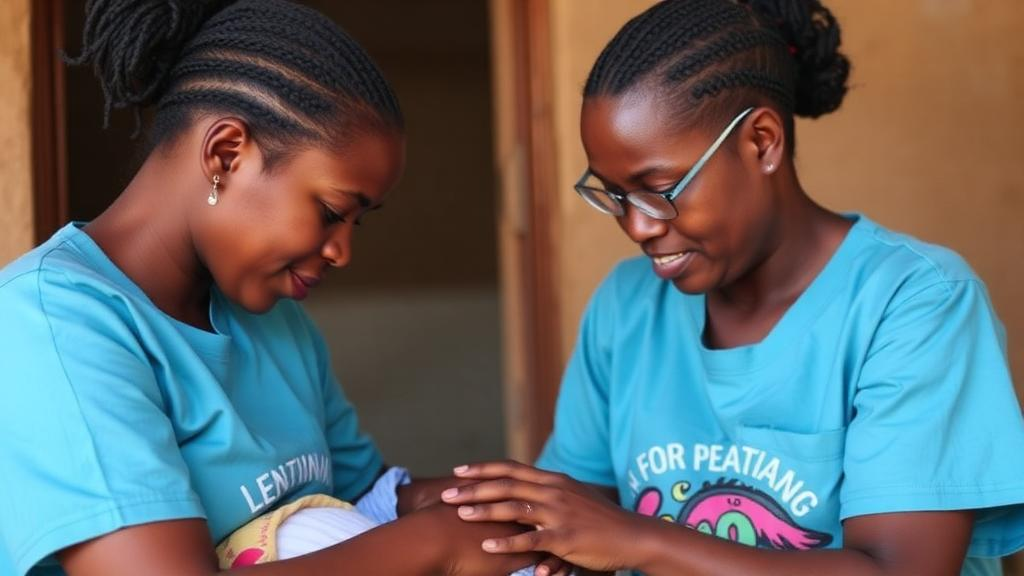
Perhaps the most striking pattern is who delivered the care. Nine studies relied on trained community women, variously described as community health workers, lay health workers, or trusted mothers, to deliver intervention content, and seven evaluated structured home visiting programs by community health workers. By contrast, only two studies used technology such as mobile phone contact or text messaging for delivery. This reliance on non-specialist providers reflects the region’s severe shortage of mental health professionals and aligns with a robust global evidence base. A landmark cluster-randomized trial in rural Pakistan demonstrated that a cognitive behavioral therapy-based intervention delivered by Lady Health Workers nearly halved the risk of perinatal depression, a finding that informed the World Health Organization’s endorsement of the Thinking Healthy Program for low-resource settings. The African trials reviewed here suggest comparable effects can be achieved when care is task-shifted to trained lay workers rather than restricted to professional providers.
The results were not uniformly positive, and the review is candid about this. A substantial minority of studies, particularly among community health worker-delivered and mother-child dyadic interventions, reported no significant between-group differences in maternal mental health outcomes. Four studies tested economic interventions, including cash transfers, agricultural supplies, and food storage strategies, with mixed results: one Malawian analysis found that adding cash transfers to community health worker visits reduced depression scores at follow-up, while a Kenyan agricultural intervention had no effect on psychosocial outcomes. These findings matter because economic stress is consistently identified as a strong predictor of postpartum depression across Africa and beyond, suggesting that poverty-alleviation components may be necessary but not sufficient without accompanying psychosocial support.
The deeper problem, the authors argue, lies not in identifying what works but in translating efficacy into system-level implementation. Almost no studies addressed scalability, health system integration, or cost-effectiveness; only one study in the entire review conducted a cost-effectiveness assessment. Only two interventions operated at the level of clinical practice or provider education, and neither the distribution of a maternal and child health handbook in Angola nor an interprofessional education program for health students changed its primary outcome of care continuity. No research was identified that strengthened midwifery or nursing curricula to include the recognition and management of perinatal depression, despite evidence that many midwives and nurses cannot identify or manage the condition. Scale-up challenges, including financing, ongoing recruitment, training, supervision, and mechanisms to ensure fidelity, were essentially unaddressed in the literature.
The review’s conclusions point toward a clear research and policy agenda. Future efforts should prioritize health professions education, health system strengthening, rigorous evaluation of economic impact, and integration of technology, an area the authors describe as a missed opportunity given the rapid spread of mobile phones across the continent. A parallel scoping review by the same team of postpartum depression interventions in South Asia reached a strikingly similar conclusion: effective interventions exist, and the pressing gap is political and policy commitment to scale delivery. For the millions of women across Sub-Saharan Africa whose distress remains unseen, the evidence now shows that culturally acceptable, feasible, and largely effective treatments can be delivered by trusted community members. What remains is the harder work of building systems that make those treatments available to every mother who needs them.
Subject of Research: Perinatal mental health interventions in Sub-Saharan Africa
Article Title: Unseen and underserved: A scoping review of perinatal mental health interventions in Sub-Saharan Africa
Article References: Aboul-Enein, B. H., Ballout, S., & Kelly, P. J. (2026). Unseen and underserved: A scoping review of perinatal mental health interventions in Sub-Saharan Africa. PLOS Mental Health, 3(10), e0000739. https://doi.org/10.1371/journal.pmen.0000739
Image Credits: AI Generated
DOI: 10.1371/journal.pmen.0000739
Keywords: perinatal depression, maternal mental health, Sub-Saharan Africa, community health workers, cognitive behavioral therapy, task-sharing, scoping review, postpartum depression, global health, mHealth, health systems, cash transfers
Cite Scienmag News
Glenn Wilkins. (October 11, 2026). Community Health Workers Show Promise for Treating Perinatal Depression Across Africa. Scienmag. https://scienmag.com/community-health-workers-show-promise-for-treating-perinatal-depression-across-africa/
Glenn Wilkins. "Community Health Workers Show Promise for Treating Perinatal Depression Across Africa." Scienmag, 11 October 2026, https://scienmag.com/community-health-workers-show-promise-for-treating-perinatal-depression-across-africa/. Accessed 11 October 2026.
Glenn Wilkins. "Community Health Workers Show Promise for Treating Perinatal Depression Across Africa." Scienmag. October 11, 2026. https://scienmag.com/community-health-workers-show-promise-for-treating-perinatal-depression-across-africa/


