


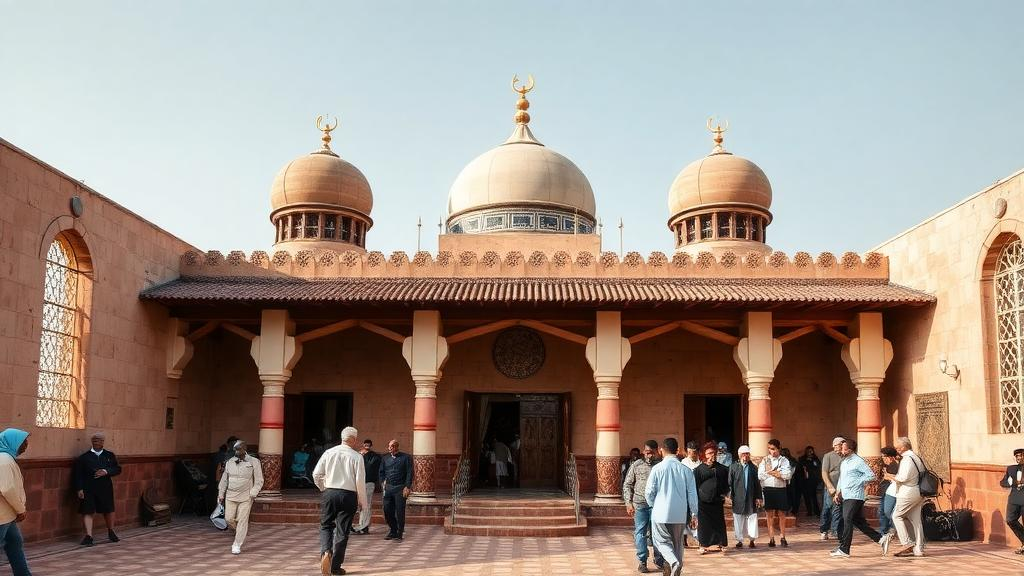
A new historical study examines how Gata Majlis, a local centre of Islamic learning in nineteenth-century South Wollo, Ethiopia, was founded and kept alive across generations. Published in Humanities and Social Sciences Communications, the research argues that although the scholar Haji Bushra was central to the centre’s formation, its survival depended on a much wider circle of people who sustained instruction, preserved manuscripts and maintained community relationships long after his death.
Scholarship on Islam in Ethiopia has explored religious authority, scholarly networks and Muslim communities, but the authors note that less attention has been paid to how local centres of Islamic learning were established and sustained over time. The study addresses that gap through three linked questions: how Haji Bushra’s scholarly authority shaped Gata Majlis’s formation, how learning continued after his death, and how later generations remembered his role.
The researchers drew on 20 manuscripts together with institutional and historical records, 12 semi-structured interviews and two focus-group discussions, alongside published scholarship. Of the manuscripts, eight were selected for detailed analysis based on provenance, relevance and textual accessibility, while the remaining twelve served as contextual evidence.
Methodologically, the team applied historical criticism together with textual and thematic analysis. These tools were used to examine four dimensions of the centre’s life: institutional development, knowledge transmission, community participation and historical memory. The authors also place Gata Majlis within the social and political context of nineteenth-century Wollo, and they deliberately distinguish the centre’s institutional history from later traditions of religious memory and pilgrimage that grew around it.
The findings indicate that Haji Bushra was central to the founding of Gata Majlis, but that this founding alone does not explain its continuity. Instruction was carried forward by teachers and students, manuscripts were preserved by custodians, and material support and community relationships were maintained by families and local supporters. The centre’s endurance, in other words, was a collective achievement rather than the extension of a single scholar’s lifetime.
The surviving manuscripts provide stronger evidence of Gata’s intellectual tradition and of how it was transmitted over time. Because the texts can be traced and analysed, they anchor the study’s account of knowledge transmission in textual evidence rather than in recollection alone, even as interviews and focus groups document how the community remembers the period.
The study contributes to Ethiopian Islamic historiography by showing how Islamic learning was sustained through community participation, educational practices and manuscript preservation beyond the lifetime of a prominent scholar. This framing shifts attention from influential individuals to the people and practices that carried their traditions across generations, a distinction the authors present as necessary for writing the history of Islamic education accurately.
As the authors conclude, Gata Majlis offers a close example of why the history of Islamic education must account not only for influential scholars but also for the teachers, students, custodians, families and local supporters who kept their traditions alive.
The article was published open access on 24 October 2026 and is currently available as a peer-reviewed accepted version that will be replaced by the final Version of Record.
Subject of Research: Haji Bushra of Gata and the making of Islamic education in nineteenth-century South Wollo, Ethiopia: institutional formation and community agency
Article Title: Haji Bushra of Gata and the making of Islamic education in nineteenth-century South Wollo, Ethiopia: institutional formation and community agency
Article References: Naizgi, A. K., & Fentaw, W. D. (2026). Haji Bushra of Gata and the making of Islamic education in nineteenth-century South Wollo, Ethiopia: institutional formation and community agency. Humanities and Social Sciences Communications. https://doi.org/10.1057/s41599-026-09405-z
Image Credits: AI Generated
DOI: 10.1057/s41599-026-09405-z
Keywords: Islamic education, Ethiopia, history, manuscripts, South Wollo, historiography, community agency, Humanities and Social Sciences Communications, Haji, Bushra, Gata, making
Cite Scienmag News
Courtney Benton. (October 24, 2026). Community effort, not one scholar, sustained a nineteenth-century Ethiopian Islamic learning centre. Scienmag. https://scienmag.com/community-effort-not-one-scholar-sustained-a-nineteenth-century-ethiopian-islamic-learning-centre/
Courtney Benton. "Community effort, not one scholar, sustained a nineteenth-century Ethiopian Islamic learning centre." Scienmag, 24 October 2026, https://scienmag.com/community-effort-not-one-scholar-sustained-a-nineteenth-century-ethiopian-islamic-learning-centre/. Accessed 24 October 2026.
Courtney Benton. "Community effort, not one scholar, sustained a nineteenth-century Ethiopian Islamic learning centre." Scienmag. October 24, 2026. https://scienmag.com/community-effort-not-one-scholar-sustained-a-nineteenth-century-ethiopian-islamic-learning-centre/


