


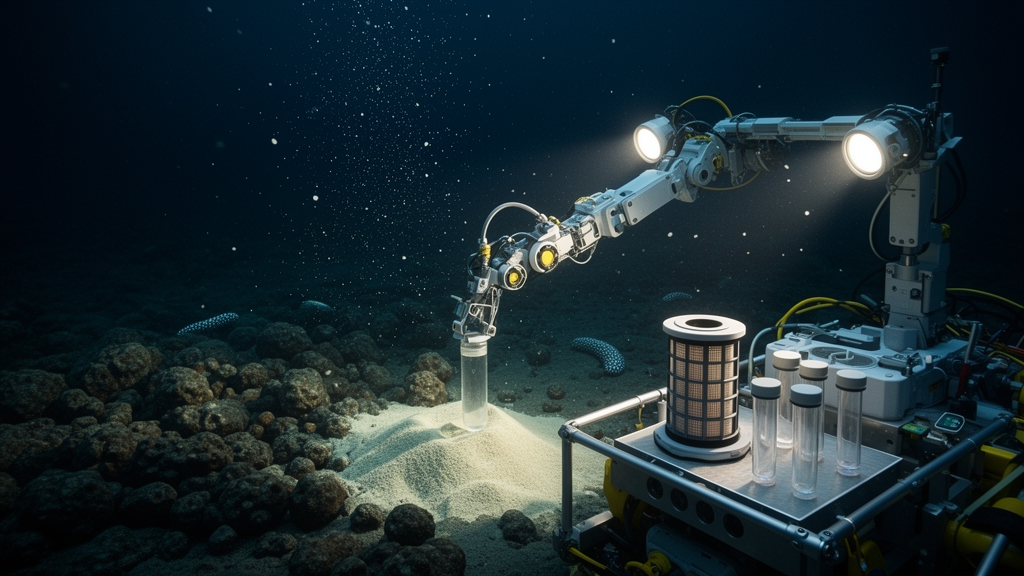
The deep seafloor is Earth’s largest ecosystem, covering more than 60 percent of the planet’s surface, and its abyssal plains are the most extensive benthic environments on the planet. Yet these remote expanses are now under pressure from a new industrial frontier: polymetallic nodule mining. In the Clarion–Clipperton Fracture Zone (CCZ) of the Northeast Pacific Ocean, an estimated 21 billion tons of manganese nodules rich in copper, nickel and cobalt have made the region a prime target for future extraction. Before any mining begins, scientists need reliable ways to measure the biodiversity that could be lost. A new study published in Metabarcoding and Metagenomics offers a sobering lesson about how the choice of DNA extraction method can dramatically change what we think lives down there.
The research team, working with samples collected during the 2018 MANGAN expedition aboard the RV Sonne, compared two fundamentally different DNA extraction strategies for assessing benthic metazoan diversity. The first, called community DNA (ComDNA), involves physically isolating the tiny animals—meiofauna—from the sediment before extracting their DNA. The second, sedimentary environmental DNA (SedDNA), extracts DNA directly from whole sediment samples. Both approaches were applied to sediment cores collected from 19 stations in the eastern part of the BGR contract area, at water depths of roughly 4,000 to 4,100 meters.
The results were striking. ComDNA extractions yielded 2,145 metazoan operational taxonomic units (OTUs), while SedDNA recovered only 392 OTUs from the same cores. Even more remarkable, only 1.2 percent of OTUs were shared between the two methods. Of the 2,507 total OTUs detected across both strategies, 2,115 were unique to ComDNA and 362 were unique to SedDNA. This means the two approaches are not simply capturing the same community with different efficiency—they are detecting substantially different subsets of the fauna.
The statistical analyses reinforced this picture. Non-metric multidimensional scaling based on both Bray–Curtis and Jaccard distances revealed two distinct, non-overlapping benthic communities corresponding to the two extraction strategies. A pairwise PERMANOVA confirmed that extraction method had a highly significant effect on community composition (p < 0.001), while sampling location did not. OTU richness was significantly greater in the ComDNA dataset (p < 0.01), and Shannon diversity followed the same pattern (p < 0.05).
Taxonomically, both methods detected Annelida as the dominant phylum by relative read abundance—50.5 percent in ComDNA and 58.8 percent in SedDNA. However, the composition beneath that headline differed. In ComDNA, Nematoda accounted for 23.2 percent of reads, followed by Arthropoda (14.3 percent) and Nemertea (6.5 percent). In SedDNA, Arthropoda came second (19.5 percent) and Nematoda third (6.7 percent). Four phyla—Hemichordata, Loricifera, Chaetognatha and Entoprocta—were detected exclusively in ComDNA samples, likely because their small, free-swimming larval stages or soft bodies are captured by the organismal enrichment process but missed by direct sediment extraction.
The underlying reason for the gap is partly technical. ComDNA extraction concentrates the target organisms through sieving and centrifugation, reducing non-target DNA and PCR inhibitors while improving DNA yield and quality. In the ComDNA dataset, 6.29 percent of high-quality reads were assigned to metazoans, representing 75.7 percent of OTUs. In the SedDNA dataset, only 1.27 percent of reads and 25.9 percent of OTUs were metazoan. The rest of the signal came from fungi and diverse microeukaryotes, which swamp the metazoan signal when DNA is extracted from raw sediment.
Recognizing that SedDNA is far more practical for large-scale monitoring—it requires no onboard sieving, reduces contamination risk, and allows many more samples to be processed—the researchers modeled how much sediment would need to be processed to match the OTU richness achieved by ComDNA. Using random subsampling of sample combinations and fitting both linear and Michaelis–Menten models, they estimated that between 27 and 82 milliliters of sediment would be required, depending on sequencing depth and statistical approach. By comparison, the ComDNA protocol processed 217 milliliters of sediment per sample. At a sequencing depth of 100,000 reads per sample, the Michaelis–Menten model suggested approximately 38.8 milliliters would suffice.
The study also highlights the importance of sediment homogenization. Deep-sea benthic communities exhibit pronounced spatial heterogeneity, even at microhabitat scales, and meiofauna often cluster in patches rich in organic matter. Homogenizing the entire sediment volume before subsampling would help ensure that the DNA extract reflects the underlying community rather than a localized hotspot. However, this comes with a trade-off: homogenization eliminates vertical stratification, obscuring depth-dependent patterns in community structure. The authors recommend homogenizing each sediment layer separately if vertical resolution is needed.
For environmental impact assessments ahead of deep-sea mining, the message is clear. ComDNA extraction remains the more reliable strategy for establishing high-resolution biodiversity baselines, despite its greater cost and labor. SedDNA approaches, with optimized protocols—larger sample volumes, homogenization, and sequencing depths of at least 100,000 reads per sample—hold promise for scalable monitoring programs, particularly where rapid, broad-scale surveys are needed. The authors also call for further methodological research, including the evaluation of technical PCR replicates and standardized sediment processing protocols, to refine sediment-based eDNA approaches before they can be trusted for regulatory decisions in one of the planet’s last unexplored frontiers.
Subject of Research: Comparison of community DNA and sedimentary eDNA metabarcoding for deep-sea benthic biodiversity assessment
Article Title: Community DNA outperforms eDNA metabarcoding for biodiversity assessments in the Clarion–Clipperton Fracture Zone
Article References: Damm, L., Khodami, S., Rubel, V., Molari, M., Vink, A., Stoeck, T., & Martinez Arbizu, P. (2026). Community DNA outperforms eDNA metabarcoding for biodiversity assessments in the Clarion–Clipperton Fracture Zone. Metabarcoding and Metagenomics, 10, Article e173793. https://doi.org/10.3897/mbmg.10.173793
Image Credits: AI Generated
Keywords: eDNA metabarcoding, community DNA, Clarion–Clipperton Fracture Zone, deep-sea mining, meiofauna, benthic biodiversity, polymetallic nodules, environmental DNA, DNA extraction, 18S rRNA, deep-sea monitoring, environmental impact assessment
Cite Scienmag News
Margaret Porter. (October 17, 2026). Community DNA Outperforms Sediment eDNA for Deep-Sea Biodiversity Monitoring in the Clarion–Clipperton Zone. Scienmag. https://scienmag.com/community-dna-outperforms-sediment-edna-for-deep-sea-biodiversity-monitoring-in-the-clarion-clipperton-zone/
Margaret Porter. "Community DNA Outperforms Sediment eDNA for Deep-Sea Biodiversity Monitoring in the Clarion–Clipperton Zone." Scienmag, 17 October 2026, https://scienmag.com/community-dna-outperforms-sediment-edna-for-deep-sea-biodiversity-monitoring-in-the-clarion-clipperton-zone/. Accessed 17 October 2026.
Margaret Porter. "Community DNA Outperforms Sediment eDNA for Deep-Sea Biodiversity Monitoring in the Clarion–Clipperton Zone." Scienmag. October 17, 2026. https://scienmag.com/community-dna-outperforms-sediment-edna-for-deep-sea-biodiversity-monitoring-in-the-clarion-clipperton-zone/


