

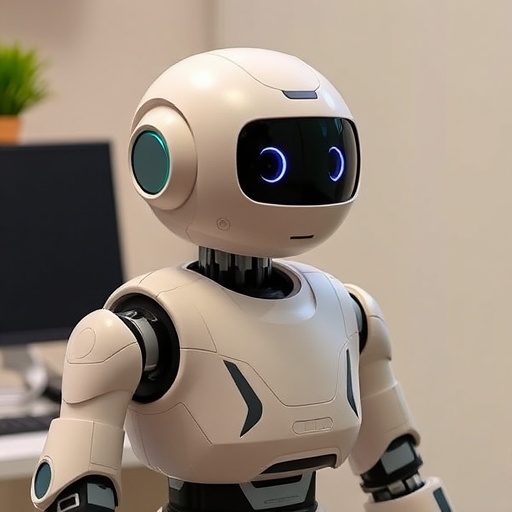
In an era where mental well-being is increasingly recognized as a global health priority, loneliness—especially among the elderly—poses a formidable challenge. Addressing this issue, a pioneering research team from The Hong Kong Polytechnic University (PolyU) has uncovered the transformative potential of integrating music and empathetic speech into AI-driven robots designed to provide companionship. This innovative approach reveals how such multimodal empathetic interactions can deepen human-robot bonds, offering new pathways for psychological support and social connection in diverse settings.
The interdisciplinary project, led by Prof. Johan Hoorn, an interfaculty full professor specializing in social robotics at PolyU, alongside Dr. Ivy Huang from The Chinese University of Hong Kong, undertook a methodical examination of how affective elements like music combined with empathetic verbal communication enhance the perceived emotional resonance of robotic interlocutors. Their findings, published in the esteemed ACM Transactions on Human-Robot Interaction, demonstrate that music not only complements empathetic speech but also contributes significantly to fostering rapport and empathy during human-machine interactions.
Crucially, the study engaged Cantonese-speaking participants across multiple interactive sessions, tracking their emotional responses and connection to on-screen robots programmed with sophisticated speech and musical outputs. The experimental design capitalized on the concept that music, when intertwined with empathetic dialogue, could serve as an emotional amplifier—making robotic interactions feel more natural, comforting, and socially present. Participants reported heightened perceptions of the robots’ empathy when music accompanied speech, underscoring music’s role as a vital adjunct in humanizing artificial agents.
Prof. Hoorn explained the underlying mechanisms, noting that music enriched the robot’s ‘persona’ by evoking qualities akin to those in human conversations. Just as counselors or therapists might use music to soothe and build therapeutic rapport, robots employing tailored musical elements established an affective context that augmented their social realism and emotional presence. This synthesis of modalities nurtures what experts call ‘social presence,’ the sense that the robot is a genuine conversational partner rather than a mechanical entity.
However, the research also identified critical nuances related to repeated exposures. Over time, as participants became accustomed to the musical elements, the initial emotional potency diminished, suggesting the necessity for dynamic and adaptive interaction strategies. Sustaining empathy and relevance in prolonged engagements requires personalized modulation—robots must be capable of altering musical features, such as tempo, key, or instrument timbre, and progressively refining dialogue to maintain emotional significance. This adaptability aligns with the broader aim of developing social robots that evolve responsively in their relationships with users.
The implications of this study extend far beyond experimental settings, heralding new horizons for the deployment of empathetic robots in healthcare and social services. Mental health support and elderly care represent domains ripe for the infusion of AI companions that can provide not only conversational engagement but also emotional solace through multimodal expression. These robots could alleviate feelings of isolation, offering companionship that is tuned to the individual’s psychological state and social needs.
Building on these findings, Prof. Hoorn’s ongoing work explores integrating large language models within social robots, funded by a substantial HK$40 million grant. This project aims to create robotic systems that facilitate stress relief among Hong Kong’s population by harnessing advanced conversational AI alongside empathetic musical interventions. Such sophisticated coupling of natural language understanding and emotional sensitivity promises to elevate human-robot interactions to unprecedented levels of subtlety and responsiveness.
Simultaneously, Prof. Hoorn is investigating quantum-inspired models to better capture human affect’s inherent ambiguity and fluidity. Traditional computational frameworks may struggle with the probabilistic and context-dependent nature of emotions. Quantum models, by contrast, conceptualize emotional states as superpositions, reflecting real-life uncertainty and complexity. Incorporating such paradigms into social robots could yield machines that genuinely appreciate and accommodate the multifaceted spectrum of human feelings.
This visionary research invites us to reimagine the role of AI in society — not merely as tools or automatons but as empathetic companions capable of meaningful interpersonal connection. By embracing multimodal communication strategies that integrate music, speech, and adaptive learning, the next generation of social robots stands poised to transform caregiving, education, and mental health support profoundly.
The study underscores the critical role of design sophistication in building trust and emotional engagement between humans and artificial agents. Emotional contagion, where music enhances affective states, and empathetic speech that recognizes and responds to user emotions are vital components in this design. The fusion of these elements could substantially mitigate loneliness and social isolation, conditions shown to elevate risks for depression, cognitive decline, and physical health deterioration.
As this research continues to evolve, ethical and practical considerations around personalization, privacy, and user autonomy will come to the forefront. Ensuring that empathetic robots adapt sensitively without becoming intrusive or predictable will be crucial for their acceptance and efficacy. Moreover, the scalable deployment of such systems requires robust frameworks that balance technical innovation with human-centered values.
Ultimately, the work from PolyU offers a compelling glimpse into an AI-augmented future, where social robots infused with the soulful power of music and nuanced empathetic speech are partners in promoting well-being. Through continuous, context-aware adaptation and quantum-informed affective modeling, these intelligent companions could redefine the landscape of emotional support, bridging the gap between isolation and companionship.
Subject of Research: Integration of music and empathetic speech in AI-driven social robots to enhance human-robot emotional interactions and companionship.
Article Title: A Talking Musical Robot over Multiple Interactions: After Bonding and Empathy Fade, Relevance and Realism Arise
News Publication Date: 28-Oct-2025
Web References: https://dl.acm.org/doi/10.1145/3758102
References: ACM Transactions on Human-Robot Interaction
Image Credits: polyu
Keywords: Robotics, Artificial intelligence, Quantum computing, Psychological science, Music, Linguistics


