

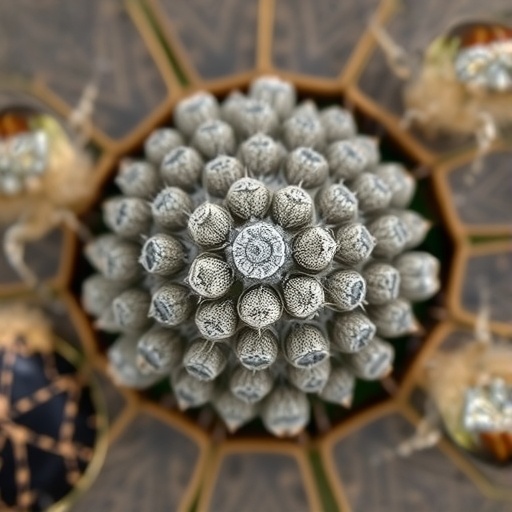
In the underwater realms where the tapestry of life unfolds in vivid hues and bizarre forms, one remarkable organism has emerged from the shadows in recent scientific exploration: Porpita porpita. This tiny yet captivating hydrozoan, often referred to as the blue button jellyfish, offers a unique perspective on colony organization and growth dynamics. Recent research led by Oguchi, Maeno, and Yoshida has delved into the intricacies of zooid arrangements and the resultant patterns of colony development, promising to shed light on the evolution of colonial organisms and their adaptive strategies.
The significance of studying Porpita porpita extends beyond mere curiosity; it touches upon vital ecological roles these organisms play in marine ecosystems. Found floating on the ocean’s surface, their colonial structure allows them to efficiently capture prey, such as tiny zooplankton, while avoiding potential predation. As the study reveals, understanding the zooid arrangement can offer insight into the ecological balance of marine environments, interspecies interactions, and even climate change effects on these intricate communities.
In a detailed exploration of the colony’s structural dynamics, the research team utilized advanced imaging techniques to analyze the spatial distribution of individual zooids—each specialized for different functions—within the colony matrix. They uncovered that these arrangements are not random; instead, they follow specific patterns that optimize feeding efficiency and resource allocation. Such intricate organization suggests a sophisticated evolutionary response to environmental pressures, akin to strategies observed in more complex life forms.
The findings also illuminate how these hydrozoans manage to thrive across various oceanic conditions. By adapting their zooid configuration, Porpita porpita can enhance its resilience against fluctuating food availability and changing currents. This adaptability underscores the significance of studying these organisms, as they may serve as bioindicators for assessing the health of marine ecosystems in response to anthropogenic pressures such as overfishing and pollution.
Furthermore, the research reflects on the evolutionary implications of colony growth patterns in Porpita porpita. The arrangement of zooids within the colony not only facilitates cooperative feeding strategies but also enhances reproductive success. With a better understanding of these processes, scientists may be able to draw parallels to other colonial organisms, thus providing a broader framework to study the evolutionary pathways of multicellular life. The implications of such research may pave the way for evolutionary biology and marine ecology to uncover how cooperation emerges in nature.
One of the astonishing aspects of Porpita porpita is its gelatinous and hydrodynamic body structure, which influences its behavior and interaction with the ocean. The colony’s buoyancy and shape allow it to maximize its surface area for sunlight absorption, crucial for photosynthetic symbionts that reside within some of its zooids. This fascinating symbiotic relationship not only provides energy but also highlights the interconnectedness of marine life forms. The research underscores how the intricate dynamics of animal behavior and energy acquisition can be harmoniously intertwined.
The implications of this research extend beyond the confines of marine biology. The sophisticated zooid arrangement found in Porpita porpita serves as a model for understanding principles of organization that can be applied in various scientific fields—ranging from evolutionary theory to ecological management practices. By drawing lessons from natural formations like these, researchers may develop better strategies for the conservation of marine life and the sustainable management of ocean resources amidst rapid environmental changes.
As this study of Porpita porpita gains attention within the scientific community, it ultimately beckons further inquiry into the ocean’s smallest inhabitants. Each finding sparks questions about the adaptability and resilience of marine ecosystems, prompting explorations into the connections among various species and their environments. The multifaceted nature of these organisms lies at the intersection of ecology, evolution, and conservation, marking them as significant subjects for ongoing research efforts.
In conclusion, Oguchi and colleagues’ pioneering work on zooid arrangements in Porpita porpita provides fresh insight into the mechanics of colony growth and ecological adaptation. Their findings will undoubtedly contribute to a greater understanding of hydrozoan biology while serving as a call to action for the conservation of marine ecosystems. These underwater wonders encourage us to look closer at the delicate and complex structures sustaining life beneath the waves.
Continued research on Porpita porpita not only fuels our understanding of marine biodiversity but also shines a spotlight on the significant, yet often overlooked, roles these organisms play in the ecological balance. Through such detailed studies, we are reminded of the importance of preserving our oceans and the myriad of life they harbor, ultimately contributing to a healthier planet.
As marine environments face unprecedented challenges from climate change and human activities, the adaptability of organisms like Porpita porpita may hold vital clues on how to bolster conservation efforts. By embracing an interdisciplinary approach, scientists can unravel the complex tapestry of life in our oceans, fostering a deeper appreciation for both the wonders of nature and our responsibility towards protecting it.
Subject of Research: Zooid arrangement and colony growth in Porpita porpita
Article Title: Zooid arrangement and colony growth in Porpita porpita
Article References:
Oguchi, K., Maeno, A., Yoshida, K. et al. Zooid arrangement and colony growth in Porpita porpita.
Front Zool 22, 11 (2025). https://doi.org/10.1186/s12983-025-00565-3
Image Credits: AI Generated
DOI: https://doi.org/10.1186/s12983-025-00565-3
Keywords: Hydrozoan, Porpita porpita, zooid arrangement, colony growth, marine ecology, evolutionary biology, adaptation, ecological balance, conservation.


