


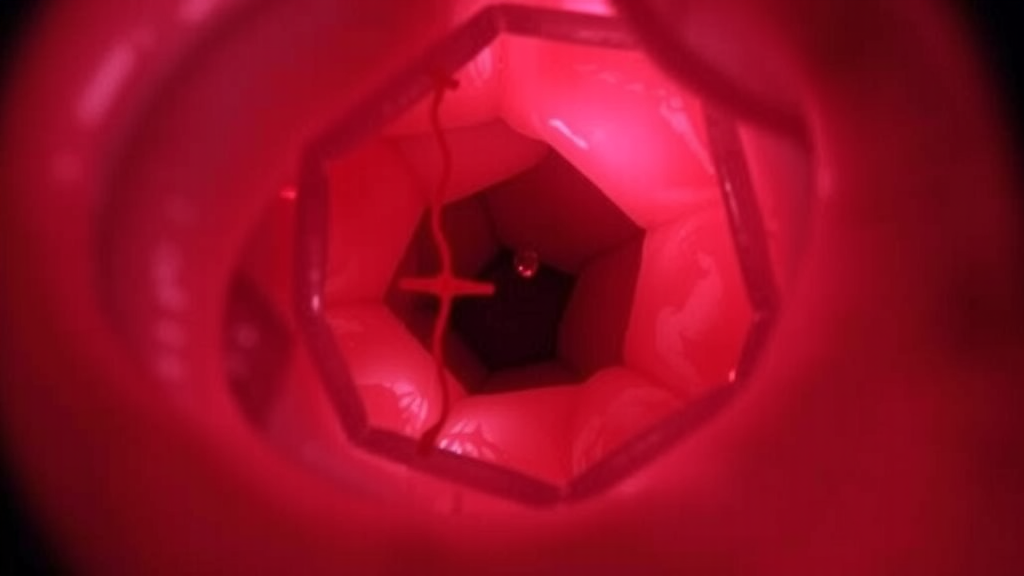
Intussusception, the condition in which one segment of the intestine slides inside another like a collapsing telescope, is the most common cause of intestinal obstruction in young children, and for most pediatricians it is a familiar emergency. Standard treatment relies on imaging-guided air or fluid enemas to push the folded bowel back into place, and in the majority of cases this works and the child goes home. Yet a subset of patients keeps coming back, or fails to reduce at all, because something inside the intestine is acting as a lead point, physically dragging one segment of bowel into the next. A new retrospective study from a major Chinese children’s hospital now offers some of the clearest data yet on how often this happens and how a tool more often associated with adult cancer screening, the colonoscope, can both find and fix the problem.
Researchers at the Children’s Hospital of Chongqing Medical University reviewed the records of pediatric patients with intussusception who underwent colonoscopy between 2015 and 2023. Over that nine-year window, 63 children, 34 boys and 29 girls with an average age of 5.46 years, were examined with the flexible endoscope after their intussusception episode. The children had been symptomatic for a median of two days, and most had already undergone a median of two air enemas before the decision was made to look inside the bowel directly. That detail matters, because it frames colonoscopy not as a first-line diagnostic tool but as a second-look procedure reserved for cases in which conventional reduction either fails or raises suspicion of an underlying lesion.
What the endoscopes found was striking. In 31 of the 63 children, nearly half, colonoscopy revealed an abnormality plausibly responsible for the intussusception. The single most common finding was the juvenile polyp, a benign but bulky hamartomatous growth of the colonic mucosa, identified in 23 children. Five children were diagnosed with Peutz-Jeghers syndrome, a rare genetic condition characterized by multiple hamartomatous polyps throughout the gastrointestinal tract and distinctive dark pigmentation of the lips and mouth. Two children turned out to have Burkitt’s lymphoma, an aggressive malignancy of the bowel that can present in the intestine as a mass capable of dragging the bowel wall into itself. A single child had an inflammatory mass. In other words, for roughly one child in two referred to colonoscopy, the intussusception was not an idiopathic event of early childhood but the visible symptom of a defined pathological lesion.
The therapeutic implications were equally significant. Among the 31 children with detected abnormalities, 24 underwent polypectomy through the colonoscope itself, and the team removed a total of 56 polyps. This means that for most of these patients, the diagnostic procedure and the definitive treatment were one and the same: the endoscopist identified the lead point, snared it, resected it, and in many cases retrieved it for histological examination, all without a surgical incision. Only a minority, including the children with Burkitt’s lymphoma, required onward management by other specialties, since a malignant infiltration of the bowel wall is not amenable to endoscopic resection. The study’s authors conclude that colonoscopy can play a genuine dual role, diagnostic and therapeutic, in secondary intussusception, and their numbers give that conclusion real quantitative weight.
To understand why this matters, it helps to consider the mechanics of the disease. Primary or idiopathic intussusception, which predominates in infants between roughly three months and three years of age, is thought to arise from enlarged lymphoid tissue in the terminal ileum, often after a viral infection, and it typically reduces successfully with enema and does not recur. Secondary intussusception is different. Here a discrete anatomical abnormality, a polyp, a tumor, an inverted Meckel’s diverticulum, or an inflamed patch of bowel, serves as the leading edge that gets propelled forward by peristalsis, pulling the adjoining segment with it. Because the lead point persists, air enema reduction may succeed temporarily but the intussusception recurs, or the enema fails outright because the lesion anchors the telescoped segment in place. Older children are disproportionately represented in this secondary group, which fits the study’s average patient age of nearly five and a half years, well beyond the typical idiopathic window.
Current international guidance has been ambivalent about endoscopy in this setting. Many pediatric surgery and radiology protocols recommend that children with recurrent intussusception, failure of nonoperative reduction, or an age atypical for idiopathic disease undergo further imaging, usually ultrasound or computed tomography, to search for a pathological lead point. Ultrasound is fast, noninvasive, and excellent at confirming the intussusception itself, but it is operator dependent and can miss small intraluminal polyps. Computed tomography offers better anatomical resolution but exposes children to ionizing radiation and still may not characterize the mucosal surface. Colonoscopy, by contrast, inspects the mucosa directly at high magnification and in real time, and, crucially, allows immediate intervention. The Chongqing data suggest that when the clinical picture points toward a secondary cause, colonoscopy deserves a more prominent and earlier position in the diagnostic pathway than it has traditionally occupied.
The safety profile of the approach is another important part of the story. Endoscopic polypectomy in children is an established technique, but performing it in a bowel segment that has recently been intussuscepted raises theoretical concerns about perforation, edema, and compromised tissue viability. The fact that 24 children in this series underwent endoscopic polypectomy without the series reporting widespread complications lends practical reassurance, although the retrospective design means the report is best read as an experience-based series rather than a controlled comparison. The authors obtained informed consent from parents or guardians for all participants, and the study was conducted under institutional ethics approval in line with the Declaration of Helsinki, reflecting the sensitivity of endoscopic intervention in a pediatric emergency context.
There are also broader lessons for practicing clinicians. A child who presents with intussusception after the age of three, who has had more than one episode, or who fails initial air enema reduction should prompt a search for a lead point rather than repeated enemas alone. The finding that five of 63 children in this cohort had Peutz-Jeghers syndrome is particularly noteworthy, because that diagnosis carries lifelong implications well beyond the acute episode: patients require regular surveillance endoscopy for polyp burden and carry elevated cancer risk that mandates structured follow-up into adulthood. Similarly, the two cases of Burkitt’s lymphoma underscore that intussusception can be the first manifestation of a life-threatening malignancy, and that the histological examination of any resected lead point is not a formality but a critical diagnostic step that may redirect the entire course of care.
Limitations of the study are worth keeping in view. As a single-center retrospective analysis, it cannot establish how frequently secondary intussusception occurs across the wider population, nor can it define the optimal timing of colonoscopy relative to enema attempts. The 63 children represent a selected group in whom endoscopy was already deemed appropriate, so the near-50 percent yield of abnormalities should not be extrapolated to all children with intussusception, most of whom will never need a scope. Selection bias likely inflates the detection rate relative to an unselected cohort, and the authors did not report long-term recurrence outcomes after polypectomy, which would be the ultimate test of whether removing the lead point prevents future episodes.
Even with those caveats, the study adds meaningful evidence to a long-standing clinical debate. It demonstrates, in a substantial pediatric cohort and across nearly a decade of practice, that colonoscopy is both feasible and frequently decisive in children whose intussusception is suspected to be secondary. For the 24 children spared an open operation, and for the families who left the hospital with a specific diagnosis rather than a mystery, the flexible scope did what it does best in modern medicine: it looked directly at the disease and, in the same sitting, removed it. As pediatric centers refine their protocols for recurrent and atypical intussusception, this work makes a strong case that the colonoscope should no longer be an afterthought but a planned, early step in the evaluation of the child whose bowel keeps telescoping for reasons the enema cannot explain.
Subject of Research: The use of colonoscopy to diagnose and treat secondary intussusception in children
Article Title: Colonoscopy in the diagnosis and treatment of secondary intussusception
Article References: Hou, J., Cao, F., Cui, M., Wang, Y., Liu, W., Feng, W., & Guo, Z. (2026). Colonoscopy in the diagnosis and treatment of secondary intussusception. BMC Pediatrics. https://doi.org/10.1186/s12887-026-07636-2
Image Credits: AI Generated
DOI: 10.1186/s12887-026-07636-2
Keywords: intussusception, colonoscopy, pediatrics, juvenile polyps, Peutz-Jeghers syndrome, Burkitt's lymphoma, endoscopy, air enema, polypectomy, children's hospital, intestinal obstruction, diagnosis
Cite Scienmag News
Ophelia Keating. (September 20, 2026). Colonoscopy Reveals Hidden Causes of Childhood Intussusception. Scienmag. https://scienmag.com/colonoscopy-reveals-hidden-causes-of-childhood-intussusception/
Ophelia Keating. "Colonoscopy Reveals Hidden Causes of Childhood Intussusception." Scienmag, 20 September 2026, https://scienmag.com/colonoscopy-reveals-hidden-causes-of-childhood-intussusception/. Accessed 4 October 2026.
Ophelia Keating. "Colonoscopy Reveals Hidden Causes of Childhood Intussusception." Scienmag. September 20, 2026. https://scienmag.com/colonoscopy-reveals-hidden-causes-of-childhood-intussusception/


