


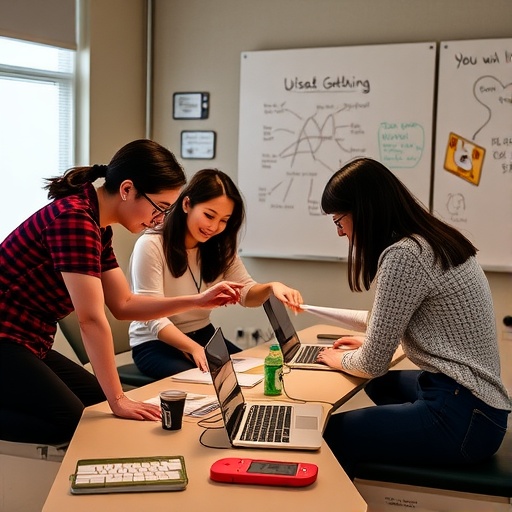
In a compelling new study from the University of Vienna, researchers have uncovered a fascinating dynamic between cooperative tasks and spontaneous movement synchrony—an interplay that could have profound implications for social cohesion. The research, conducted by an interdisciplinary team of sports scientists and cognitive biologists, delves deep into the mechanisms by which working jointly on a simple task can translate into enhanced unconscious physical coordination. The nuanced findings, published in the reputable journal PLOS ONE, reveal that pairs collaborating to solve a jigsaw puzzle subsequently demonstrated significantly greater synchronization while jumping on trampolines compared to those who tackled the puzzles individually.
The concept of interpersonal synchrony, often referred to as the coordination of movements or actions between individuals, is increasingly recognized by scientists as a vital “social glue” that fosters closeness and communal functioning. Prior work has primarily established the notion that synchronous engagement strengthens positive social emotions such as togetherness and affinity. Yet, this study pivots the dialogue, exploring whether shared experiences can actually amplify our preconscious ability to move in harmony with one another—essentially whether cooperation primes our nervous systems to sync up involuntarily, even in unrelated contexts.
The experiment itself was inventive and methodically precise. Sixty-eight participants, divided into same-gender dyads, were randomly assigned into two experimental conditions. In the first, pairs worked collaboratively on a single jigsaw puzzle, while in the second, members of the pair assembled different puzzles independently but side-by-side. Upon completion, each pair’s members immediately engaged in jumping on separate trampolines equipped with acceleration sensors designed to meticulously capture movement patterns. This innovative approach allowed the researchers to quantify the degree of movement synchrony between partners objectively.
Beyond just movement data, the scientists also incorporated psychometric measures by administering questionnaires before and after the tasks. These assessed mood fluctuations and the interpersonal rapport between partners, factors hypothesized to influence or be influenced by the cooperative puzzle-solving experience. The integration of subjective emotional data alongside objective movement measurements provides a comprehensive picture of how social bonding and motor coordination might be bi-directionally linked.
What emerged was a compelling demonstration of the link between cooperative engagement and enhanced physical synchrony. Pairs who actively collaborated on the puzzle exhibited markedly greater synchronicity in their trampoline jumping than pairs who completed puzzles independently. This effect underscores a fascinating neural and psychological mechanism: shared problem-solving likely activates cognitive and affective systems that heighten attunement, leading to unconscious movement alignment during subsequent joint activity.
Moreover, initial rapport between participants before the task was also a significant predictor of synchrony. Those dyads entering the experiment with a positive interpersonal baseline amplified their movement coordination after working together. This highlights that both pre-existing social connections and real-time joint actions are crucial in cultivating the intuitive alignment of bodily movements—a finding that resonates with broader theories about social bonding and empathy.
An additional intriguing finding related to mood states. Participants who collaborated reported elevated mood levels post-experiment, an effect absent in the individually working group. This suggests that cooperative engagement may not only enhance social and motor synchrony but also boost emotional well-being, potentially creating reinforcing feedback loops that promote group cohesion and collaborative success.
The research team’s insights stimulate exciting philosophical and practical questions about the antecedents of synchrony in human interaction. If collaborative tasks enhance spontaneous bodily synchronization, such mechanisms might underpin everything from effective team dynamics and interpersonal relationships to therapeutic settings designed to foster social bonding. Educational environments and sports teams could harness these insights to optimize cooperation and group cohesion, while therapists might develop novel interventions rooted in synchronized physical activity.
These findings work to explicate why joint action is so fundamental to human sociality. Beyond cognitive and verbal communication, the human phenomenology of connection involves deeply embodied processes—movement, rhythm, and timing—that are fine-tuned through shared experiences. The synchronization of physical movement might act as a subconscious indicator and catalyst of trust, understanding, and rapport between individuals.
Scientifically, the study contributes a critical piece to the puzzle of how motor and social systems intertwine. By demonstrating that collaborative intellectual tasks like puzzle-solving translate into measurable changes in motor synchrony, it unravels some of the complex feedback loops between cognitive cooperation and embodied interaction. This synergy between mind and movement offers new pathways for research into how social and neural circuits co-evolve to reinforce group functioning.
In practical terms, such work prompts rethinking about how group activities can be structured to maximize both social desirability and performance. Team-building exercises, for example, might be designed around cooperative tasks promoting not only verbal but also physical synchronization. Similarly, rehabilitation programs could implement exercises harnessing these natural human propensity for synchrony to strengthen patient-therapist rapport and healing dynamics.
This University of Vienna study beautifully encapsulates interdisciplinary collaboration, merging cognitive biology, psychology, and kinesiology to reveal the subtle but powerful ways in which joint activity forges connections beyond conscious awareness. The realization that cooperation enhances spontaneous movement alignment elevates our understanding of human sociality as profoundly embodied, integrative, and dynamic—opening compelling avenues for future exploration across numerous domains.
As this research garners attention, it holds the potential to reshape educational and therapeutic methodologies while providing fresh scientific insights into the underpinnings of social bonding. The just-published findings enrich the broader narrative of how simple shared tasks ripple outward, synchronizing minds and bodies in concert and ultimately weaving the threads of cohesive societies.
News Publication Date: 22-Oct-2025.
Web References: https://doi.org/10.1371/journal.pone.0333709.
References: Scheer, C., et al. (2025). Work together, move together – Cooperation and rapport promote interpersonal synchrony. PLOS ONE, DOI: 10.1371/journal.pone.0333709.
Cite Scienmag News
Courtney Benton. (November 5, 2025). Collaborators Often Move in Sync, Study Finds. Scienmag. https://scienmag.com/collaborators-often-move-in-sync-study-finds/
Courtney Benton. "Collaborators Often Move in Sync, Study Finds." Scienmag, 5 November 2025, https://scienmag.com/collaborators-often-move-in-sync-study-finds/. Accessed 4 September 2026.
Courtney Benton. "Collaborators Often Move in Sync, Study Finds." Scienmag. November 5, 2025. https://scienmag.com/collaborators-often-move-in-sync-study-finds/


