

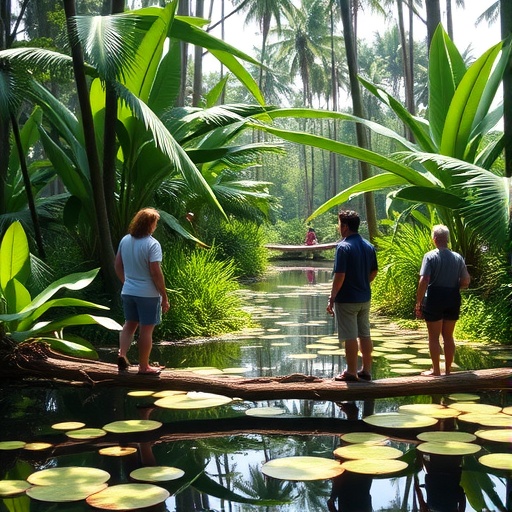
In the dense, ancient woodlands of southeastern Colombia, a groundbreaking botanical discovery has come to light. Rodrigo Cámara-Leret, a professor at the University of Zurich’s Department of Systematic and Evolutionary Botany, along with his PhD student Juan Carlos Copete, unearthed a new species of palm tree — one previously unknown to science but deeply familiar to the indigenous Cacua community inhabiting the region. This palm, christened Attalea táam, grows in the remote forests of Wacará, Vaupés, accessible only by a long river journey and a strenuous hike, underscoring the inaccessibility of this pristine ecosystem that guards its mysteries with resilience.
The discovery of Attalea táam was serendipitous but not accidental. It underscores the crucial role of local knowledge in scientific advancement. The researchers were initially guided by a local professor’s tip that highlighted the Cacua people, an indigenous group of approximately 200 individuals living near Colombia’s border with Brazil. The Cacua’s isolation has preserved their language, culture, and traditional ecological knowledge, which proved instrumental in identifying the palms. During a visit, the researchers were offered palm fruits unfamiliar to them, sparking curiosity and leading to the realization that these palms thrived wild in the vicinity rather than being cultivated.
What followed was a close-knit collaboration between scientists and the Cacua community. The elders and a young hunter of the Cacua guided the researchers directly to the palms’ natural populations scattered through the forest. This partnership not only provided ethnobotanical insights but also allowed precise documentation of the species in context—where it grows, the health of these populations, and their ecological role as perceived and managed by the indigenous people. The Cacua’s intimate knowledge encompassed sustainable harvesting practices, as they knew exactly how to collect the fruits and use the leaves without jeopardizing the palm’s long-term survival.
Back in Zurich, the team embarked on detailed morphological and anatomical analyses of the palms. Utilizing digital microscopy, they scrutinized the floral structures and distinct characteristics of the fruit and leaf scars, which serve as identifying markers. Unlike many other palms in the genus Attalea that exhibit significant morphological variation and frequent hybridization, Attalea táam stood out with unique traits—including pronounced orange-brown ring-shaped leaf scars on its trunk and sizable erect leaves reaching lengths up to 12 meters. Fruit maturation demands roughly a year to reach edibility, displaying an ovate form with a yellowish-brown hue and a brown apex.
The Attalea genus is notorious amongst tropical botanists for its complexity. It comprises some of the most common canopy palms in the Amazon, forming critical components of the forest structure and ecosystem functioning. Yet, species-level identification within the genus remains a profound challenge due to overlapping morphological features, phenotypic plasticity, and form hybrid populations with mixed sexual inflorescences. The clear distinction of Attalea táam highlights both the morphological diversity in the genus and the importance of integrating traditional knowledge when conducting taxonomic surveys.
What sets this scientific venture apart is the paradigm of equitable collaboration it embodies. By integrating Cacua community expertise from the outset, the researchers accelerated species identification and enriched their understanding of the palms’ ecological niche. This approach exemplifies a shift from traditional extractive scientific methods to co-creative, interdisciplinary enterprise incorporating indigenous perspectives. The Cacua themselves took pride in sharing their expertise and simultaneously sought to acquire scientific insights, fostering a rare bi-directional exchange of knowledge during fieldwork.
Such ethical reciprocity extended beyond data collection. Returning to Colombia, the researchers, together with the Cacua and a Colombian artist, mapped the distribution of Attalea táam and its surrounding geography, incorporating local place names and ecological markers. Local schoolchildren’s artwork adorned the map’s symbols, embedding cultural identity and collective memory into this scientific artifact. This map was presented in the Cacua language, ensuring accessibility and validating indigenous intellectual contributions, a corrective to historic marginalization that once rendered such knowledge invisible or appropriated without acknowledgment.
The project stands as a contemporary blueprint for scientifically responsible exploration, respecting and sustaining indigenous intellectual heritage while advancing botanical taxonomy. It counters the colonial legacy of figures like Alexander von Humboldt, whose expansive expeditions often enslaved local knowledge for European science with little reciprocation. Here, the local peer review process invited the Cacua to assess the research outcomes themselves, affirming the value of their input and reinforcing trust and community-driven stewardship.
Beyond taxonomy, the endeavor opens pathways for future technological integration, such as employing high-resolution satellite imagery and remote sensing to monitor palm populations and their habitat continuity. This would enable ongoing assessments of forest health, species dispersal, and impacts of environmental change, supporting conservation efforts informed by both science and indigenous land management practices. It also offers a model for applying cutting-edge tools alongside traditional knowledge systems to sustainably manage biodiversity hotspots.
The journey also reflects the profound human dimension of scientific inquiry. For Cámara-Leret and Copete, the expedition was more than a botanical survey; it was an immersive cultural exchange that broadened their worldview and underscored science’s capacity to foster mutual respect and understanding. They highlight how openness to the unexpected combined with patience and humility yields profound rewards, both intellectually and personally.
Attalea táam grows as a towering canopy species, reaching heights of up to 23 meters, crowned by royal, erect fronds—a symbol of both natural grandeur and community identity. Its discovery invites renewed focus on conservation in Colombia’s Amazon region, emphasizing the necessity of protecting indigenous lands not only for their cultural significance but also as reservoirs of invaluable biological diversity that science continues to uncover.
This new palm species enriches knowledge of Amazonian botany while illuminating the vital synergy between indigenous wisdom and modern science. It challenges researchers worldwide to rethink methodologies, prioritize ethical partnerships, and recognize that some of the planet’s greatest scientific treasures may already be known intimately by those who have lived alongside them for centuries.
Subject of Research: Not applicable
Article Title: Attalea táam – a new palm species well known by the Cacua indigenous people.
News Publication Date: 23-Jan-2026
Web References: http://dx.doi.org/10.11646/phytotaxa.739.1.5
References: Juan Carlos Copete et al. Attalea táam – a new palm species well known by the Cacua indigenous people. Phytotaxa, 23 Jan. 2026. DOI: 10.11646/phytotaxa.739.1.5
Image Credits: Image: Juan Carlos Copete
Keywords: Developmental biology, Evolutionary developmental biology, Forestry, Biodiversity conservation, Ecosystem management, Community ecology, Ecological adaptation, Ecological speciation


