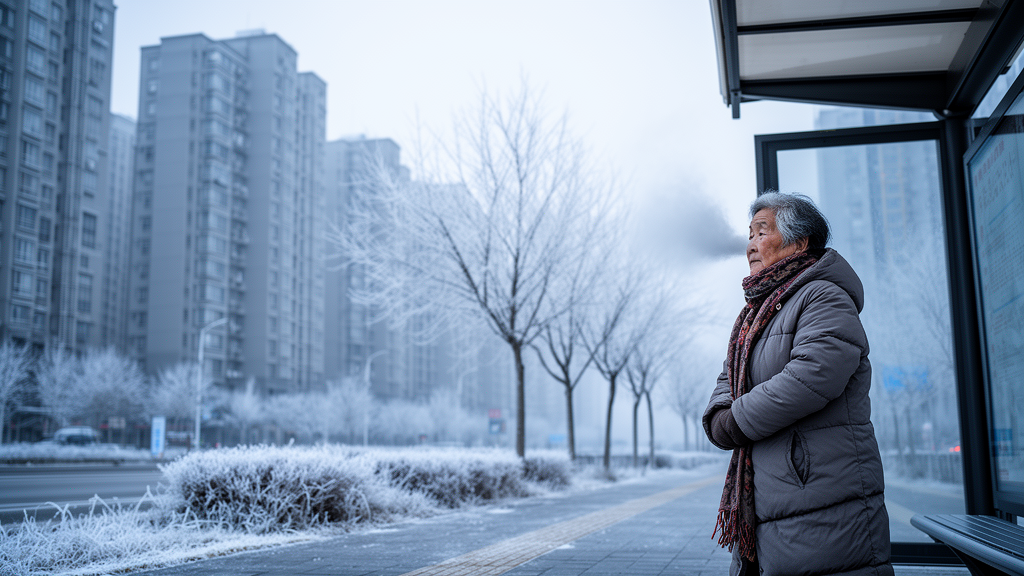
When public health officials think about deadly weather, heatwaves usually dominate the conversation. A new seven-year study from Changsha, a subtropical metropolis in southern China, turns that intuition on its head. Researchers analysing more than 344,000 deaths found that cold was responsible for roughly nine times as many temperature-related deaths as heat, and that most of the cold burden came not from dramatic cold snaps but from ordinary, moderately chilly days that never trigger any warning. The findings, published in BMC Public Health, suggest that the quiet chill of winter may be one of the most underestimated killers in a warming world.
The research team, led by Liu-yi Fu and Wen-ting Zha of Hunan Normal University together with colleagues at the Changsha Center for Disease Control and Prevention, assembled daily mortality records for the years 2015 to 2021, covering 2,557 consecutive days. Every non-accidental death in the city during that period was matched against daily mean temperature, allowing the scientists to trace how death rates shifted as temperatures moved above and below a local optimum. The dataset included cause-of-death classifications, sex and age group, but no individual identifiers, and the study was approved by the ethics committee of the Changsha CDC.
The statistical engine behind the study was a quasi-Poisson distributed lag non-linear model, or DLNM, a technique that has become the standard tool for temperature-mortality epidemiology. Unlike simpler regression approaches, a DLNM can capture two dimensions of risk simultaneously: how mortality changes with temperature, and how those effects unfold over time. The researchers allowed effects to accumulate over a maximum lag of 21 days, while adjusting for long-term and seasonal trends, day of the week and public holidays. This matters because cold and heat kill on very different clocks, and a model that ignores timing can badly misjudge the total burden.
The results revealed a classic U-shaped relationship. Mortality was lowest at 28.0 degrees Celsius, the 85.7th percentile of the local temperature distribution, a figure that reflects how well adapted residents of a hot subtropical city are to warmth. From that minimum-mortality temperature, risk climbed steeply in both directions. At extreme cold, defined as the 2.5th percentile at 2.2 degrees Celsius, the cumulative 21-day relative risk of death was 1.355, meaning deaths were about 36 percent more likely than at the optimum. At extreme heat, the 97.5th percentile at 31.1 degrees Celsius, the relative risk was 1.139, a 14 percent increase. Both estimates were statistically robust, but the cold effect was clearly the larger of the two.
The timing of these effects was strikingly different. Cold-related mortality risk emerged gradually, with lag-specific effects running from around day 1.4 to day 16.4 after exposure. In other words, a cold day could keep claiming lives for more than two weeks. Heat, by contrast, acted fast and faded fast: its effects were confined to days 0 through 4. This asymmetry has a clear biological logic. Heat stress can push vulnerable cardiovascular and respiratory systems over the edge within hours, while cold works more slowly, thickening blood, raising blood pressure, promoting clot formation and straining the heart over days of sustained exposure. It also means the two hazards demand different kinds of public health response.
Quantifying the total burden, the researchers calculated attributable fractions, the share of all deaths that could be linked to temperature. Cold accounted for 7.70 percent of non-accidental deaths, with a confidence interval of 1.31 to 13.36 percent, while heat accounted for just 0.85 percent, from 0.24 to 1.42 percent. That is a ratio of roughly nine to one in favour of cold as the dominant killer. Even more surprising was where that burden fell: 86 percent of cold-attributable deaths occurred on moderately cold days rather than extreme ones, and 54 percent of heat-attributable deaths occurred on moderately hot days. The killer, in both cases, was less often the headline-grabbing extreme and more often the unremarkable day that nobody would call dangerous.
The team also tested a question that has divided the field: do cold spells and heatwaves, as discrete events, add risk beyond what daily temperature already explains? The answer in Changsha was no. Once daily mean temperature was properly modelled, adding event indicators for cold spells or heatwaves produced no significant additional effect. This does not mean such events are harmless; rather, their danger appears to be captured by the temperature itself. For policy, that simplifies matters: what matters is the thermometer reading and how long it stays unfavourable, not whether the conditions cross an arbitrary event threshold.
Subgroup analyses pointed to older adults as the most vulnerable population. The researchers pre-specified four comparisons across age, sex and other strata, and only one reached statistical significance: the age contrast for extreme heat, with a P value of 0.011. Adults aged 65 and over bore the greatest risk across the temperature range, consistent with the known physiology of ageing, including diminished thermoregulation, higher prevalence of chronic cardiovascular and respiratory disease, and reduced behavioural capacity to escape unfavourable indoor conditions. The authors were careful to note that most subgroup differences did not reach significance, a reminder of the statistical limits even in a study of this size.
The team stress-tested their findings with sensitivity analyses. Cumulative relative risks proved robust to alternative model specifications, but attributable fractions were sensitive to how the temperature-response curve was parameterised, particularly the placement of knots in the splines. That caveat is worth taking seriously: the headline conclusion that cold dominates is stable, but the precise percentage of deaths attributable to temperature carries uncertainty. The study also has the usual limitations of a single-city time-series design, and its results describe one subtropical Chinese city whose population is adapted to a hot climate; the same absolute temperatures could carry different risks elsewhere.
The practical implications are nonetheless clear and, in some ways, uncomfortable. Because cold risk builds over about two and a half weeks and heat risk strikes within days, protection strategies must be asymmetric. Heat response should be fast, activating emergency measures within a day or two of a hot spell. Cold protection, by contrast, needs to begin before winter arrives and be sustained throughout the season, especially for older adults. And because most of the burden falls on moderate rather than extreme temperatures, warnings tied only to extreme events will miss most of the danger. A home left too cold in winter, or too hot in summer, can shorten life even when no official alert is in force. As climate change continues to raise average temperatures, this study is a reminder that the deadliest thermal hazard in many regions may still be the cold we have learned to stop noticing.
Subject of Research: Temperature-related mortality and the comparative burden of cold spells and heatwaves in Changsha, China
Article Title: Cold dominates the temperature–mortality burden and defines a longer window for protection: a seven-year time-series study of cold spells and heatwaves in Changsha, China
Article References: Cold dominates the temperature–mortality burden and defines a longer window for protection: a seven-year time-series study of cold spells and heatwaves in Changsha, China. (n.d.). https://doi.org/10.1186/s12889-026-29787-8
Image Credits: AI Generated
DOI: 10.1186/s12889-026-29787-8
Keywords: cold mortality, heatwave, temperature-mortality, distributed lag non-linear model, attributable fraction, Changsha, BMC Public Health, older adults, public health, climate change, cold spells, subtropical climate
Cite Scienmag News
Phoebe Ingram. (October 15, 2026). Cold, Not Heat, Is the Deadlier Threat in a Warming Chinese City. Scienmag. https://scienmag.com/cold-not-heat-is-the-deadlier-threat-in-a-warming-chinese-city/
Phoebe Ingram. "Cold, Not Heat, Is the Deadlier Threat in a Warming Chinese City." Scienmag, 15 October 2026, https://scienmag.com/cold-not-heat-is-the-deadlier-threat-in-a-warming-chinese-city/. Accessed 15 October 2026.
Phoebe Ingram. "Cold, Not Heat, Is the Deadlier Threat in a Warming Chinese City." Scienmag. October 15, 2026. https://scienmag.com/cold-not-heat-is-the-deadlier-threat-in-a-warming-chinese-city/