


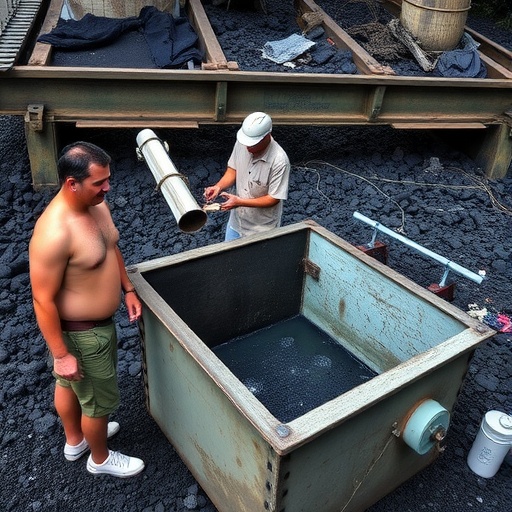
Coal gangue, the dark, rock-like waste left behind by coal mining, could be transformed from an environmental liability into a powerful tool for cleaning polluted water, according to a new review published in Environmental and Biogeochemical Processes. The study examines how this abundant mining byproduct can be reconstructed into a catalyst capable of activating peroxymonosulfate, or PMS, a strong oxidant used to break down persistent organic contaminants.
Coal gangue is produced in enormous quantities during coal extraction and processing. It is commonly stored in open-air piles, where it can occupy large areas of land and contribute to erosion, dust pollution and the release of acidic drainage, salts and metals. Yet the material is far from chemically inactive. Its composition often includes silica, alumina, iron-bearing minerals, carbonaceous matter and trace metals—components that may participate in catalytic reactions when the gangue is properly engineered.
The review’s central message is that coal gangue should not be treated merely as a cheap support on which other catalytic metals are deposited. Through carefully designed processing, its own mineral structure can become part of the reactive interface. “The most important change in perspective is to stop treating coal gangue as an inert carrier and begin asking how its own mineral structure can contribute to oxidation,” said corresponding author Lixin Li. The approach could allow researchers to combine waste reduction with the treatment of contaminated water.
Several processing methods can unlock the material’s chemical potential. Thermal treatment can disrupt stable mineral crystals and produce more disordered, reactive phases. Mechanical grinding reduces particle size, exposes fresh surfaces and introduces structural defects that may serve as reaction sites. Acidic or alkaline treatments can change pore structure, surface charge and chemical bonding. These modifications influence how pollutants are adsorbed and how oxidants interact with the catalyst. In practice, the most effective material may require a carefully balanced combination of thermal, mechanical and chemical reconstruction rather than a single treatment step.
Once activated at the coal-gangue surface, PMS can generate a range of highly reactive species. These include sulfate radicals, hydroxyl radicals and singlet oxygen, all of which can attack difficult-to-degrade organic molecules. The catalyst may also facilitate direct electron transfer between PMS and the pollutant, creating a non-radical oxidation pathway. Which mechanism dominates depends on the catalyst’s mineral phases, defect density, electronic structure and surface chemistry, as well as the pollutant and the composition of the surrounding water.
The review highlights tetracycline antibiotics and phenolic compounds as valuable test pollutants for evaluating these systems. Tetracycline is chemically complex and contains several electron-rich sites, making its degradation a demanding test of adsorption, electron movement and oxidative attack. Phenolic compounds, meanwhile, can help reveal whether treatment proceeds mainly through radicals, singlet oxygen, direct electron transfer or a combination of pathways. Understanding these routes is essential because removing a pollutant from water does not necessarily mean that all potentially harmful transformation products have been eliminated.
One of the study’s most important recommendations is that researchers should first maximize coal gangue’s intrinsic oxidative performance—particularly its ability to promote hydroxyl radical formation—before adding external metals or other active phases. Additional components should be selected to complement the gangue’s existing surface chemistry, structural defects and electronic properties. This design strategy could reduce the amount of expensive or potentially leachable metals required, while also producing catalysts that are more closely matched to the chemistry of the waste material.
The authors stress, however, that impressive pollutant removal in laboratory-prepared water is not enough to establish practical value. Future studies must compare raw coal gangue, reconstructed coal gangue and added catalytic components under standardized conditions. They should also determine how the catalysts perform in real industrial wastewater, which may contain salts, natural organic matter and competing contaminants that interfere with PMS activation. Reusability, reaction rates, energy consumption and treatment costs will be just as important as the initial removal percentage.
Environmental safety is another critical hurdle. Researchers will need to measure the release of metals and other substances from the catalyst during repeated use, identify degradation products and assess whether those products are less toxic than the original pollutants. PMS treatment itself can produce complex reaction mixtures, and the formation of secondary contaminants must be carefully monitored. Only when catalytic performance, durability, low leaching, reduced toxicity and economic feasibility are demonstrated together can coal gangue be considered a genuinely sustainable resource for water treatment.
The review presents coal-gangue-based PMS activation as part of a broader shift in environmental engineering: turning difficult waste streams into functional materials rather than treating them solely as disposal problems. If researchers can connect mineral reconstruction with a precise understanding of oxidation mechanisms, coal gangue may help address two major challenges at once—persistent pollution in wastewater and the growing accumulation of mining waste. The next step is to move beyond proof-of-concept experiments and determine whether these waste-derived catalysts can operate reliably outside the laboratory.
News Publication Date: 21-Jul-2026
Web References: https://doi.org/10.48130/ebp-0026-0008
References: Wu Y, Tan R, Huang L, Dong Z, Yang F, et al. 2026. “Coal gangue-based catalyst activates peroxymonosulfate for efficient degradation of organic pollutants in wastewater.” Environmental and Biogeochemical Processes 2: e014. DOI: 10.48130/ebp-0026-0008
Keywords
Coal gangue, wastewater treatment, peroxymonosulfate, advanced oxidation, sulfate radicals, hydroxyl radicals, singlet oxygen, tetracycline degradation, phenolic pollutants, sustainable catalysis, mining waste, environmental chemistry
Cite Scienmag News
Bethany Barker. (August 1, 2026). Coal Waste May Become Active Catalyst for Cleaner Wastewater Treatment. Scienmag. https://scienmag.com/coal-waste-may-become-active-catalyst-for-cleaner-wastewater-treatment/
Bethany Barker. "Coal Waste May Become Active Catalyst for Cleaner Wastewater Treatment." Scienmag, 1 August 2026, https://scienmag.com/coal-waste-may-become-active-catalyst-for-cleaner-wastewater-treatment/. Accessed 4 September 2026.
Bethany Barker. "Coal Waste May Become Active Catalyst for Cleaner Wastewater Treatment." Scienmag. August 1, 2026. https://scienmag.com/coal-waste-may-become-active-catalyst-for-cleaner-wastewater-treatment/


