


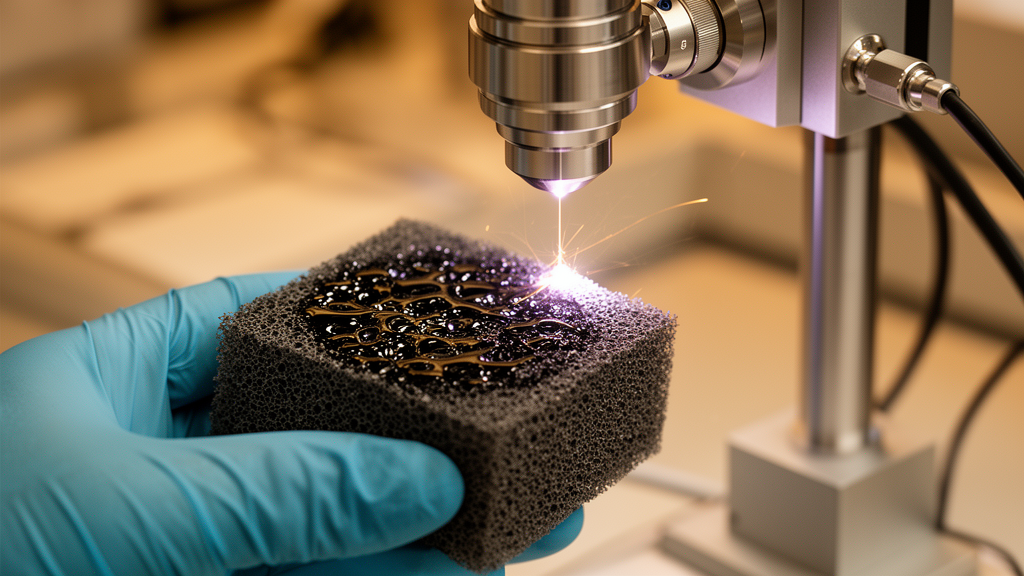
A team of researchers at King Faisal University in Saudi Arabia, working with a collaborator at UPES in India, has demonstrated a remarkably simple way to make high-performance energy storage electrodes: spraying a cheap nickel salt onto commercial nickel foam and sweeping a CO₂ laser across it. The process converts the precursor directly into crystalline nickel oxide (NiO) bonded to the foam, with no glues, binders, or high-temperature furnaces. The resulting electrodes, described in the journal Ionics, deliver areal capacitance values that rival far more elaborate nanostructured materials, and they work not only as supercapacitor electrodes but also as the positive electrode in an aqueous nickel–zinc battery.
The central idea is deceptively straightforward. Nickel sulfate hexahydrate, an inexpensive and widely available salt, is dissolved and spray-coated onto nickel foam, a porous metallic scaffold commonly used as a current collector in aqueous electrochemistry. Once the precursor layer is in place, a CO₂ laser operating at its familiar wavelength of 10.6 micrometers is scanned over the surface. The laser rapidly heats the coated foam, decomposing the sulfate salt and oxidizing the nickel locally, so that a crystalline NiO layer forms directly on the metallic substrate within seconds of exposure. Because the oxide grows in place, it is electrically wired to the underlying foam without any polymer binder, the insulating additive that conventional paste-based electrodes require and that adds dead weight, blocks pores, and degrades over repeated cycling.
Binder-free construction matters more than it might first appear. In a typical slurry-cast electrode, active material particles are glued to a metal foil with a polymer such as polyvinylidene fluoride, along with conductive carbon additives. Every interface introduced by these extra phases adds resistance and a potential failure point. Growing the active material directly on a conductive scaffold eliminates the binder entirely, ensuring that every bit of electrochemically active NiO is in intimate contact with the current collector. It also preserves the open pore structure of the foam, allowing electrolyte ions to flood the interior and reach active sites efficiently. The King Faisal team’s laser route achieves this architecture in a single rapid step, which is precisely what makes it attractive for scale-up.
To tune the electrode, the researchers varied the number of spray passes, which controls how much precursor, and therefore how much final NiO, is loaded onto each square centimeter of foam. Three versions were fabricated with 5, 10, and 20 spray passes. Structural and compositional analyses confirmed that the laser treatment produced crystalline NiO in all cases, but the electrochemical results revealed a clear optimum. The 10-pass electrode, with an intermediate mass loading, consistently outperformed both the lighter and heavier coatings, striking the best balance between having enough active material to store charge and keeping the layer thin enough for ions to access it all.
Tested in a concentrated 5 molar potassium hydroxide electrolyte, the optimized 10-pass electrode reached an areal capacitance of 5838 millifarads per square centimeter at a scan rate of 2 millivolts per second, and 6907 millifarads per square centimeter when driven at a current density of 10 milliamperes per square centimeter. Those figures translate into an areal capacity of 0.94 milliampere-hours per square centimeter, or a specific capacity of 249.9 milliampere-hours per gram. Areal metrics are the ones that matter for practical devices, because they measure how much charge a given footprint of electrode can store, and the reported values place this laser-written NiO among the competitive performers for nickel oxide-based supercapacitor electrodes.
Just as important as the headline numbers is how the electrode behaves under stress. The 10-pass coating maintained high capacitance even when the current density was pushed higher, a sign that ions and electrons can move through the structure without choking. In many electrode materials, capacitance collapses at high rates because the innermost active material becomes inaccessible on the timescale of the charge-discharge cycle. The laser-formed layer on nickel foam apparently avoids that pitfall, indicating efficient ion transport and fast charge transfer, likely a consequence of the direct electronic connection to the metal scaffold and the open porosity that the spray-and-laser process leaves intact.
The team then went a step further and assembled the optimized cathode into a full aqueous nickel–zinc battery, pairing it with a zinc anode in alkaline electrolyte. Nickel–zinc chemistry has attracted renewed attention as a safer, cheaper alternative to lithium-ion systems, using water-based electrolyte and abundant materials, but its performance depends heavily on the quality of the nickel-based positive electrode. The laser-fabricated NiO cathode retained its charge-storage functionality in the full-cell configuration, confirming that the material works beyond the idealized three-electrode setup used for single-electrode screening. The assembled battery delivered an areal capacity of 0.31 milliampere-hours per square centimeter, equivalent to 81.57 milliampere-hours per gram, at a current density of 0.44 milliamperes per square centimeter.
Cycling stability, the perennial challenge for oxide-based aqueous electrodes, was moderate rather than spectacular: the Ni–Zn cell retained roughly 70 percent of its capacitance after 1000 cycles. That figure leaves room for improvement, and the authors are candid that their work is a proof of concept. The demonstration was carried out on 9 square centimeter electrodes, with a preliminary extension to a 16 square centimeter full-cell electrode, showing that the laser process is not confined to tiny laboratory coupons. The researchers identify large-area coating uniformity as the key target for further optimization, since consistent precursor loading across a wide foam sheet will be essential if the technique is to move toward practical device fabrication.
According to the authors, this is the first reported case of direct CO₂ laser fabrication of NiO on nickel foam from a nickel sulfate hexahydrate precursor. That distinction matters because CO₂ lasers are among the most mature, affordable, and widely deployed industrial laser systems, already commonplace in cutting, engraving, and marking lines. Building an electrode fabrication step on top of such hardware means the barrier to adoption is low: no vacuum chambers, no electrodeposition baths, no multi-hour hydrothermal reactions in pressurized autoclaves. A spray gun and a laser scanner, in principle, could pattern active electrode material onto metal scaffolds at production speeds, and the precursor is a commodity chemical rather than a specialized organometallic reagent.
The broader significance lies in what the approach represents for energy storage manufacturing. Supercapacitors and aqueous batteries both depend on electrodes that pack a large amount of electrochemically active material into a small footprint while keeping ion and electron pathways short. Laser conversion of a sprayed precursor achieves both goals in one motion, and the identification of precursor loading as the single most important control parameter gives engineers a simple dial to tune performance. If the uniformity challenges on large areas can be solved, the same spray-and-laser recipe could plausibly be extended to other metal salts and substrates, opening a general route to binder-free oxide electrodes written directly onto current collectors. For now, the King Faisal team’s nickel oxide electrodes stand as a compelling demonstration that a tool as ordinary as a CO₂ laser can help build the next generation of energy storage hardware.
Subject of Research: CO₂ laser-assisted fabrication of binder-free NiO electrodes on nickel foam for supercapacitors and Ni–Zn batteries
Article Title: Toward scalable and direct CO₂ laser-assisted fabrication of binder-free NiO/Ni foam electrodes with high areal capacitance for supercapacitor and Ni–Zn battery applications
Article References: Toward scalable and direct CO₂ laser-assisted fabrication of binder-free NiO/Ni foam electrodes with high areal capacitance for supercapacitor and Ni–Zn battery applications. (n.d.). https://doi.org/10.1007/s11581-026-07585-x
Image Credits: AI Generated
DOI: 10.1007/s11581-026-07585-x
Keywords: nickel oxide, nickel foam, CO₂ laser, binder-free electrode, supercapacitor, Ni–Zn battery, areal capacitance, energy storage, electrochemistry, nickel sulfate precursor, aqueous battery, laser processing
Cite Scienmag News
Denise Maddox. (October 15, 2026). CO₂ Laser Turns Nickel Foam Into High-Performance Binder-Free Electrodes for Supercapacitors and Batteries. Scienmag. https://scienmag.com/co%e2%82%82-laser-turns-nickel-foam-into-high-performance-binder-free-electrodes-for-supercapacitors-and-batteries/
Denise Maddox. "CO₂ Laser Turns Nickel Foam Into High-Performance Binder-Free Electrodes for Supercapacitors and Batteries." Scienmag, 15 October 2026, https://scienmag.com/co%e2%82%82-laser-turns-nickel-foam-into-high-performance-binder-free-electrodes-for-supercapacitors-and-batteries/. Accessed 15 October 2026.
Denise Maddox. "CO₂ Laser Turns Nickel Foam Into High-Performance Binder-Free Electrodes for Supercapacitors and Batteries." Scienmag. October 15, 2026. https://scienmag.com/co%e2%82%82-laser-turns-nickel-foam-into-high-performance-binder-free-electrodes-for-supercapacitors-and-batteries/


