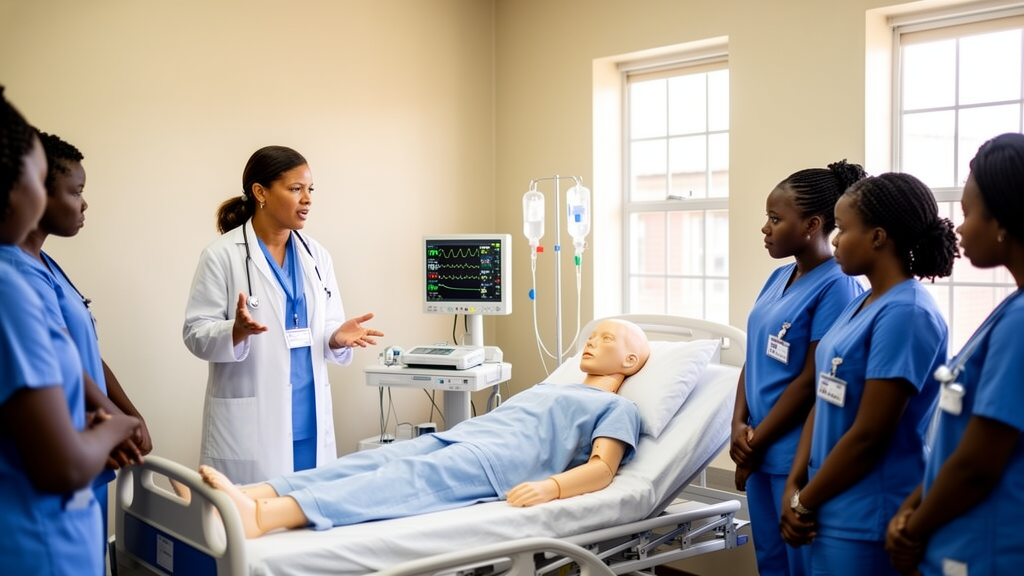
High-fidelity manikins are used by nursing education institutions around the world to help students achieve clinical teaching objectives, but the instructors who rely on them in KwaZulu-Natal report significant obstacles. A qualitative study published in BMC Medical Education explored the experiences of clinical instructors using high-fidelity manikins to teach student nurses at selected higher education institutions in the South African province, and found that challenges in skills, staffing, and institutional support are shaping how simulation is actually delivered.
Clinical instructors are the individuals who support student nurses in the clinical learning environment, and they are expected to use high-fidelity manikins to teach clinical skills. The study’s authors note that these instructors require resources and support to render effective and efficient services in the clinical simulation laboratory.
The research used a qualitative exploratory descriptive design. Participants were selected through non-probability purposive sampling, and data saturation was reached at participant 10. The researchers analysed the data using the six steps of thematic analysis described by Braun and Clarke, and adhered to credibility, transferability, dependability, confirmability, and authenticity to ensure data quality.
From the analysis, two themes and five sub-themes emerged. The first theme was hindrances to the use of high-fidelity mannequins. Its sub-themes were limited technological skills among clinical instructors, a shortage of technological skills among clinical laboratory support staff, and a lack of orientation of new staff on the use of high-fidelity manikins.
The second theme was a lack of support for the clinical instructors, with two sub-themes: a lack of in-service training and an inability to develop and use scenarios. Together, these findings suggest that the barriers are not only technical but also organisational, spanning both the readiness of individual instructors and the structures that institutions provide around them.
The pattern of results points to a chain of dependencies in simulation-based teaching. Instructors need their own technological competence, but they also depend on laboratory support staff who possess technological skills, and on orientation processes that prepare new staff to operate the manikins. When any part of that chain is weak, the use of high-fidelity manikins in teaching is hindered.
The scenario-related finding is particularly relevant to how simulation is used in practice. The study identified an inability to develop and use scenarios as a sub-theme under the second theme, the lack of support of the clinical instructors. This suggests that support gaps affect not only the operation of the equipment but also the pedagogical content delivered through it.
The study’s conclusions are directed at the institutions of higher learning themselves. The authors state that these institutions should provide clinical instructors with continuous professional development to improve their confidence and competence in high-fidelity manikins. They further state that it is fundamental that guidelines for incorporating simulation into curricula be developed.
The conclusions also emphasise investment in technical support. According to the authors, investing in technical support and developing clear guidelines for integrating simulation into curricula can help ensure more effective and consistent use of high-fidelity mannequins. In other words, the recommended response addresses both the human capacity of instructors and the institutional systems that surround simulation-based education.
As a qualitative exploratory descriptive study conducted at selected higher education institutions in KwaZulu-Natal, with data saturation reached at ten participants, the findings describe the experiences of the instructors studied rather than measuring outcomes across all nursing education settings. The study was published as open access research in BMC Medical Education, with the article published on 27 October 2026 and authored by S. T. Madlala, B. J. Molato, and J. Mbambo. Within that scope, the work identifies concrete, addressable barriers: limited technological skills, shortages of skilled laboratory support staff, insufficient orientation, absent in-service training, difficulty developing scenarios, and a broader lack of institutional support for the instructors tasked with teaching student nurses through simulation.
Subject of Research: Experiences of clinical instructors using high-fidelity manikins to teach student nurses in KwaZulu-Natal
Article Title: Experiences of clinical instructors in using high-fidelity manikins to teach student nurses at the selected higher education institutions in KwaZulu-Natal
Article References: Madlala, S. T., Molato, B. J., & Mbambo, J. (2026). Experiences of clinical instructors in using high-fidelity manikins to teach student nurses at the selected higher education institutions in KwaZulu-Natal. BMC Medical Education. https://doi.org/10.1186/s12909-026-10662-4
Image Credits: AI Generated
DOI: 10.1186/s12909-026-10662-4
Keywords: high-fidelity manikins, nursing education, clinical instructors, simulation, KwaZulu-Natal, qualitative research, thematic analysis, clinical skills training, in-service training, higher education institutions, Experiences, clinical
Cite Scienmag News
Courtney Benton. (October 27, 2026). Clinical instructors in KwaZulu-Natal report barriers to using high-fidelity manikins. Scienmag. https://scienmag.com/clinical-instructors-in-kwazulu-natal-report-barriers-to-using-high-fidelity-manikins/
Courtney Benton. "Clinical instructors in KwaZulu-Natal report barriers to using high-fidelity manikins." Scienmag, 27 October 2026, https://scienmag.com/clinical-instructors-in-kwazulu-natal-report-barriers-to-using-high-fidelity-manikins/. Accessed 28 October 2026.
Courtney Benton. "Clinical instructors in KwaZulu-Natal report barriers to using high-fidelity manikins." Scienmag. October 27, 2026. https://scienmag.com/clinical-instructors-in-kwazulu-natal-report-barriers-to-using-high-fidelity-manikins/