


Osaka, Japan – Upward social mobility may ward off dementia, according to a new study. Dementia, a collective term for conditions marked by memory loss and diminished cognitive functioning, strains healthcare systems and devastates quality of life for patients and their families. Research thus far has found correlations between socioeconomic status (SES) – Parent’s asset, education level, income, and work status – and susceptibility to dementia, and SES changes throughout a person’s life, known as social mobility, seem to influence this risk; however, scientific evidences are lacking.
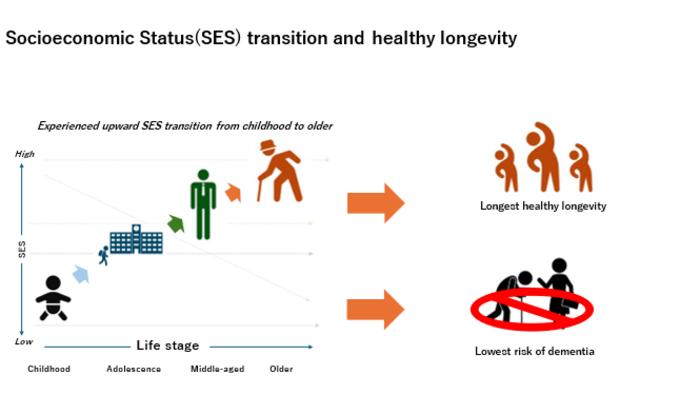
The new study, led by Osaka University researchers and published in JAMA Network Open, provides data-backed evidence that upward social mobility is associated with a lower dementia risk. Specifically, a downward SES transition was associated with the highest loss of healthy longevity from age 75 onward in their lifetime. Yet, an upward transition was linked with the longest period of healthy longevity. Interestingly, these result from upward are more favorable than those with stable high SES since childhood.
“Thanks to a large and robust dataset, our findings solidify the association between socioeconomic mobility and dementia risk,” the study’s lead author Ryoto Sakaniwa says. “Our finding that upward social mobility throughout a person’s life correlates with a prolonged period of dementia-free aging means that improving socioeconomic conditions could be a key to dementia prevention and healthier longevity.”
The researchers used data from the Japan Gerontological Evaluation Study, which followed 9,186 participants aged 65 and over from 2010 to 2016. The study employed unsupervised clustering analysis and data-driven classification to analyze changes in participants’ SES throughout their lives. The analysis identified six distinct SES transition patterns. The researchers used a national registry of long-term nursing care services to determine dementia incidence, which enabled a detailed examination of the relationship between these transitions and dementia risk.
The analysis found that upward SES transitions were associated with a notably lower risk of dementia incidence compared with stable SES patterns. Conversely, downward SES transitions had a significantly increased risk.
The study also explored the mediating effects of lifestyle behaviors, comorbidities, and social factors on the association of SES transitions and dementia risk. These factors were found to play significant roles in mediating that risk, particularly physical characteristics and lifestyle behaviors in upward transitions and social factors in downward transitions.
“Future research should delve deeper into the mechanisms by which SES influences cognitive health, including potential interventions for mitigating dementia risk,” senior author Hiroyasu Iso says.” Understanding the nuances of how SES and its transitions impact dementia is vital for developing targeted strategies addressing underlying socioeconomic factors throughout one’s life.
So, it seems that climbing the social ladder can indeed lead to healthier, dementia-free lives.
###
The article, “Socioeconomic status transition throughout the life course and the risk of dementia,” was published in JAMA Network Open at DOI:
About Osaka University
Osaka University was founded in 1931 as one of the seven imperial universities of Japan and is now one of Japan’s leading comprehensive universities with a broad disciplinary spectrum. This strength is coupled with a singular drive for innovation that extends throughout the scientific process, from fundamental research to the creation of applied technology with positive economic impacts. Its commitment to innovation has been recognized in Japan and around the world, being named Japan’s most innovative university in 2015 (Reuters 2015 Top 100) and one of the most innovative institutions in the world in 2017 (Innovative Universities and the Nature Index Innovation 2017). Now, Osaka University is leveraging its role as a Designated National University Corporation selected by the Ministry of Education, Culture, Sports, Science and Technology to contribute to innovation for human welfare, sustainable development of society, and social transformation.
Website:

Credit: R.Sakaniwa et al.
Osaka, Japan – Upward social mobility may ward off dementia, according to a new study. Dementia, a collective term for conditions marked by memory loss and diminished cognitive functioning, strains healthcare systems and devastates quality of life for patients and their families. Research thus far has found correlations between socioeconomic status (SES) – Parent’s asset, education level, income, and work status – and susceptibility to dementia, and SES changes throughout a person’s life, known as social mobility, seem to influence this risk; however, scientific evidences are lacking.
The new study, led by Osaka University researchers and published in JAMA Network Open, provides data-backed evidence that upward social mobility is associated with a lower dementia risk. Specifically, a downward SES transition was associated with the highest loss of healthy longevity from age 75 onward in their lifetime. Yet, an upward transition was linked with the longest period of healthy longevity. Interestingly, these result from upward are more favorable than those with stable high SES since childhood.
“Thanks to a large and robust dataset, our findings solidify the association between socioeconomic mobility and dementia risk,” the study’s lead author Ryoto Sakaniwa says. “Our finding that upward social mobility throughout a person’s life correlates with a prolonged period of dementia-free aging means that improving socioeconomic conditions could be a key to dementia prevention and healthier longevity.”
The researchers used data from the Japan Gerontological Evaluation Study, which followed 9,186 participants aged 65 and over from 2010 to 2016. The study employed unsupervised clustering analysis and data-driven classification to analyze changes in participants’ SES throughout their lives. The analysis identified six distinct SES transition patterns. The researchers used a national registry of long-term nursing care services to determine dementia incidence, which enabled a detailed examination of the relationship between these transitions and dementia risk.
The analysis found that upward SES transitions were associated with a notably lower risk of dementia incidence compared with stable SES patterns. Conversely, downward SES transitions had a significantly increased risk.
The study also explored the mediating effects of lifestyle behaviors, comorbidities, and social factors on the association of SES transitions and dementia risk. These factors were found to play significant roles in mediating that risk, particularly physical characteristics and lifestyle behaviors in upward transitions and social factors in downward transitions.
“Future research should delve deeper into the mechanisms by which SES influences cognitive health, including potential interventions for mitigating dementia risk,” senior author Hiroyasu Iso says.” Understanding the nuances of how SES and its transitions impact dementia is vital for developing targeted strategies addressing underlying socioeconomic factors throughout one’s life.
So, it seems that climbing the social ladder can indeed lead to healthier, dementia-free lives.
###
The article, “Socioeconomic status transition throughout the life course and the risk of dementia,” was published in JAMA Network Open at DOI:
About Osaka University
Osaka University was founded in 1931 as one of the seven imperial universities of Japan and is now one of Japan’s leading comprehensive universities with a broad disciplinary spectrum. This strength is coupled with a singular drive for innovation that extends throughout the scientific process, from fundamental research to the creation of applied technology with positive economic impacts. Its commitment to innovation has been recognized in Japan and around the world, being named Japan’s most innovative university in 2015 (Reuters 2015 Top 100) and one of the most innovative institutions in the world in 2017 (Innovative Universities and the Nature Index Innovation 2017). Now, Osaka University is leveraging its role as a Designated National University Corporation selected by the Ministry of Education, Culture, Sports, Science and Technology to contribute to innovation for human welfare, sustainable development of society, and social transformation.
Website:
Journal
JAMA Network Open
Method of Research
Observational study
Subject of Research
People
Article Title
Socioeconomic status transition throughout the life course and the risk of dementia
Cite Scienmag News
Cassandra Pierce. (May 21, 2024). Climbing the social ladder slows dementia, Japanese study reveals. Scienmag. https://scienmag.com/climbing-the-social-ladder-slows-dementia-japanese-study-reveals/
Cassandra Pierce. "Climbing the social ladder slows dementia, Japanese study reveals." Scienmag, 21 May 2024, https://scienmag.com/climbing-the-social-ladder-slows-dementia-japanese-study-reveals/. Accessed 4 September 2026.
Cassandra Pierce. "Climbing the social ladder slows dementia, Japanese study reveals." Scienmag. May 21, 2024. https://scienmag.com/climbing-the-social-ladder-slows-dementia-japanese-study-reveals/

