

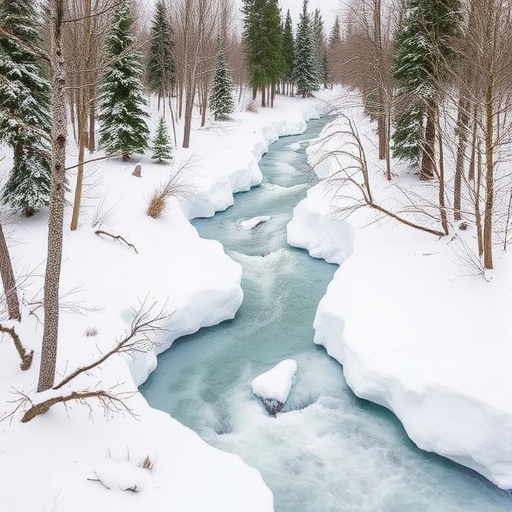
Climate warming is reshaping the hydrological dynamics of cold-region headwater basins, particularly in Northwest China, as revealed in a recent groundbreaking study published in Environmental Earth Sciences. This research offers an unprecedented look at how rising temperatures are altering the delicate balance between snowmelt and rainfall-runoff processes, with profound implications for water resource management, ecosystem sustainability, and regional climate adaptation strategies. The study focuses on a representative cold-region headwater basin where snowmelt traditionally dominates the hydrological cycle, but ongoing climatic shifts are bringing a marked change to the behavior of runoff.
At the heart of this investigation lies the complex interplay between temperature increases and hydrological responses in mountainous cold regions, where snowpacks act as critical reservoirs that regulate river flow throughout the year. The research team employed advanced hydrological modeling combined with long-term meteorological and hydrological data to capture spatial and temporal variations in snowmelt and rainfall-runoff partitioning. Their findings reveal a tangible trend of earlier snowmelt initiation and accelerated runoff generation, driven by warming-induced shifts in snow accumulation patterns and melting rates.
The study’s granular approach enables an intricate understanding of the processes modulating river discharge patterns in the basin. Traditionally, snowmelt has served as a steady, predictable contributor to streamflow during spring and early summer, supporting downstream ecosystems and agricultural demands. However, warming climate conditions have compressed the snowmelt period, increasing the runoff intensity over shorter timeframes. This not only augments the risk of spring floods but also challenges water storage systems designed around historical hydrological regimes, which could struggle to operate efficiently under altered runoff schedules.
Moreover, the evolving rainfall-runoff partitioning introduces additional complexity. Rainfall contributions to runoff are becoming more variable, with the interplay between precipitation intensity and soil moisture dynamics shifting alongside temperature increases. The research highlights that warming is modifying soil infiltration rates and evapotranspiration patterns, thereby influencing how precipitation is partitioned between runoff generation and subsurface recharge. These changes threaten to destabilize water availability in the basin during drier months when rainfall is scarce and snowmelt traditionally sustained flows.
The authors underscore the critical role of snowpack evolution and its cryospheric feedback mechanisms in modulating hydrological outcomes. As warming accelerates snowpack depletion, feedbacks such as reduced surface albedo and enhanced ground heat flux further amplify snowmelt rates. This positive feedback loop exacerbates seasonal runoff irregularities, pushing the basin toward a hydrological regime increasingly dominated by rainfall rather than snowmelt, with possible downstream effects on nutrient transport, sediment flux, and aquatic habitat structure.
From a methodological perspective, the study integrates remote sensing data, ground-based observations, and a suite of hydrological models finely calibrated to the basin’s physical characteristics. This multi-source data integration facilitates a robust and nuanced analysis of climate-driven hydrological shifts at scales ranging from catchment to regional watershed levels. The use of ensemble climate projections permits an exploration of future scenarios, lending critical foresight for planning adaptive water management infrastructure in the face of continued warming.
The implications of these findings extend beyond regional hydrology, touching on wider aspects of socio-economic vulnerability and ecological resilience. Communities dependent on stable river flow for agriculture, drinking water, and hydropower generation face uncertainty as traditional water supply windows narrow and hydrological extremes intensify. Furthermore, altered runoff regimes could disrupt aquatic ecosystems adapted to the timing and volume of historical flows, challenging biodiversity conservation efforts in these fragile cold environments.
Ultimately, this pioneering research stresses the urgency for integrating climate adaptation into hydrological planning. Water managers and policy makers are called to recalibrate water allocation practices, update flood risk assessments, and enhance reservoir operation protocols. Additionally, it advocates for the implementation of ecosystem-based adaptation approaches that bolster the natural buffering capacity of catchments, such as restoring wetlands and protecting upstream forests that influence runoff dynamics and water retention.
The study also contributes vital insights into the broader scientific dialogue on climate-hydrology interactions in cold mountainous regions, an area previously underrepresented in global hydrological research despite its high sensitivity to warming. By revealing alterations in runoff partitioning mechanisms, it enriches our understanding of how cryospheric changes cascade through hydrological systems, presenting a compelling case for intensified monitoring and research collaborations at the intersection of climate science, hydrology, and environmental management.
Further investigations prompted by this work should delve into quantifying the socio-ecological impacts of altered water regimes and develop predictive models tailored to specific catchments with diverse climatic and geological conditions. Such efforts could foster the design of site-specific adaptation frameworks that harmonize human needs with ecosystem health in cold-region watersheds.
In summary, the research led by Shi, Yang, and Li elucidates the transformative effects of climate warming on snowmelt and rainfall-runoff dynamics within a key headwater basin in Northwest China. Their comprehensive analysis reveals fundamental shifts in hydrological partitioning driven by warming-induced changes in snowpack behavior, precipitation patterns, and soil moisture processes. These findings have far-reaching consequences for water resource sustainability, risk management, and biodiversity conservation, highlighting the critical need for innovative adaptive strategies in cold-region hydrological frameworks. As climate change accelerates, integrating these hydrological insights into policy and practice will be crucial to safeguarding water security and ecosystem integrity in vulnerable mountainous regions worldwide.
Subject of Research: Climate warming impacts on snowmelt and rainfall-runoff partitioning in a cold-region headwater basin.
Article Title: Climate warming alters snowmelt and rainfall-runoff partitioning in a cold-region headwater basin of Northwest China.
Article References:
Shi, P., Yang, W. & Li, Z. Climate warming alters snowmelt and rainfall-runoff partitioning in a cold-region headwater basin of Northwest China. Environ Earth Sci 85, 41 (2026). https://doi.org/10.1007/s12665-025-12770-8
Image Credits: AI Generated


