

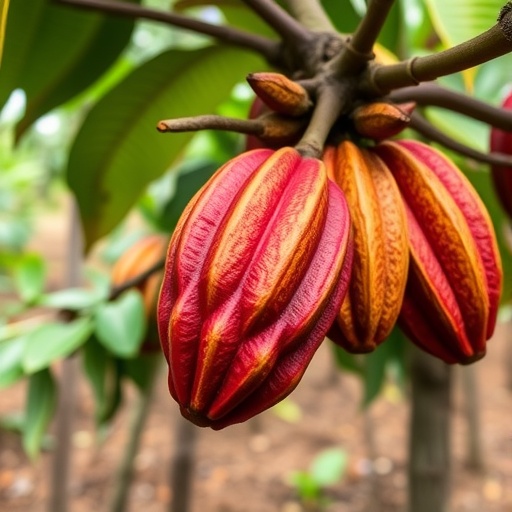
A recent comprehensive study foresees a paradigm shift in the cultivation landscape of Colombian cacao driven by the multifaceted impacts of climate change. By the mid-21st century, climatic suitability for cacao farming in Colombia is expected to experience significant reconfiguration, predominantly influenced by rising temperatures and shifting precipitation patterns. This transformation underscores an urgent need for adaptive strategies to secure the future sustainability and economic viability of cacao production in the region.
The research, a collaborative effort between the Alliance of Bioversity International and CIAT, Fedecacao, and AGROSAVIA, utilizes advanced computational modeling to forecast climatic trends and their interactions with existing cacao growing zones. Integrating data on current cultivation regions along with the geographic distributions of wild Theobroma cocoa relatives, the study projects the extent to which climate suitability for cacao can change over the next few decades, with profound implications for agricultural planning and biodiversity conservation.
Model outputs indicate that nearly 20% of Colombia’s current cacao-suitable areas may become climatically inhospitable by 2050. This anticipated reduction is particularly acute in the low-altitude Caribbean region, as well as in northeastern departments such as Atlántico, Bolívar, Cesar, Córdoba, Sucre, Antioquia, Arauca, Casanare, Meta, and Vichada. Escalating regional temperatures and increasingly erratic rainfall patterns threaten to impose physiological stress on cacao plants, diminish yields, and exacerbate financial precariousness among farming communities traditionally dependent on this crop.
Interestingly, the study reveals a contrasting narrative in Colombia’s Andean foothills. These higher elevation zones, currently home to a majority of the country’s cacao production, are projected to retain favorable agroclimatic conditions. Moreover, an approximate 3% increase in suitable cultivation areas at these elevations may emerge, signaling a gradual altitudinal shift in cacao farming. This spatial reallocation could enable producers to adapt by migrating their cultivation practices to more resilient environments, thereby mitigating some adverse effects of climate change.
The scientific analysis highlights the vital role of wild cocoa species, which could extend their range into newly hospitable habitats as climatic parameters evolve. Wild Theobroma populations have, over millennia, adapted to survive under extreme environmental stressors such as high temperatures, drought, and excessive moisture. Their inherent genetic diversity presents a valuable repository for breeding programs aiming to develop cultivars with enhanced resilience against abiotic stressors linked to climate variability.
Conservation of native lowland forests emerges as a key recommendation, given that these ecosystems harbor the wild cocoa gene pools crucial for future breeding efforts. Protecting these habitats ensures continued genetic flow and preserves the adaptive potential needed to confront unpredictable climatic shifts. This strategic focus on biodiversity conservation exemplifies a holistic approach to climate adaptation, integrating ecological preservation with agricultural innovation.
In addition to leveraging genetic resources, the researchers emphasize agroforestry systems as a pragmatic adaptation methodology. By cultivating cacao under the protective canopies of shade trees, microclimatic conditions around the crop can be moderated. These systems offer benefits such as reduced soil erosion, maintenance of soil moisture, and temperature regulation, collectively enhancing crop stability in the face of climatic stress. Agroforestry thereby represents a sustainable framework that harmonizes production with ecosystem services.
Addressing potential drought episodes, supplemental irrigation is proposed as a critical intervention in regions prone to rainfall variability. Water management practices can buffer the effects of periodic moisture deficits, safeguarding plant health and yield consistency. The integration of such technological solutions with traditional agricultural knowledge can optimize adaptive capacity at the farm level, especially when complemented by diversification strategies and use of climate-resilient genetic materials.
Effective climate adaptation also hinges on the availability of high-resolution, reliable climatic data. The dissemination of actionable climate intelligence to farmers and associated governmental agencies, including the Ministerio de Agricultura, UPRA, and Fedecacao, provides a foundation for informed decision-making. Proactive land-use planning and risk management can thus be informed by tangible scientific evidence, facilitating tailored interventions congruent with local environmental heterogeneity.
To facilitate knowledge transfer and adaptation, the study’s findings will be incorporated into the open-access platform www.cacaodiversity.org. This digital resource aims to support stakeholders at multiple scales, from policymakers to individual farmers, by providing data-driven recommendations for optimizing cacao cultivation under evolving climatic regimes. Such tools underscore the intersection of digital innovation with agroecological resilience.
Moreover, the study’s publication in the reputable scientific journal Regional Environmental Change lends credibility and visibility to its insights. This peer-reviewed dissemination ensures that policymakers, researchers, and practitioners across the globe can access and utilize the data to inform broader climate adaptation frameworks within tropical agriculture.
The implications of this research extend beyond Colombian borders, exemplifying the complex challenges confronting tropical perennial crops worldwide. As climate dynamics exert mounting pressure, interdisciplinary approaches that blend genetics, ecology, agronomy, and information technology will be critical in safeguarding both crop yields and rural livelihoods.
In summary, while climate change will indubitably reshape the Colombian cacao landscape, it will not signify an existential threat to the crop. Rather, it presents a clarion call for strategic, science-based adaptation, leveraging genetic diversity, sustainable agroforestry, precise irrigation, and robust climate information systems. Through these concerted efforts, the resilience and productivity of Colombian cacao agroecosystems can be upheld amid an uncertain climatic future, securing a cherished commodity that supports millions of livelihoods and global supply chains.
Subject of Research: Not applicable
Article Title: Securing the future of Colombian cacao: projected suitability changes and adaptation strategies under climate change
News Publication Date: March 3, 2026
Web References:
- Study platform: www.cacaodiversity.org
- Journal article: https://link.springer.com/article/10.1007/s10113-026-02549-3
References:
González, C.E., Fremout, T., et al. (2026). Securing the future of Colombian cacao: projected suitability changes and adaptation strategies under climate change. Regional Environmental Change. DOI: 10.1007/s10113-026-02549-3
Image Credits: Neil Palmer/CIAT
Keywords: Climate change effects, Range shifts, Abrupt climate change, Climate change adaptation, Climate change mitigation


