

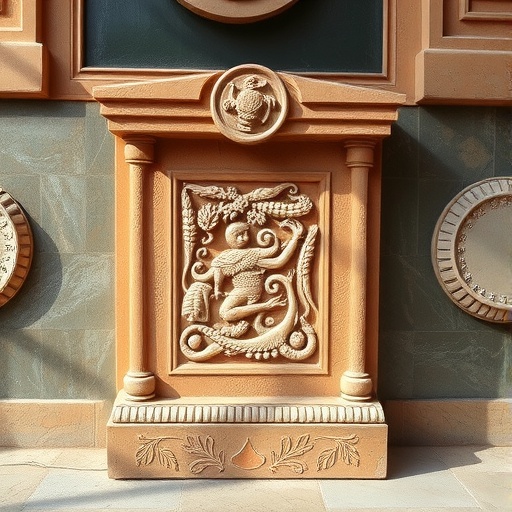
As cultural heritage sites continue to captivate the imagination of people around the globe, the challenges posed by microbial deterioration driven by climate change are increasingly coming to the forefront. A groundbreaking study led by researchers Yang, Li, and Chai, and published in the journal Communications Earth & Environment, sheds light on this critical issue, offering insights into the unexpected and complex relationships between environmental factors and microbial activity on stone surfaces of historic monuments. This illuminating research has highlighted how shifts in climate can catalyze transitions in microbial communities that either degrade or inadvertently protect these treasured artifacts.
The study begins by emphasizing the vital importance of cultural heritage sites, which not only represent historical significance but also house invaluable artistic and architectural innovations. As these structures age, however, they become susceptible to various forms of deterioration, most notably from microbial activity. Historically, microorganisms such as bacteria and fungi have been viewed primarily as agents of decay; this new research suggests that their roles may be far more nuanced, with certain microbial populations potentially providing protective benefits under specific conditions.
Researchers employed a multifaceted approach to examine the interplay of climate variables—such as temperature, humidity, and precipitation—on microbial communities in stone heritage sites. Utilizing both field studies and laboratory experiments, the team identified distinct shifts in microbial populations that corresponded with varying climatic conditions. Specifically, they observed that warmer temperatures and increased humidity levels were correlated with higher levels of microbial diversity and population density on stone surfaces, suggesting that climate change could lead to a proliferation of more resilient microbial species.
One striking finding was the emergence of certain fungi that exhibited the capacity to form biofilms on porous stone materials. These biofilms can act as protective barriers, potentially shielding the stone from more damaging microbial invaders. Yet, this duality of impact raises crucial questions. Under what conditions do these beneficial microorganisms thrive, and how can we leverage this knowledge for conservation efforts? Understanding this balance between deterioration and protection is essential for developing effective strategies to preserve these irreplaceable cultural heritage sites.
Further complicating matters, the researchers discovered that the microbial communities did not respond uniformly to climate variations. Instead, the geographic location significantly influenced the types of microorganisms present. For instance, in more temperate regions, certain bacteria diminished in response to increased moisture, while in arid areas, the same conditions promoted a surge in protective fungal species. This indicates that conservation strategies must consider local environmental conditions and microbial baselines, thus allowing for more tailored approaches to heritage preservation.
The significance of these findings extends beyond mere academic interest; they carry profound implications for heritage conservation in an era marked by rapid climatic shifts. The research advocates for a paradigm shift in conservation methodologies, urging a move away from traditional passive monitoring of decay to active management of microbial communities. This transformative approach not only prioritizes the health of historic monuments but also acknowledges the potential role of microorganisms as allies in the preservation efforts.
Moreover, the researchers highlight the urgency of integrating climate data with microbial monitoring. By drawing on climate modeling and microbial profiling, conservators can develop predictive frameworks that inform proactive measures. This could involve bioengineering exploration into beneficial microbial strains that could be encouraged or introduced in specific contexts to counteract damaging ones, effectively turning the enemies of heritage preservation into unexpected allies.
As cities around the world grapple with the realities of climate change, the insights gained from Yang and colleagues’ pioneering research illuminate a path forward. Cultural heritage conservation is deeply intertwined with ecological dynamics, and this interconnectedness must be recognized to optimize protection efforts. Engaging interdisciplinary collaborations that unite microbiologists, conservationists, and climate scientists could prove invaluable in innovating sustainable solutions.
Finally, the study concludes with a call to action for policymakers and conservation practitioners. As the world continues to document and celebrate its rich cultural and historical legacies, it is imperative to adopt a stewardship approach proactive enough to address the changing landscapes brought about by climate change. Implementation of findings such as those derived from this research is essential to ensuring that future generations can appreciate and learn from the cultural treasures of the past without being diminished by the inevitable march of time.
In summary, the research underscores an urgent need to reevaluate our understanding of microbial roles in cultural heritage sites. By recognizing both the deteriorative and protective capacities of these microorganisms in response to climate variations, this study sets the stage for innovative strategies in heritage preservation. It challenges us to embrace complexity in conservation efforts and adapt to the evolving threats posed by climate change, ultimately safeguarding the legacies that define our shared humanity.
Subject of Research: Climate-driven microbial deterioration and protection of stone surfaces at cultural heritage sites.
Article Title: Climate-driven transition in microbial deterioration and protection of stone surfaces at cultural heritage sites.
Article References:
Yang, H., Li, X., Chai, L. et al. Climate-driven transition in microbial deterioration and protection of stone surfaces at cultural heritage sites.
Commun Earth Environ 6, 1019 (2025). https://doi.org/10.1038/s43247-025-02993-9
Image Credits: AI Generated
DOI: https://doi.org/10.1038/s43247-025-02993-9
Keywords: Climate change, microbial communities, heritage conservation, stone deterioration, biofilm protection, cultural heritage.


