

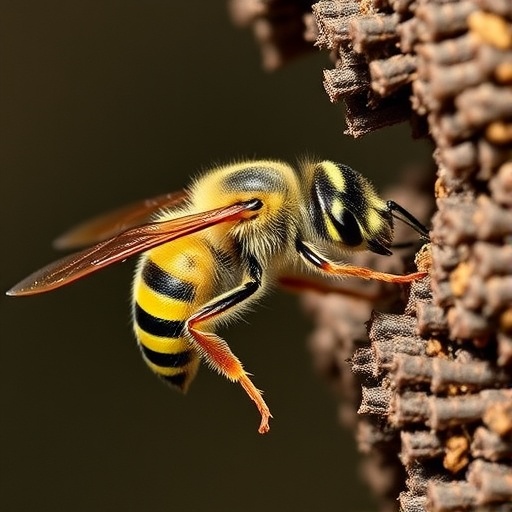
In the subtle corners of Bavaria’s natural habitats, a silent yet profound struggle unfolds, revealing the intricate and fragile relationship between climate and insect survival. Recent research conducted by the University of Würzburg has illuminated how the timing of emergence and physical fitness of wild bees and wasps are being reshaped by changing spring temperatures—a phenomenon with potentially devastating consequences for ecosystem dynamics and biodiversity. This comprehensive study highlights the vulnerability of these essential pollinators to global warming, particularly those populations hailing from cooler regions and emerging early in the year.
The study’s focus was a meticulous collection of wild bees and wasps across more than 160 diverse locations in Bavaria, an effort that yielded nearly 15,000 hibernating individuals encompassing five distinct species with varying seasonal emergence patterns. These insects serve as critical bioindicators for understanding how dramatic shifts in climate variables—especially rising temperatures—affect the physiology and developmental timing of cold-blooded organisms adapting to seasonal niches. By simulating “springtime climates” at controlled laboratory conditions, the researchers could precisely dissect the effects of temperature on emergence timing, post-hibernation energy states, and the resultant fitness implications.
Most wild bees enter hibernation as pupated larvae within protective cocoons embedded deep in soil, wood, or other sheltered substrates, while certain early spring species overwinter as fully developed adults within their cocoons. Conversely, species emerging later in summer undergo developmental continuance through the spring. This life-history variation poses distinct challenges under warming regimes. Crucially, when spring warmth arrives prematurely due to climate change, it can desynchronize the delicate phenology between insect emergence and the availability of floral or prey resources vital for their survival and reproduction.
A striking outcome from the experimental treatments revealed that warmer springs universally advanced emergence timing for all bee and wasp species studied. However, this advancement was not uniform across populations; it was modulated by their climatic origin. Those insects originating from warmer subregions, such as Lower Franconia, emerged especially early under elevated temperature scenarios and retained higher body mass post-emergence compared to their counterparts from historically cooler zones like the Bavarian Forest. This difference underscores an evolutionary or phenotypic plasticity dimension whereby local adaptation has tuned physiological responses to regional thermal regimes.
Conversely, late-summer emergent species demonstrated a contrasting pattern wherein only individuals from cooler origin populations exhibited significantly accelerated emergence under warming scenarios. Notably, female insects from these summer species suffered substantial body mass losses exceeding 30 percent in some cases, signifying a rapid depletion of vital energy reserves during their now compressed and prematurely initiated post-hibernation activity window. Since fat stores accumulated before hibernation critically fuel initial flights and reproduction, such losses likely translate to reduced foraging efficiency, mating success, and overall population viability.
The physiological stresses imposed by warmer winters and springs are thus not merely shifts in phenological dates; they carry profound consequences for the life histories of these essential pollinators. The premature depletion of energetic reserves caused by elevated temperatures may weaken the insects’ ability to cope with environmental challenges, increasing mortality risks and reducing fecundity. This phenomenon is particularly alarming for populations native to cooler climates, which appear maladapted to rapidly warming conditions. Their developmental and metabolic pathways, evolved over millennia to cope with cold temperate climates, are now being outpaced by climatic unpredictability.
This groundbreaking research highlights the complex interplay between climatic origin, phenological plasticity, and fitness outcomes in wild bees and wasps. It shines a light on how warming trends disrupt long-established evolutionary strategies that time emergence to coincide with resource abundance. The results vividly demonstrate that climate change exerts nuanced and population-specific pressures that could undermine pollinator abundance and diversity—foundational elements for ecosystem stability and agricultural productivity.
Given the critical ecosystem services provided by bees and wasps, including pollination and pest control, any impairment induced by climate-driven timing mismatches could cascade through food webs. As flowering plants are themselves responding to temperature cues, the potential for trophic mismatches—where pollinators emerge either before or after floral peak resource availability—raises concerns about synchronized ecosystem functioning. The decreased energy stores observed in warmer conditions further exacerbate this mismatch, limiting pollinators’ ability to exploit floral resources effectively when they become available.
The study’s authors emphasize the urgent need to address several unresolved questions. For instance, how will extended periods of extreme heat during early spring influence emergence and survival? What are the long-term implications of diminished energy reserves on pollination efficacy, and by extension, agricultural yields? Most significantly, how rapidly can bee and wasp populations genetically or behaviorally adapt to the rapidly transforming climate landscape? The answers to these questions will be critical for predicting and mitigating biodiversity loss in temperate regions.
By experimentally recreating potential climate scenarios and tracking physiological responses in wild populations, this study represents an essential advancement in our understanding of climate change’s impact on insect ecology. It also underscores the importance of integrating climatic origin and local adaptation into predictive models forecasting species responses to warming environments. Conservation strategies that ignore such population-specific sensitivities risk overlooking vulnerable groups and misdirecting resource allocation.
Furthermore, this work contributes to a growing body of evidence that climate change influences species not just by altering distributions but by fundamentally reshaping life-history traits with direct fitness repercussions. The elegant scale and detail of the experimentation, spanning a range of climatic backgrounds and multiple species, enable a robust, nuanced interpretation of these complex biological responses. It sets a new benchmark for how ecological and physiological plasticity should be incorporated into research addressing climate adaptation.
In summary, this research from the University of Würzburg reveals an alarming narrative: bees and wasps from cooler climates, emerging early in the spring, face disproportionately negative impacts from warming trends. This results from accelerated energy reserve depletion and mismatched phenology, culminating in poorer fitness and potentially compromised reproductive success. As climate change progresses unabated, such findings underline the urgent necessity for targeted conservation and adaptive management approaches to preserve these critical pollinators and maintain ecological resilience in temperate ecosystems.
Subject of Research:
Animals
Article Title:
Climatic origin and plasticity shape emergence timing and fitness in bees and wasps under experimental climate regimes.
News Publication Date:
13-Apr-2026
Web References:
http://dx.doi.org/10.1111/1365-2435.70309
Image Credits:
Cristina Ganuza / University of Wuerzburg
Keywords:
Insect physiology, Climate change


