

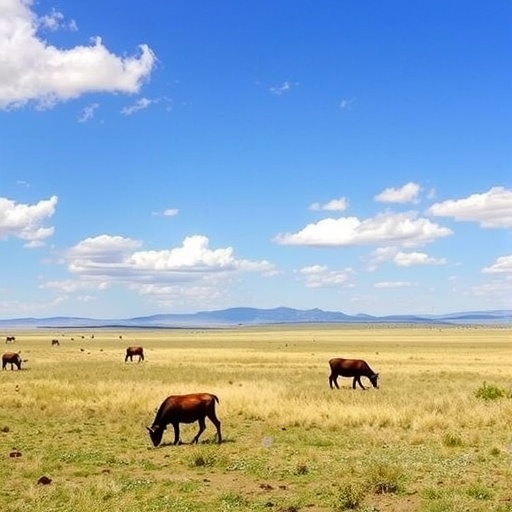
In a compelling new study published in npj Sustainable Agriculture, researchers have embarked on a comprehensive examination of the climate benefits derived from rangeland and pasture management practices across the United States. This scrutiny delves deep into the nuanced opportunities and inherent tradeoffs, uncovering critical information gaps that challenge existing paradigms in sustainable agricultural stewardship. The findings challenge traditional approaches and open fresh avenues for climate-smart land management, especially in light of growing global concerns over carbon emissions, biodiversity loss, and ecosystem degradation.
Rangelands and pastures cover an expanse of over 1.2 billion acres in the United States, representing some of the most extensive terrestrial ecosystems. These lands play an indispensable role in carbon sequestration, biodiversity conservation, and supporting rural livelihoods. However, they are increasingly under pressure from climate variability, invasive species, and intensive land use changes. The new research highlights how strategic management of these lands could significantly modulate greenhouse gas fluxes, ultimately contributing to national and global climate mitigation goals.
The study underscores the importance of adaptive grazing techniques, which optimize the timing, intensity, and duration of grazing to boost plant productivity and soil health. By enhancing root biomass and soil organic carbon, these practices have the potential to transform rangelands into carbon sinks. Researchers emphasize that adaptive grazing must be tailored to site-specific environmental conditions, such as soil type, precipitation patterns, and native vegetation, to maximize the climate mitigation benefits without compromising ecosystem resilience.
Moreover, the investigation points to the critical roles that prescribed fire and invasive species control play in sustaining rangeland ecosystems. Prescribed burns, when carefully applied, can enhance nutrient cycling, reduce wildfire risks, and promote the regeneration of native plant species. However, the challenge lies in balancing fire regimes to avoid unintended releases of stored carbon. Similarly, invasive species management can prevent the displacement of deep-rooted native plants, which are more effective at carbon storage, but this requires sustained monitoring and resources.
The researchers also critically evaluate the multifunctionality of rangeland and pasture systems, elaborating on the inevitable tradeoffs that arise when prioritizing climate benefits alongside other ecosystem services. For instance, increasing stocking rates to boost economic returns may degrade soil carbon stocks or biodiversity. Conversely, reducing grazing intensity to enhance carbon sequestration can alter forage availability and affect livestock productivity. These tradeoffs necessitate a holistic decision-making framework that integrates ecological, economic, and social dimensions.
Significantly, the paper identifies glaring information gaps hindering the translation of scientific knowledge into effective policy and practice. One major limitation is the paucity of high-resolution, long-term data on soil carbon dynamics under varying management regimes. Without such data, quantifying the true climate mitigation potential remains fraught with uncertainties. Furthermore, there exists a disconnect between scientific assessments and the practical realities faced by land managers, which limits the adoption of climate-smart practices at scale.
The study invokes advanced remote sensing technologies and spatial modeling as promising tools to bridge these data gaps. By integrating satellite imagery with ground-based surveys, researchers can track vegetation changes, biomass accumulation, and soil moisture across vast and heterogeneous landscapes. These technologies also enable more precise assessments of greenhouse gas fluxes, thereby enhancing predictive capacity and informing adaptive management strategies.
Beyond technical innovations, the paper highlights the indispensable role of participatory research and stakeholder engagement. Engaging ranchers, indigenous communities, and conservation organizations fosters co-production of knowledge and ensures that management interventions are culturally appropriate, economically viable, and ecologically sustainable. The authors argue that such collaborative approaches enhance resilience by embedding local knowledge within broader scientific frameworks.
Institutional and policy frameworks receive careful consideration in the discourse, as these can either foster or inhibit climate-positive rangeland management. Current incentive structures often fail to reward ecosystem services or carbon sequestration, focusing instead on short-term commodity yields. The researchers call for policy realignment that incorporates payments for ecosystem services, carbon offset programs, and technical assistance tailored to ranching systems.
The environmental implications of improved rangeland management extend beyond carbon metrics. Healthier rangelands contribute to biodiversity conservation, soil erosion prevention, water quality enhancement, and climate adaptation. This multifaceted impact underscores the necessity of integrated landscape approaches that transcend simplistic carbon accounting and embrace ecosystem health holistically.
While the study focuses on the U.S. context, the authors suggest that their insights have broader applicability for global rangeland regions, many of which face similar pressures and uncertainties. They advocate for increased international collaboration, data sharing, and capacity building to harness rangelands’ untapped climate mitigation potential worldwide.
Looking ahead, the study charts a research agenda emphasizing experimental manipulation, long-term monitoring, and socio-ecological systems analysis. Prioritizing interdisciplinary efforts that merge agronomy, ecology, economics, and social sciences will be key to unraveling the complex interdependencies that define rangeland landscapes.
Ultimately, this examination offers a clarion call for reinvigorated scientific and policy attention to rangeland and pasture management as viable and necessary instruments in the global climate strategy portfolio. By illuminating both the promise and challenges, it provides a robust foundation for more informed and effective stewardship of these vital ecosystems.
In the face of mounting pressures on agricultural systems and climatic instability, this research foregrounds the critical contributions that sustainable rangeland management can make toward achieving net zero emissions, safeguarding rural livelihoods, and preserving ecological integrity. The integrative framework and insights presented could catalyze transformative shifts in land management philosophies.
As governments, scientists, and land managers grapple with the complexity of climate mitigation, studies like this serve as indispensable guides. They underscore the need for nuanced, evidence-based approaches that balance ecological function with economic realities—and crucially, promote resilience in the face of a rapidly changing environment.
In conclusion, the comprehensive analysis provided in this research piece offers a vital roadmap for leveraging rangelands and pastures as pivotal assets in combatting climate change. Its emphasis on adaptive management, stakeholder engagement, and policy innovation marks a significant step forward in the ongoing quest to harmonize agricultural production with planetary health.
Subject of Research: Climate benefits of rangeland and pasture management practices in the United States, including opportunities, tradeoffs, and information gaps.
Article Title: Examining climate benefits from rangeland and pasture management practices in the United States: opportunities, tradeoffs, and information gaps.
Article References:
Willard, S., Gennet, S., Anderson, T. et al. Examining climate benefits from rangeland and pasture management practices in the United States: opportunities, tradeoffs, and information gaps. npj Sustain. Agric. 3, 63 (2025). https://doi.org/10.1038/s44264-025-00105-w
Image Credits: AI Generated


