


When the sea pulled back from the shores of the Makran coast on the morning of 27 November 1945, few of the people watching from the fishing town of Pasni understood what the retreating water meant. Within minutes, and then again over the hours that followed, successive walls of water swept ashore, killing thousands along the coasts of Pakistan, Iran, Oman and India. For eight decades, the event has puzzled scientists: the earthquake that generated the tsunami was large, but not so large that standard models could easily explain the enormous waves that struck the coast. A new study published in the journal Natural Hazards now argues that the answer lies not in the earthquake itself, but in the way the coastline and the seafloor bounced, trapped and amplified the waves.
The research, led by Rashid Haider of RWTH Aachen University and the Geological Survey of Pakistan, together with colleagues in Pakistan, China and Germany, focuses on four long-standing puzzles surrounding the 1945 tsunami at the Pasni coast. First, the waves arrived one to two hours later than a directly propagating tsunami from the known epicentral region should have. Second, the wave heights reached at least ten metres, an exceptional value given the magnitude of the parent earthquake. Third, survivors consistently reported three successive waves rather than a single surge. Fourth, the sea first withdrew from the shore, a temporary shoreline regression known as an initial draw-down, before the flooding began.
To resolve these puzzles, the team tested three near-field tsunamigenic earthquake scenarios, simulating the full chain of tsunami physics: generation at the seafloor, propagation across the Arabian Sea, coastal inundation, and the interaction of waves through reflection and amplification. The modelling, which drew on high-resolution topographic and bathymetric data, including an unprocessed digital elevation model provided by the German Aerospace Center, allowed the researchers to track how the tsunami energy behaved once it reached the shallow waters and rugged shoreline of the Makran margin.
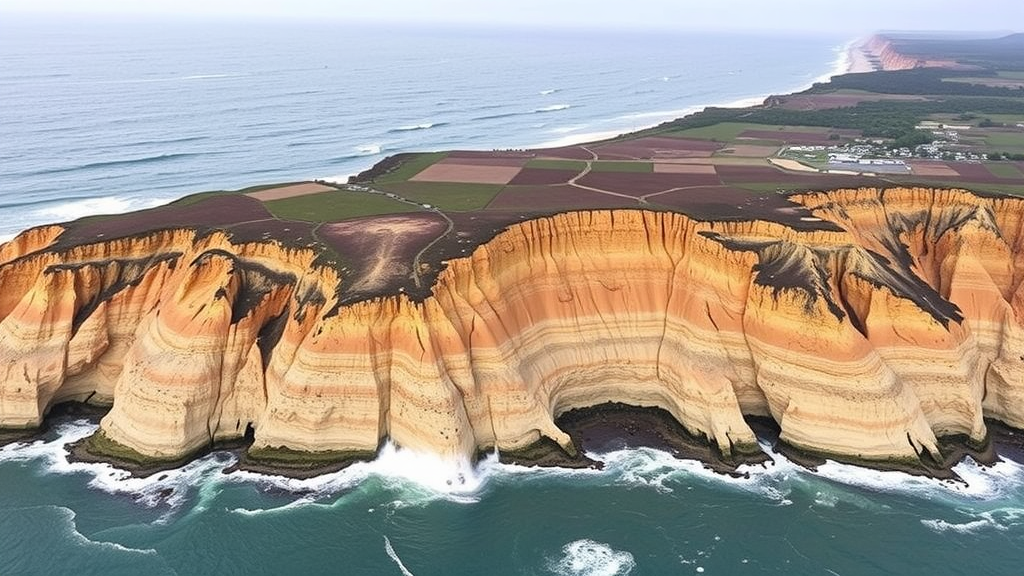
The simulations point to a phenomenon the authors call reflection-amplification as the key mechanism behind both the extraordinary wave heights and the delayed arrivals. Two geomorphic reflectors dominate this process. The first is a set of coastal beach cliffs that extend intermittently along the shore, bouncing incoming wave energy back toward the sea. The second, and more consequential, is a bathymetric high, a structural shelf rim on the seafloor that runs continuously along the entire Makran coast of Pakistan. Together, these natural mirrors turned the shallow shelf into a kind of echo chamber for tsunami energy.
The quantitative results are striking. According to the study, a primary tsunami wave of approximately five metres in height can be amplified to roughly ten metres through reflection-amplification, effectively doubling the destructive potential of the original wave. Crucially, this amplification is not instantaneous. The reflected and re-reflected wave energy takes more than eighty minutes, about an hour and a half, to develop fully and strike the coast. That delay explains why the destructive waves at Pasni arrived one to two hours after the earthquake, long after residents might have assumed the danger had passed.
The mechanism also accounts for the three distinct waves reported by survivors. The researchers found that the wave package reaching the coast could be categorised into three major wave-sets, matching the accounts collected from tsunami survivors, including interviews documented by UNESCO. The first wave corresponds to the direct arrival, while the subsequent sets reflect energy that bounced between the shelf rim and the shoreline before returning, enlarged, to the coast. The initial draw-down, the eerie withdrawal of the sea, fits naturally into this sequence as the leading depression of the tsunami signal and the interaction of the wave train with the shallow shelf.
Perhaps the most consequential conclusion of the study is its verdict on the tsunami’s source. Previous researchers had proposed that a submarine landslide, or a combination of earthquake slip and landslide, might be needed to explain the outsized waves. By showing that reflection-amplification alone can transform a moderate primary wave into a ten-metre monster, the team argues that a single earthquake can account for all four observed features of the 1945 event. In their integrated and comparative analysis, no secondary landslide source is required, simplifying the picture of tsunami generation in one of the world’s least understood subduction zones.
The Makran subduction zone, where the Arabian plate slides beneath the Eurasian plate along the coasts of Iran and Pakistan, remains a region of considerable seismic uncertainty. Compared with better-studied margins such as Nankai in Japan or Sumatra in Indonesia, the Makran has produced few instrumentally recorded great earthquakes, and the 1945 event remains its only well-documented tsunamigenic rupture. The new findings suggest that hazard assessments for the region cannot rely on earthquake magnitude alone. Even a moderate megathrust rupture could produce devastating local waves if the coastal cliffs and the continuous shelf rim amplify the signal as they did in 1945.
The implications extend to the rapidly developing coastline of southern Pakistan, including the port city of Gwadar and the town of Pasni, where population and infrastructure have grown substantially since 1945. If a future earthquake produces a primary wave of only a few metres, the reflection-amplification mechanism identified in this study could still deliver waves of catastrophic height to nearby shores, and the hour-and-a-half development time means that the worst flooding may come well after the shaking has stopped. The authors emphasise that further investigation is needed, particularly in reassessing the 1945 earthquake in terms of its fault parameters and fault location, and in characterising the local tsunami reflection-amplification phenomenon in greater detail.
By reinterpreting one of the deadliest tsunamis of the twentieth century through the lens of wave reflection, the study offers both a solution to an old mystery and a warning for the future. The same cliffs and seafloor ridges that shaped the 1945 disaster are still in place along the Makran coast, ready to amplify the next tsunami. Understanding how they work, the researchers argue, is now essential for protecting the communities that live in their shadow.
Subject of Research: Reflection-amplification of the 1945 Makran tsunami by coastal cliffs and a bathymetric shelf rim along the Pakistan coast
Article Title: Tsunami amplification and time-delay mechanism; an insight into the case study of the 1945 tsunami event, Makran coast, Pakistan
Article References: Haider, R., Javed, H., Gardezi, S. A. H., Ali, S., Hoffmann, G., & Reicherter, K. (2026). Tsunami amplification and time-delay mechanism; an insight into the case study of the 1945 tsunami event, Makran coast, Pakistan. Natural Hazards, 122(19), Article 634. https://doi.org/10.1007/s11069-026-08398-x
Image Credits: AI Generated
DOI: 10.1007/s11069-026-08398-x
Keywords: 1945 Makran tsunami, Makran subduction zone, tsunami reflection and amplification, tsunami arrival delay, Pasni coast, Pakistan, numerical modelling, bathymetric high, initial draw-down, earthquake source, Natural Hazards, tsunami hazard
Cite Scienmag News
Violet Maxwell. (September 13, 2026). Cliffs and Seafloor Ridges Doubled the Deadly 1945 Makran Tsunami, Study Finds. Scienmag. https://scienmag.com/cliffs-and-seafloor-ridges-doubled-the-deadly-1945-makran-tsunami-study-finds/
Violet Maxwell. "Cliffs and Seafloor Ridges Doubled the Deadly 1945 Makran Tsunami, Study Finds." Scienmag, 13 September 2026, https://scienmag.com/cliffs-and-seafloor-ridges-doubled-the-deadly-1945-makran-tsunami-study-finds/. Accessed 5 October 2026.
Violet Maxwell. "Cliffs and Seafloor Ridges Doubled the Deadly 1945 Makran Tsunami, Study Finds." Scienmag. September 13, 2026. https://scienmag.com/cliffs-and-seafloor-ridges-doubled-the-deadly-1945-makran-tsunami-study-finds/


