

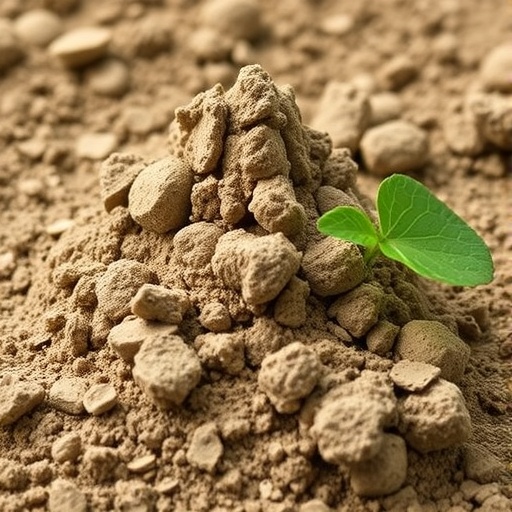
In the intricate world beneath our feet, a remarkable process unfolds that has profound implications for soil health, carbon cycling, and ultimately, climate change mitigation. A groundbreaking study published recently in Nature Communications by Wang, Kallenbach, Almaraz, and their colleagues has unveiled how the interplay between clay minerals and organic matter orchestrates the preservation of microbial necromass in soils. This discovery sheds light on the long-debated mechanisms driving soil carbon stabilization and opens new avenues for enhancing soil carbon sequestration strategies.
Soils harbor one of the largest reservoirs of organic carbon on Earth, surpassing the amount stored in vegetation and the atmosphere combined. The stability of this organic carbon is crucial to regulating atmospheric CO₂ levels and thus influencing global climate. Despite decades of research, the exact pathways through which organic matter resists decomposition and remains preserved in soils have remained elusive. This study zeroes in on microbial necromass—dead microbial biomass—as a significant fraction of soil organic matter and investigates the role of clay particles in safeguarding it from mineralization.
Microbial necromass is composed of the remnants of dead bacteria and fungi, rich in biomolecules like amino sugars, peptidoglycans, and cell wall polymers. These components, once part of living microbes, have been recognized increasingly as major contributors to soil organic carbon stocks. However, the chemical and physical interactions that stabilize microbial residues have been somewhat speculative until now. Wang and colleagues employed state-of-the-art spectroscopic techniques combined with nanoscale imaging to dissect the microscopic relationships between clay minerals and organic fragments within soil aggregates.
One of the pivotal findings of the study is that clay minerals form intimate bonds with microbial necromass, effectively encapsulating these organic pools within mineral matrices. This mineral protection shields organic molecules from enzymatic degradation and microbial consumption. The study highlights the importance of specific clay mineral types, such as smectites and illites, which have high surface areas and reactive sites that bind with organic functional groups. This binding not only immobilizes necromass but also facilitates the gradual transformation of these organic materials into more stable, recalcitrant forms.
The role of clay minerals in soil organic matter preservation extends beyond passive protection; it is an active, dynamic interface where mineral surfaces catalyze chemical modifications. These modifications often include the formation of organo-mineral complexes through ligand exchange, hydrogen bonding, and cation bridging. Such interactions increase the molecular weight and aromaticity of microbial-derived compounds, conferring resistance to biological and chemical breakdown. This research provides compelling evidence that clay-organic interfaces act as hubs of biogeochemical stabilization, controlling the longevity of soil organic carbon.
Another fascinating aspect the authors explored is the spatial distribution of microbial necromass relative to clay particles at the micro and nanoscale levels. Using high-resolution imaging, they observed that necromass is not randomly dispersed but rather strategically located in close association with fine clay fractions. This spatial co-location ensures efficient protection and suggests a co-evolution of microbial communities and mineral assemblages in shaping soil carbon persistence. The granularity at which this process manifests calls for a reassessment of soil models that treat organic matter as a uniform pool.
In addition to providing mechanistic insights, the study has economic and environmental implications. By understanding the clay-mineral mediated preservation pathways, land managers and policymakers can develop targeted soil management practices to enhance carbon sequestration. For example, conservation tillage and cover cropping that increase clay-organic interfaces could boost soil carbon storage, mitigating climate change impacts. Furthermore, this knowledge can be harnessed in agriculture to improve soil fertility and resilience by preserving the microbial legacies that fuel nutrient cycling.
The methodology employed by the team involved integrating cutting-edge molecular spectroscopy techniques like nuclear magnetic resonance (NMR) and Fourier-transform infrared spectroscopy (FTIR) with electron microscopy technologies, including scanning transmission X-ray microscopy (STXM). These approaches provided complementary data revealing the composition, chemical bonding, and ultrastructure of clay-necromass complexes. The multi-instrumental approach represents a significant advancement in soil science, setting a standard for future investigations on soil organic matter stabilization.
Wang and colleagues also delved into the kinetics of microbial necromass preservation. By incubating soil samples under controlled laboratory conditions, they tracked the fate of isotopically labeled microbial residues over time. Their results showed that once associated with clays, microbial necromass exhibited markedly slower decomposition rates compared to unprotected organic matter. This finding underscores that clay interaction is a critical modifier of microbial residue longevity and highlights the potential for manipulating soil mineralogy to influence carbon dynamics.
The study further contextualizes its findings within the broader framework of the terrestrial carbon cycle. Microbial necromass preservation mediated by clay minerals bridges the gap between fast-cycling microbial biomass and long-term organic matter stabilization. This linkage is integral to understanding soil carbon fluxes and feedbacks to atmospheric CO₂ concentrations. The recognition that microbial contributions are stabilized by mineral matrices revises classical perspectives that emphasized plant-derived organic matter as the primary source of stable soil carbon.
Importantly, the research addresses the variability of clay-organic matter interactions across different soil types and climatic regions. The authors note that soil texture and mineralogy dictate the extent of microbial necromass preservation, suggesting that global carbon models must incorporate spatial heterogeneity in mineral-organic associations. This requirement challenges modelers to refine predictions of soil carbon turnover under changing environmental conditions and to consider mineralogy as a dynamic factor modulated by land use and climate.
Beyond climate implications, the study offers intriguing insights into the soil microbiome’s legacy effects. The stabilization of microbial necromass by clay surfaces preserves microbial-derived nutrients and biomolecules that continue to influence soil biogeochemical cycles. These preserved residues form a historical record of microbial activity and support ongoing microbial community functions, thus maintaining soil ecosystem services. This perspective elevates the role of microbes not only as drivers of decomposition but also as architects of long-lived soil organic matter.
This cutting-edge research by Wang et al. represents a milestone in soil science. It highlights the intricate and elegant mechanisms through which clay minerals govern microbial necromass preservation, advancing our comprehension of soil organic matter stability. The elucidation of these processes holds promise for innovation in soil management aimed at enhancing carbon sequestration and mitigating global warming. Moreover, it invites multidisciplinary collaboration between soil scientists, microbiologists, and climate modelers to translate mechanistic insights into actionable strategies.
The implications of this study resonate far beyond academic circles. With soil degradation and climate crisis escalating worldwide, understanding and leveraging natural soil processes become imperative. The revelation that microscopic mineral-organic interactions are central to preserving microbial residues offers hope that terrestrial ecosystems can be allies in the fight against climate change. This research opens a new chapter in the quest to unlock soil’s potential as a carbon sink while sustaining agricultural productivity and ecosystem health.
As we explore the complexity beneath our feet, the partnership between clay and microbial necromass emerges as a cornerstone of the terrestrial environment. Such discoveries underscore the value of embracing complexity in natural systems and harnessing it through science and stewardship. The findings by Wang and colleagues illuminate pathways toward more resilient soils and a more sustainable planet, reminding us that sometimes the smallest interactions carry the greatest weight.
Subject of Research: Microbial necromass preservation in soils mediated by clay-organic matter interactions.
Article Title: Clay-organic matter interactions drive microbial necromass preservation in soils.
Article References:
Wang, X., Kallenbach, C.M., Almaraz, M. et al. Clay-organic matter interactions drive microbial necromass preservation in soils. Nat Commun (2026). https://doi.org/10.1038/s41467-026-70156-1
Image Credits: AI Generated


