


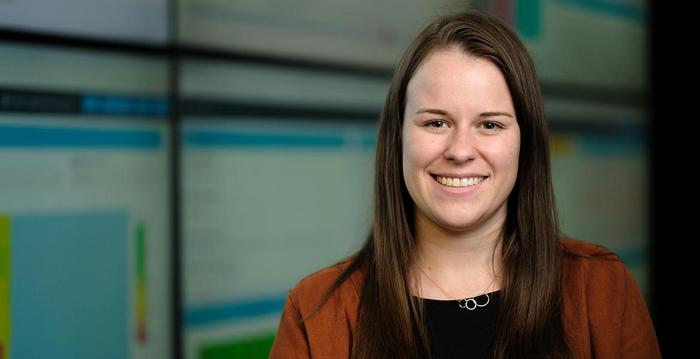
Alyssa Ryan, an assistant professor of civil and architectural engineering and mechanics, in the University of Arizona College of Engineering, is leading a national study to identify disparities in traffic safety for all transportation users, including drivers, bicyclists and walkers.

Credit: University of Arizona College of Engineering
Alyssa Ryan, an assistant professor of civil and architectural engineering and mechanics, in the University of Arizona College of Engineering, is leading a national study to identify disparities in traffic safety for all transportation users, including drivers, bicyclists and walkers.
“Transportation engineering is very focused on people and impacting society and how people interact with the world,” said Ryan. “If you don’t have transportation, you can’t do anything.”
With a $467,000 award from the AAA Foundation for Traffic Safety and building on Ryan’s previous research, the project aims to identify populations most at risk for crash injuries given factors such as location, race, sex, ethnicity and socioeconomic status.
“In our quest to ensure safe mobility for all communities,” said Rebecca Steinbach, senior researcher at the AAA Foundation for Traffic Safety, “we need a better understanding of the extent of disparities, contributing factors and countermeasures to mitigate disparities where they exist. The rigorous approach of this project will help identify meaningful solutions that can be applied by a variety of professionals to improve equity in traffic safety.”
National resources, such as the Infrastructure Investment and Jobs Act passed in 2021, are providing billions of dollars to states for equitable transportation improvements, and the researchers plan to take their findings and recommendations to officials in every state.
“We’re really looking for trends, what is happening across the United States and who is getting into these crashes,” said Ryan, also assistant director at the Center for Applied Transportation Sciences in the College of Engineering.
Ryan, in collaboration with Oregon State University professor David Hurwitz, will analyze massive datasets from the U.S. Census Bureau, National Emergency Medical Services Information System, Federal Highway Administration Highway Statistics and the Fatal Accident Reporting Systems to identify crash trends among different groups. This is the first time that data of such magnitude has been used to research traffic inequity on a national scale.
“This is an issue in society, but it presents itself in transportation in really compelling ways,” said Hurwitz, the co-principal investigator who is a professor of transportation engineering and director of the Kiewit Center for Infrastructure and Transportation Research at OSU.
Hurwitz and Ryan, fellow University of Massachusetts Amherst alums, will split the data collection and analysis of four demographically diverse states, including Arizona and Oregon.
Historically, fatal crashes have been the preferred data source, said Ryan, and studies typically compared fatalities to race. In 2021, a Harvard study found that Black and Latino Americans were more likely to be killed in traffic than other racial or ethnic groups per mile traveled.
“But it’s not enough data to really dive into what’s happening,” said Ryan. “In reality, the number of crashes we have every year in the U.S. alone is in the millions, so we’re looking at the crashes themselves. It’ll give us a much better perspective.”
To help broaden the scope, this study combines layered national and state demographic data from sources such as the Census with injury and fatality data from Emergency Medical Services.
Tackling Tough History
Disparities have existed since the inception of the U.S. transportation system.
“These inequities are grounded in our history, and we need to do something about it,” said Ryan.
“The interstate system that runs across the United States primarily went through neighborhoods and homes of people who were Black, people who were poor, Indigenous populations – destroying their communities and displacing them.”
Further, regions with fewer resources for transportation infrastructure, including low-density, rural areas, often experience higher rates of serious crashes per capita. For instance, communities with less to spend on sidewalks next to roads tend to see more pedestrian-related crashes.
Ryan’s previous crash data analysis also uncovered gender disparities.
“Female drivers were more likely to get injured in a crash, and they were more likely to walk away with certain injuries,” she said.
Her 2020 study showed that no crash dummies with proportions characteristic of females had been used to date and concluded that women drivers’ safety is overlooked in vehicle design and testing. The study found that female drivers are more likely than male drivers to experience a primary injury to the abdomen, chest and extremities.
Equity ≠ Equality
University of Arizona civil and architectural engineering and mechanics doctoral student Saquib Haroon, who is helping build machine learning models to distill the mountains of data and identify patterns, said the project makes an important distinction between social equity and equality.
Equality means everyone is treated similarly, he explained, whereas equity accepts that some individuals need to be provided with additional or different resources to be successful.
“We all need to understand that not everything in this world is going to be equal and focus on ensuring those who are disadvantaged receive adequate resources,” he stressed.
Cite Scienmag News
Denise Maddox. (April 15, 2024). Civil engineer looks to remedy inequities in traffic safety. Scienmag. https://scienmag.com/civil-engineer-looks-to-remedy-inequities-in-traffic-safety/
Denise Maddox. "Civil engineer looks to remedy inequities in traffic safety." Scienmag, 15 April 2024, https://scienmag.com/civil-engineer-looks-to-remedy-inequities-in-traffic-safety/. Accessed 4 September 2026.
Denise Maddox. "Civil engineer looks to remedy inequities in traffic safety." Scienmag. April 15, 2024. https://scienmag.com/civil-engineer-looks-to-remedy-inequities-in-traffic-safety/

