


Hydrogels have long been celebrated as one of the most versatile classes of biomaterials, offering a water-rich, tissue-like environment in which cells can survive, migrate, and regenerate damaged structures. Yet the same softness that makes them biologically attractive has also made them mechanically fragile. When engineers try to push a hydrogel patch through the narrow channel of a syringe or catheter, the intense deformation often tears the network apart, releasing fragments that can embolize blood vessels or simply fail to reach the target tissue intact. A team of researchers led by Kaige Xu, Chaoran Zhao, Malcolm M. Q. Xing, and Leyu Wang now reports in Nature Communications an unexpectedly simple solution to this problem, and the key ingredient may already be sitting in the leaves of every green plant on Earth: chlorophyll.
The study demonstrates that chlorophyll, the pigment responsible for photosynthesis, can act as a universal physical crosslinker that dramatically transforms the mechanical behavior of hydrogels. Crosslinking is the process by which polymer chains are tied together into a network, and it is the single most important determinant of a gel’s stiffness, toughness, and resilience. Traditional chemical crosslinkers form permanent covalent bonds, which can be toxic, difficult to control, and irreversible. Physical crosslinkers, by contrast, rely on reversible interactions, but finding one that is biocompatible, inexpensive, and sustainably sourced has remained a persistent challenge. Chlorophyll, a plant-derived small molecule that is abundant and renewable, turns out to satisfy all of these criteria at once.
The mechanism underlying this transformation is rooted in the amphiphilic chemistry of the chlorophyll molecule. In an aqueous pre-polymer solution, chlorophyll molecules spontaneously self-assemble through hydrophobic interactions, clustering into nanoscale aggregates. These nano-aggregations become dispersed throughout the hydrogel matrix and function as anchoring points, physically tethering neighboring polymer chains without forming any covalent bonds. The result is a network that can dissipate energy through the reversible breaking and reforming of these physical junctions, rather than failing catastrophically when stressed. This energy-dissipating architecture is precisely what allows the material to survive extreme compression and spring back to its original shape, a property that conventional hydrogels conspicuously lack.
The quantitative gains reported by the team are striking. In gelatin methacrylate hydrogels, a widely used biomaterial platform abbreviated here as GC, the maximum compressive strain rose from approximately 43 percent to at least 90 percent after chlorophyll incorporation. In practical terms, this means a patch that previously would have cracked or shattered under moderate squeezing can now be deformed by more than nine-tenths of its height and still maintain its structural integrity. The researchers showed that a chlorophyll-reinforced gel could be injected through a delivery device while compressed to 90.4 percent deformation, emerging on the other side as a coherent, functional patch. For minimally invasive medicine, where materials must often travel through catheters no wider than a drinking straw, this level of compressibility represents a genuine breakthrough.
Chlorophyll was not the only innovation at work. The team paired the pigment-based crosslinking with a solvent exchange process, in which the water inside the gel is progressively replaced by another solvent, promoting the formation of a macroporous structure. These large, interconnected pores act like microscopic shock absorbers: when the gel is compressed, the pore walls buckle and fold rather than fracturing, and when the load is released, the elastic network drives the pores to reopen. The combination of nanoscale physical crosslinking and macroscale porosity produces a material that is simultaneously soft, compressible, and resilient, a trio of properties that usually involves difficult trade-offs in hydrogel design. By addressing the problem at two different length scales simultaneously, the researchers achieved mechanical performance that neither strategy could deliver alone.
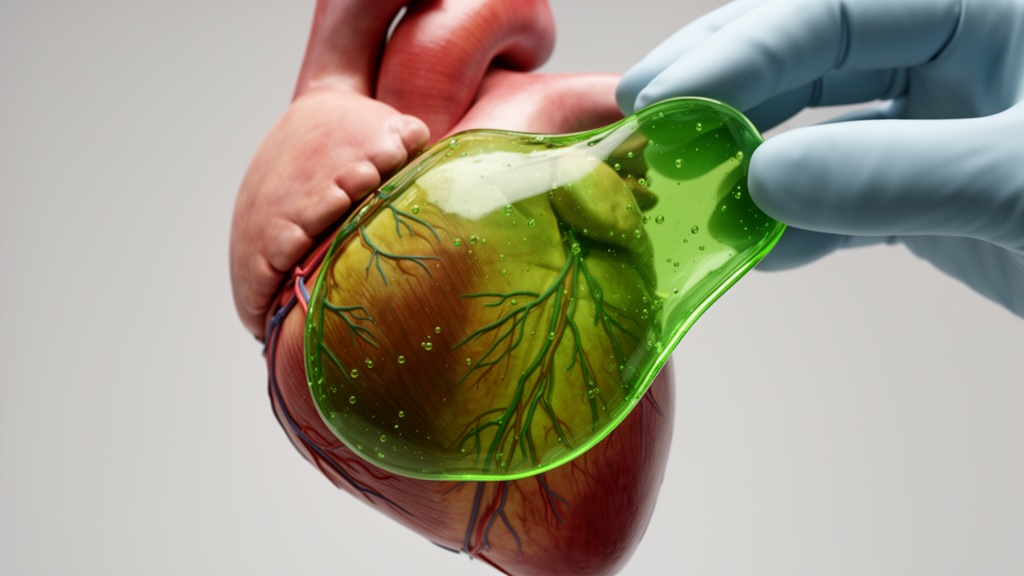
To showcase the clinical potential of the approach, the team turned to one of the most demanding applications in regenerative medicine: repairing heart tissue after a myocardial infarction. When heart muscle dies following a blocked coronary artery, the surviving tissue is left weakened and progressively remodels toward scar formation, ultimately leading to heart failure. Injectable cardiac patches offer a way to reinforce the damaged wall and deliver therapeutic function without open-heart surgery, but they must withstand enormous cyclic strains, roughly 40 million heartbeats per year, and must survive the trauma of injection. The researchers fabricated a conductive cardiac patch by depositing polypyrrole, an electrically conducting polymer, onto the chlorophyll-reinforced gelatin methacrylate matrix, producing a material designated GCP that could both conduct electrical signals and endure extreme deformation.
The scale of the demonstration is notable. Rather than testing small laboratory specimens, the team engineered a single patch measuring 36 millimeters in diameter, large enough to cover a substantial infarct region, and delivered it to the hearts of minipigs, an animal model whose cardiac anatomy and physiology closely resemble those of humans. The patch survived injection under high deformation and integrated into the beating heart, where its conductivity could support electrical coupling across the damaged region. In large-animal models of myocardial infarction, this kind of size fidelity matters enormously, because results obtained with tiny rodent-sized patches often fail to translate to the scale required for human therapy.
The functional outcomes added a second layer of significance. Beyond its mechanical and conductive roles, chlorophyll proved to be an intrinsic antioxidant reservoir within the patch. Infarcted heart tissue is bathed in reactive oxygen species generated by inflammation and mitochondrial dysfunction, and this oxidative stress drives further cell death and adverse remodeling. By releasing antioxidant activity directly at the injury site, the chlorophyll-containing patch counteracted this hostile chemical environment. In the porcine model, animals receiving the treatment showed an 11 percent improvement in ejection fraction, the standard clinical measure of how much blood the left ventricle pumps with each contraction. An improvement of that magnitude, achieved by a biomaterial intervention rather than a drug or a device, would be clinically meaningful if it carried through to human trials.
The broader implications of the work extend well beyond cardiology. Because chlorophyll functions as a universal physical crosslinker, the strategy should in principle apply to many hydrogel chemistries beyond gelatin methacrylate, opening a route to compressible, injectable versions of materials used in cartilage repair, wound healing, drug delivery, and soft robotics. The sustainability angle is equally compelling: chlorophyll is arguably the most abundant pigment on the planet, extracted annually in industrial quantities as a byproduct of the food and agricultural industries, and its use as a biomaterial additive requires no exotic synthesis. A crosslinking strategy that is simultaneously plant-derived, inexpensive, biocompatible, and mechanically transformative is a rare combination, and it illustrates how revisiting familiar natural molecules with fresh engineering eyes can unlock solutions that decades of synthetic chemistry have struggled to match. If the pig-heart results can be reproduced in clinical settings, the humble green molecule that powers photosynthesis may one day help power the recovery of failing human hearts.
Subject of Research: Chlorophyll-based physical crosslinking for compressible injectable hydrogel cardiac patches
Article Title: Chlorophyll as a sustainable crosslinking strategy for engineering highly compressible hydrogels
Article References: Xu, K., Zhao, C., Liu, Y., Liu, J., Xing, X., Ojo, O. W., Wu, M., Wang, Q., Xing, M. M. Q., & Wang, L. (2026). Chlorophyll as a sustainable crosslinking strategy for engineering highly compressible hydrogels. Nature Communications. https://doi.org/10.1038/s41467-026-77673-z
Image Credits: AI Generated
DOI: 10.1038/s41467-026-77673-z
Keywords: chlorophyll, hydrogels, crosslinking, cardiac patch, myocardial infarction, injectable biomaterials, gelatin methacrylate, polypyrrole, antioxidant, tissue engineering, minipig model, biomedical materials
Cite Scienmag News
Gregory Coleman. (October 9, 2026). Chlorophyll Turns Fragile Hydrogels Into Squeezable Cardiac Patches. Scienmag. https://scienmag.com/chlorophyll-turns-fragile-hydrogels-into-squeezable-cardiac-patches/
Gregory Coleman. "Chlorophyll Turns Fragile Hydrogels Into Squeezable Cardiac Patches." Scienmag, 9 October 2026, https://scienmag.com/chlorophyll-turns-fragile-hydrogels-into-squeezable-cardiac-patches/. Accessed 9 October 2026.
Gregory Coleman. "Chlorophyll Turns Fragile Hydrogels Into Squeezable Cardiac Patches." Scienmag. October 9, 2026. https://scienmag.com/chlorophyll-turns-fragile-hydrogels-into-squeezable-cardiac-patches/


