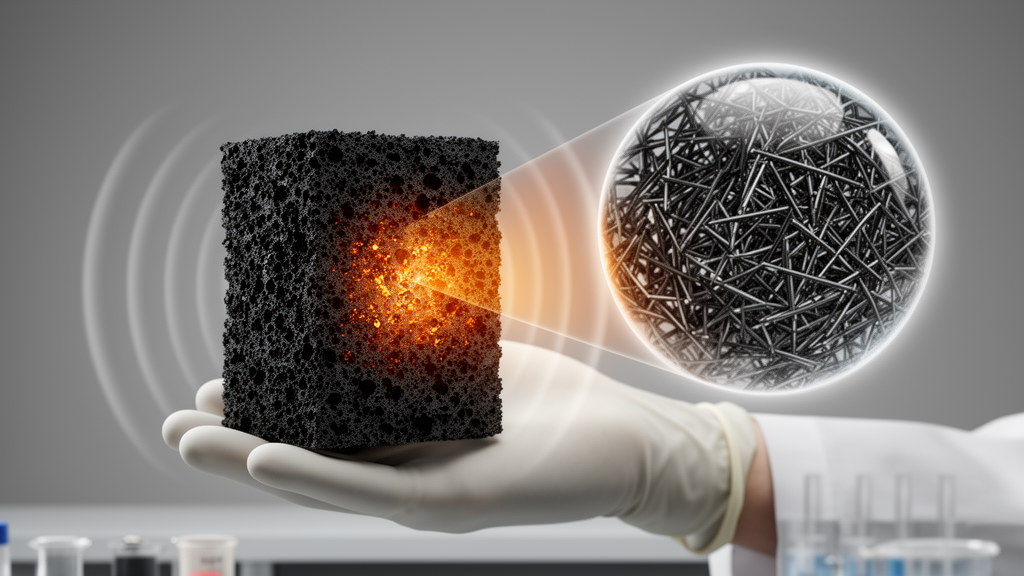
A team of materials researchers has reported a lightweight composite aerogel, built from chitosan and chitin nanofibrils and decorated with cobalt-nickel alloy particles, that absorbs microwaves across an exceptionally wide frequency range while simultaneously insulating against heat. The material, described in the journal Carbon Research, reaches an effective absorption bandwidth of 10.26 gigahertz at a filler loading of only 2 weight percent, with a minimum reflection loss of −21.34 decibels at a matching thickness of 5.0 millimeters. According to the authors, this performance fully covers the entire X and Ku bands and outperforms most analogous carbon-based composites reported to date. The aerogel weighs just 13 milligrams per cubic centimeter, light enough to rest on a dandelion without bending the seed head.
The work responds to a growing engineering problem. The spread of 5G and 6G communications, the Internet of Things, radar detection, and high-speed electronics has intensified electromagnetic wave pollution and electromagnetic interference, creating demand for materials that can soak up stray microwave energy. Conventional absorbers often face a trade-off: adding magnetic components to widen the absorbed band tends to increase the thickness and weight needed to achieve target performance.
The fabrication route begins with two biomass-derived polymers. Chitosan, a flexible polysaccharide soluble in acidic solvents, was blended with chitin nanofibrils, rigid fibers that serve as a structural skeleton, at mass ratios of 2:8, 4:6, 6:4, and 8:2. Glutaraldehyde was added as a chemical crosslinker, forming Schiff-base C=N linkages between the aldehyde groups of the crosslinker and the amino groups of both polymers, a reaction confirmed by infrared spectroscopy through a pronounced absorption band at 1645 wavenumbers and a weakened N-H bending band at 1560 wavenumbers. The mixture was frozen at −196 degrees Celsius with liquid nitrogen, vacuum-dried, and carbonized at 700 degrees Celsius for two hours under argon. The temperature gradient drove directional ice-crystal growth that expelled the polymers and assembled them into polygonal channels, yielding the carbon aerogel the team calls CCNG.
The ratio of the two polymers proved decisive for the internal architecture. With low chitin nanofibril content, scanning electron microscopy showed a vertical layered structure with interlayer spacing of roughly 30 micrometers and no ordered pore network, because the flexible chitosan lacked skeletal support. As the nanofibril fraction rose, a honeycomb-like architecture emerged, featuring hexagonal and irregular polygonal openings about 20 micrometers across, thin pore walls, and straight-through channels visible in longitudinal sections. These open channels extend the path a microwave travels inside the material and promote multiple scattering and reflection, mechanisms that strengthen energy dissipation. At still higher nanofibril loadings, the walls became denser with interwoven fibers and the channels narrowed, showing that the rigid fibers inhibit pore collapse during drying.
Onto this carbon skeleton the researchers grew cobalt-nickel metal-organic frameworks by a solvothermal process: cobalt and nickel nitrates were dissolved in methanol with 1,2-dimethylimidazole, the aerogel was added, and the mixture was held at 140 degrees Celsius for 24 hours in a Teflon-lined autoclave, followed by a second carbonization at 700 degrees Celsius. Transmission electron microscopy revealed petal-like CoNi@C particles uniformly distributed on the skeleton, with lattice spacings of 0.2 and 0.18 nanometers matching the (111) and (200) planes of the CoNi alloy, plus graphitic carbon at 0.34 nanometers formed through CoNi-induced catalytic graphitization. X-ray diffraction confirmed alloy peaks at 44.2, 51.7, and 75.9 degrees, and X-ray photoelectron spectroscopy showed coexisting metallic and divalent states of both metals, supporting the alloy assignment. Nitrogen atoms, inherited intrinsically from the chitosan amino groups rather than an external dopant, were uniformly dispersed as pyridinic, pyrrolic, and graphitic species.
Electromagnetic measurements were carried out with a vector network analyzer from 2 to 18 gigahertz on toroidal samples of the composite dispersed in paraffin at 2 weight percent. The pure carbon aerogel CCNG2, made at the 6:4 chitin-to-chitosan ratio, delivered the headline broadband result: an effective absorption bandwidth, defined as reflection loss below −10 decibels, of 10.26 gigahertz at 5.0 millimeters, with a minimum reflection loss of −49.33 decibels at 3.9 millimeters. Introducing the magnetic CoNi phase shifted the optimum toward thinner designs. The composite CN-CCNG2 achieved a minimum reflection loss of −44.06 decibels at 17.37 gigahertz with a thickness of only 2.9 millimeters, and a maximum effective bandwidth of 9.18 gigahertz at 3.8 millimeters.
The authors attribute the performance to a synergy of loss mechanisms. Dielectric loss arises from tunable conductivity in the carbon matrix, interfacial polarization at the many heterogeneous boundaries between carbon layers, pores, and CoNi nanoparticles, and dipole polarization centered on nitrogen dopants and oxygen-containing functional groups, which introduce defects and lone-pair electrons into the carbon ring system. Cole-Cole plots showing multiple semicircles and a linear tail point to several Debye-type relaxation processes alongside conduction loss. Magnetic loss comes from natural resonance at low frequencies and exchange resonance above 8 gigahertz; an analysis of the eddy-current parameter C0, which varies with frequency rather than staying constant, ruled out eddy currents as the dominant magnetic mechanism. Impedance matching proved equally important: CN-CCNG2 maintained the widest frequency range within the optimal matching zone, with input impedance between 0.8 and 1.2 times that of free space, and the measured matching thicknesses followed the quarter-wavelength interference curve, confirming that wave cancellation inside the layer governs the peak absorption positions.
The porous architecture also delivers a second function. Placed on a 90-degree-Celsius hot plate for 30 minutes, a 7-millimeter-thick CN-CCNG2 aerogel showed a surface temperature of only 47.6 degrees Celsius, varying by less than 0.4 degrees across its surface. When the plate temperature was raised to 200 and 280 degrees Celsius, the surface stabilized near 104.4 and 156.5 degrees respectively, indicating effective insulation even under high-temperature conditions. Laser-flash measurements gave thermal conductivities of 0.033, 0.040, 0.041, and 0.038 watts per meter-kelvin for the four composite compositions; the values did not fall monotonically with composition, first rising and then falling as pore size enlarged, a trend the authors link to air circulating more freely within larger pores and potentially inducing convective heat transfer.
The study, published as an open-access article in Carbon Research, presents the aerogels as a route toward multifunctional stealth and shielding materials that combine broadband microwave absorption, low density, and thermal management in a single structure. The authors note that the strategy relies on sustainable, cost-effective biomass precursors and straightforward processing steps: directional freeze-drying, carbonization, and solvothermal growth. They position the approach as a practical path for designing lightweight, structurally controllable absorbers for advanced electromagnetic applications, with the composition-to-pore-structure relationship offering a tunable handle for matching specific operating environments.
As with all laboratory-scale absorber studies, the reported reflection-loss values are calculated from measured electromagnetic parameters using transmission line theory, and the radar cross-section figures come from simulation rather than field testing, so real-world performance at system scale remains to be demonstrated. The comparison with previously reported absorbers, compiled by the authors across dozens of studies, nonetheless places the 2-weight-percent loading and the combined bandwidth-thickness figures among the strongest values for aerogel-based microwave absorbers, underscoring the payoff of coupling rigid-flexible polymer assembly with in-situ grown magnetic alloy particles.
Subject of Research: Lightweight biomass-derived CoNi/carbon aerogels engineered for broadband microwave absorption and thermal insulation
Article Title: Lightweight CoNi/carbon aerogels with tailored structure for integrated ultra-broadband microwave absorption and thermal insulation
Article References: Zhu, M., Li, Y., Ren, J., Guan, J., Lv, S., Zhang, C., Cui, X., Xu, J., Tang, L., Panin, S., & Lu, S. (2026). Lightweight CoNi/carbon aerogels with tailored structure for integrated ultra-broadband microwave absorption and thermal insulation. Carbon Research, 5(1), Article 57. https://doi.org/10.1007/s44246-026-00297-x
Image Credits: AI Generated
DOI: 10.1007/s44246-026-00297-x
Keywords: microwave absorption, carbon aerogel, chitosan, chitin nanofibrils, CoNi alloy, metal-organic framework, electromagnetic interference, thermal insulation, impedance matching, biomass materials, directional freezing, radar absorption
Cite Scienmag News
Bethany Barker. (October 28, 2026). Chitosan-Derived CoNi Carbon Aerogels Deliver Broadband Microwave Absorption with Thermal Insulation. Scienmag. https://scienmag.com/chitosan-derived-coni-carbon-aerogels-deliver-broadband-microwave-absorption-with-thermal-insulation/
Bethany Barker. "Chitosan-Derived CoNi Carbon Aerogels Deliver Broadband Microwave Absorption with Thermal Insulation." Scienmag, 28 October 2026, https://scienmag.com/chitosan-derived-coni-carbon-aerogels-deliver-broadband-microwave-absorption-with-thermal-insulation/. Accessed 4 November 2026.
Bethany Barker. "Chitosan-Derived CoNi Carbon Aerogels Deliver Broadband Microwave Absorption with Thermal Insulation." Scienmag. October 28, 2026. https://scienmag.com/chitosan-derived-coni-carbon-aerogels-deliver-broadband-microwave-absorption-with-thermal-insulation/