


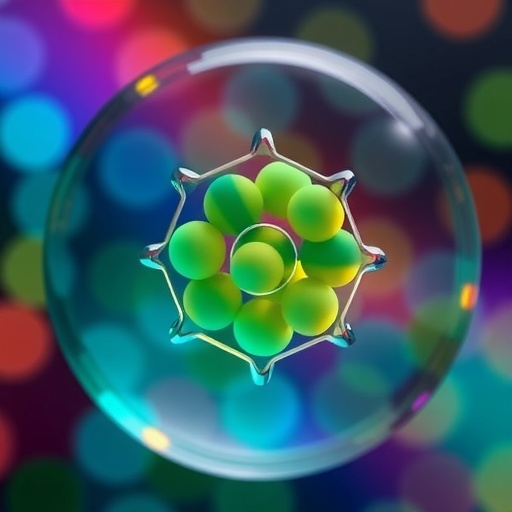
In a groundbreaking advancement poised to redefine molecular design, researchers in Japan have engineered novel molecular capsules capable of bestowing chiral properties upon inherently non-chiral metal-containing dyes. This innovation utilizes a process of spontaneous self-assembly in aqueous environments to create adaptive, chiral nanocavities that can encapsulate large and structurally rigid metallodyes without modifying their chemical frameworks. The implications of this breakthrough extend far beyond traditional synthetic pathways, promising revolutionary applications in chiral materials science and catalytic technologies.
Chirality, the molecular “handedness” concept rooted deeply within biological systems, plays a crucial role in life’s chemistry. Much like how human hands are asymmetric mirror images, many biomolecules exhibit handedness that fundamentally alters their biochemical interactions and effects. In nature, this chiral recognition governs processes crucial to health and development, with enantiomers of identical molecules often presenting highly divergent biological activity. Emulating such precise, chiral environments synthetically is a challenging frontier in chemistry, driving the search for biomimetic cavities capable of inducing and controlling molecular handedness under mild and efficient conditions.
Historically, synthetic chemists have grappled with designing chiral cavities via stepwise, highly controlled syntheses of rigid frameworks that impose significant synthetic burdens and limitations on scalability and versatility. Achieving chirality induction in highly symmetrical, planar, and robust metallodyes represents an even more formidable challenge, as these dyes typically resist conformational distortion and stereo-selective interactions. The problem intensifies because moderate, non-covalent interactions usually fail to discriminate or induce handedness in such stable molecular architectures.
Addressing this pressing challenge, a team led by Professor Michito Yoshizawa and Assistant Professor Yuya Tanaka at the newly established Institute of Science Tokyo has unveiled a pioneering strategy that transcends conventional constraints. Their approach harnesses the inherent self-assembly behavior of specially designed bent amphiphilic molecules, synthesized from the chiral aromatic backbone 1,1’-binaphthyl-2,2’-diol (BINOL). These molecules coalesce in aqueous solution into discrete, approximately three-nanometer spherical capsules featuring flexible, chiral inner cavities. This adaptable morphology is pivotal, enabling the encapsulation of a broad spectrum of metallodyes, including notoriously rigid metalloporphyrins, metallophthalocyanines, and metallonorcorroles.
The study, which was published in the prestigious Journal of the American Chemical Society in July 2025, details extensive optical characterization confirming that the encapsulated metallodyes exhibit pronounced chiroptical activity. These host-guest assemblies interact selectively with circularly polarized light, revealing chiral signatures that had previously been elusive without laborious chemical modification of the dyes themselves. Notably, the capacity to induce chirality in planar, symmetric metallophthalocyanines underscores the capsules’ exceptional versatility and transformative potential in chiral photonic materials.
What elevates this technology further is the discovery that the induced chirality within these encapsulated metallodyes can be fine-tuned by applying thermal stimuli. Controlled heating triggers irreversible modulation of the chiroptical response, varying by the type of dye involved. This thermal responsiveness transforms the molecular capsules into dynamic tools capable of tailoring chiral environments on demand, a feature unparalleled in current molecular host design. Such control paves the way for highly sophisticated applications in switchable catalysts and responsive chiral materials.
The underlying design principle of these chiral aromatic micelles represents a paradigm shift in host-guest chemistry, departing from the rigid, static cavities that dominate the field. The flexible, yet well-defined, chiral pocket adjusts conformationally to embrace diverse metallodyes. This adaptability underpins the capsules’ ability to ‘chiralize’ substrates that elude traditional supramolecular approaches. This biomimetic strategy captures essential features of natural chiral recognition, leveraging weak interactions and dynamic structural rearrangements.
From a synthetic chemistry perspective, the elimination of multistep synthesis and complicated isolation procedures marks a significant advance in practical chiral nanomaterial fabrication. The self-assembly pathway exploits simple amphiphilic molecular components that spontaneously organize in water, a green and scalable medium. This environmentally benign setup not only facilitates large-scale production but also offers unprecedented ease in modifying the system via molecular design of the amphiphiles themselves.
The implications of this discovery span fundamental and applied science realms. In asymmetric catalysis, the ability to impose chirality on metallodyes without modifying their core structure could lead to the rapid development of novel catalysts with enhanced enantioselectivities and tunable activity. Similarly, in photonic and optoelectronic applications, the generation of strong chiroptical responses in dyes traditionally considered non-chiral expands the toolkit for designing advanced sensors, display technologies, and circularly polarized light emitters.
The research team emphasizes that this method unlocks new avenues for controlling molecular handedness with simplicity and precision. The capsules function as molecular nanoscale hosts that manipulate electronic and optical properties through the supramolecular environment. This work not only enriches the fundamental understanding of chirality induction mechanisms but also offers a transformative platform for engineering responsive, selective molecular systems.
In conclusion, the development of adaptive chiral capsules heralds a new era in the manipulation of molecular chirality. By seamlessly combining self-assembly, supramolecular flexibility, and thermal tunability, these molecular micelles provide a versatile, efficient, and elegant solution to a longstanding challenge in chemistry. Future explorations are poised to expand the scope of encapsulated substrates and refine control mechanisms, potentially revolutionizing molecular design principles in catalysis, materials science, and beyond.
News Publication Date: 2-Jul-2025
Web References: https://doi.org/10.1021/jacs.5c06179
Keywords
Chirality, Molecular Chemistry, Chemical Engineering, Chemical Processes, Applied Sciences and Engineering
Cite Scienmag News
Bethany Barker. (August 7, 2025). Chiral Induction in Metal-Containing Dyes Achieved Through Simple Encapsulation. Scienmag. https://scienmag.com/chiral-induction-in-metal-containing-dyes-achieved-through-simple-encapsulation/
Bethany Barker. "Chiral Induction in Metal-Containing Dyes Achieved Through Simple Encapsulation." Scienmag, 7 August 2025, https://scienmag.com/chiral-induction-in-metal-containing-dyes-achieved-through-simple-encapsulation/. Accessed 4 September 2026.
Bethany Barker. "Chiral Induction in Metal-Containing Dyes Achieved Through Simple Encapsulation." Scienmag. August 7, 2025. https://scienmag.com/chiral-induction-in-metal-containing-dyes-achieved-through-simple-encapsulation/


