


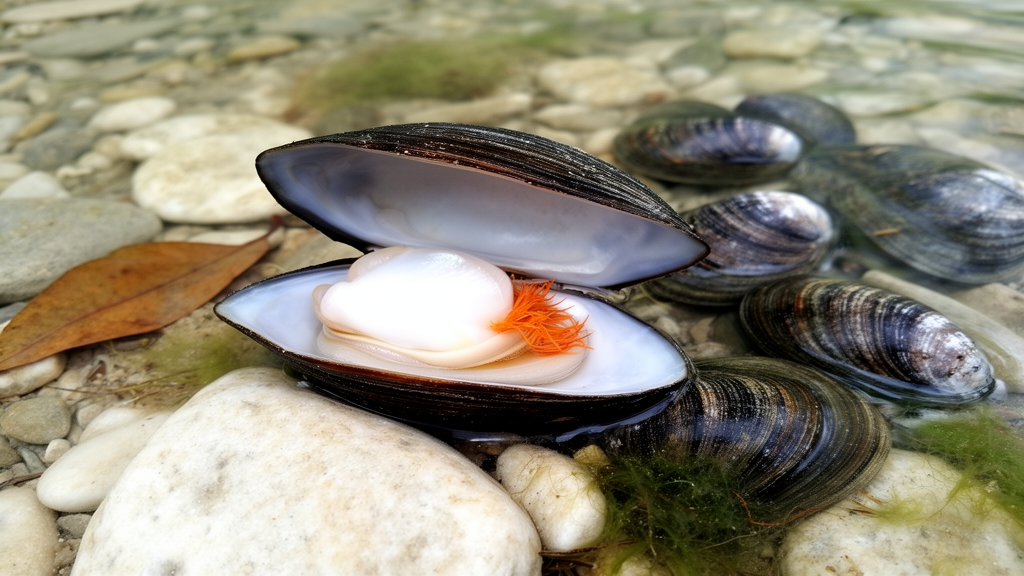
Freshwater mytiloid bivalves traditionally grouped in the genus Sinomytilus in China do not represent a single evolutionary lineage, according to an integrative taxonomic study that combined shell morphology, anatomy, microscopy, DNA sequences and fossil calibrations. Material collected from major river systems, Lake Fuxian and the drained Luliang palaeolake basin showed that the Chinese species formerly known as Sinomytilus swinhoei belongs alongside Limnoperna rather than with the type species of Sinomytilus. The researchers established a new genus, Shenzhousia, for S. swinhoei and described a new subfossil species, Shanomytilus frendae, from Quaternary lacustrine deposits in Yunnan.
The study also recovered Limnoperna siamensis and the widely introduced L. fortunei as a well-supported monophyletic group, resolving conflicting results from earlier molecular analyses. The study examined living and subfossil specimens representing several freshwater modiolid lineages in China. Material later named Shenzhousia swinhoei was collected from the Yangtze River system at Changde in Hunan Province and the Yellow River system at Xi’an in Shaanxi Province.
Limnoperna fortunei was sampled at eight Chinese localities spanning Guangdong, Shanghai, Jiangxi, Zhejiang, Guizhou, Guangxi, Yunnan and Hainan. The only Shanomytilus species collected from Lake Fuxian was S. liuliwanqing, the small-bodied taxon previously assigned provisionally to Sinomytilus on the basis of shell form and limited molecular evidence. The new subfossil species was recovered near Wanghai Temple in Luliang County, Yunnan, where the available material consists of isolated valves from lacustrine sediment.
Researchers measured shells to the nearest 0.1 mm, examined their surfaces by scanning electron microscopy and compared anatomical features. Phylogenetic analyses used five markers—mitochondrial COI and 16S rRNA, nuclear 18S and 28S rRNA, and histone H3—and were supplemented by an analysis of 12 protein-coding genes from a mitochondrial genome, excluding ATP8. Maximum-likelihood and Bayesian analyses produced broadly consistent trees from the mitochondrial and five-marker datasets.
The sampled freshwater taxa formed a strongly supported lineage within Modiolidae, while L. fortunei consistently grouped with L. siamensis, with 100% bootstrap support and a Bayesian posterior probability of 1 in both principal datasets. In contrast, species formerly assigned to Sinomytilus did not form a single branch. S. swinhoei clustered strongly with Limnoperna rather than with Sinomytilus harmandi, the type species of Sinomytilus.
In the mitochondrial and five-marker analyses, the S. swinhoei–Limnoperna group was followed by S. harmandi, while S. liuliwanqing and S. mortoni formed another strongly supported subgroup. The mitogenomic tree likewise placed S. swinhoei with L. fortunei and found the genus Sinomytilus sensu lato to be polyphyletic. These concordant results from mitochondrial, nuclear and mitogenomic evidence support a taxonomic separation that had not been resolved by earlier, more limited datasets.
On the basis of these relationships, the authors transferred S. swinhoei into Shenzhousia gen. nov. and designated it as the type species. The species was originally described in 1870 as Dreissena swinhoei. Its original type material could not be located in relevant historical collections and was presumed lost, so a modern specimen from the Yuanjiang River at Changde was designated as the neotype to stabilize the name during its reassignment.
Shenzhousia is distinguished by an axe-shaped shell with a sharply tapering anterior end, a prominent elevated umbo, a strongly concave ventral margin and a continuous ridge extending from the umbo to the posteroventral extremity. Its anterior adductor muscle is strongly reduced, no anterior adductor scar is visible, and the internal septum is weak and inconspicuous. Scanning electron microscopy also revealed slight longitudinal striations on the shell surface.
The genus is currently known only from the Yangtze River drainage and the Yellow River basin in China, and its living members were recorded at depths of about 2–5 metres, where they attach to submerged stones by byssal threads. The researchers used a concatenated five-marker dataset and an uncorrelated lognormal relaxed molecular clock to estimate divergence times, with three fossil calibration points distributed across the phylogeny. The sampled freshwater modiolid lineage was estimated to have diverged from its nearest sampled marine relative, Leiosolenus, at 173.39 million years ago, although the 95% highest posterior density interval was extremely broad, spanning 99.35–264.1 million years.
Within the freshwater clade, Shanomytilus was estimated to have separated from the remaining taxa at about 89.37 million years ago, S. harmandi at about 62.5 million years, and S. swinhoei from the two Limnoperna species at about 40.27 million years. These are model-based estimates rather than direct fossil dates, and their uncertainty is substantial. The authors therefore described the deep freshwater lineage’s apparent Middle Jurassic origin cautiously, noting that the confidence interval extends from the late Paleozoic to the mid-Cretaceous and that additional fossil calibrations are needed to refine the timing of marine-to-freshwater transitions.
Anatomical comparisons suggest that severe reduction of the anterior adductor muscle evolved independently in the Sinomytilus and Shenzhousia lineages. Shanomytilus and Limnoperna retain a relatively well-developed anterior adductor, whereas the sampled Sinomytilus and Shenzhousia species show marked reduction. The authors note that this pattern does not fit a simple linear progression across the phylogeny.
Instead, it is consistent with repeated reduction in separate lineages that also possess specialized shell forms and anterior compression. They suggest that similar pressures associated with burrowing or byssal attachment in different freshwater habitats may have contributed, but the anatomical observations do not directly establish the selective mechanism. The study also cautions against interpreting the continental spread of L. fortunei as evidence that all freshwater modiolids are ecologically equivalent.
Its efficient attachment to hard substrates, high reproductive output and physiological tolerance of varied freshwater conditions appear to be lineage-specific characteristics developed after an earlier transition to freshwater life. Examination of the Luliang Basin material produced the second major taxonomic result: the description of Shanomytilus frendae sp. nov. The subfossil species has a minute, thin and translucent shell measuring 1.39–1.55 mm in length.
Its outline is compact and ovately triangular, with a low subterminal umbo, a broadly rounded posterior margin, a nearly straight dorsal margin and a ventral margin that is almost straight but slightly concave behind the midpoint. The shell surface bears fine concentric growth lines but no radial sculpture. Its hinge is edentulous, and the narrow ligament occupies approximately 36–39% of shell length.
These features are consistent with Shanomytilus, while the species’ small size and relatively short, high profile distinguish it from S. mortoni and S. liuliwanqing. The dorsal and posterior margins meet at an angle of about 120° in S. frendae, compared with about 150° in S. liuliwanqing, and its proportionally longer ligament further separates the two. All recovered specimens are disarticulated subfossil valves, so no soft anatomy was available.
The researchers also treated differences in surface sculpture cautiously because prolonged burial, dissolution and recrystallisation may have modified the original shell microstructure. The subfossil occurrence shows that the Luliang sediments preserve a freshwater mussel lineage in a lake system that no longer exists. The basin once contained interconnected Quaternary lakes that were artificially drained during the mid-20th century, leaving molluscan remains in lacustrine deposits.
Other fossils from the locality include freshwater gastropods assigned to Pomatiopsidae and Viviparidae. Lake Fuxian, by contrast, still contains living endemic fauna, including S. liuliwanqing, and the present study sampled that species directly from the lake. Shanomytilus has also been reported from the Irrawaddy, Chao Phraya and Mekong river basins in Myanmar and Thailand, indicating a wider Indochinese range for the genus.
The Luliang occurrence therefore adds a subfossil record to a distribution that includes extant and recently described populations. It does not by itself demonstrate a continuous population through time or a measured decline associated with lake drainage, but it documents a taxonomic presence preserved in ancient sediment rather than the modern living fauna. The findings demonstrate why shell appearance alone cannot reliably define relationships among freshwater mytiloid bivalves.
Similar generalized shells, together with independent changes in the anterior adductor and other anatomical features, can obscure the placement of species once grouped together. By combining specimens from active rivers, an extant plateau lake, a vanished palaeolake and geographically separated populations, the study tested relationships with five nuclear and mitochondrial markers, a 12-gene mitogenome, shell measurements, scanning electron microscopy and anatomical observations. The approach produced consistent support for several central conclusions: Sinomytilus as formerly circumscribed is polyphyletic; L. siamensis and L. fortunei form a supported clade; S. swinhoei warrants placement in the new genus Shenzhousia; and the Luliang deposits contain the newly described subfossil species S. frendae.
Important limitations remain. The oldest divergence estimates have very wide credible intervals, the new subfossil species is known from one locality and shell-only material, and the proposed ranges of the living lineages were not comprehensively sampled throughout their full extent. Even so, the revised classification provides a tested framework for further anatomical, fossil and molecular work on the evolution of freshwater modiolids in East Asia.
Subject of Research: Phylogeny and taxonomy of freshwater modiolid bivalves in China
Article Title: Multiple lineages in freshwater mytiloid bivalves: polyphyly of Sinomytilus and establishment of a new genus from China ( Bivalvia , Modiolidae )
Article References: Zheng, H., Wang, X.-X., Xie, J.-W., Zhou, C.-H., He, Y.-M., Xiang, H.-Q., Ouyang, S., Zeng, F.-F., & Wu, X.-P. (2026). Multiple lineages in freshwater mytiloid bivalves: polyphyly of Sinomytilus and establishment of a new genus from China (Bivalvia, Modiolidae). ZooKeys, 1295, 85-109. https://doi.org/10.3897/zookeys.1295.205333
Image Credits: AI Generated
DOI: 10.3897/zookeys.1295.205333
Keywords: freshwater mussels, Sinomytilus, Shenzhousia, Shanomytilus, Limnoperna, molecular phylogeny, integrative taxonomy, Lake Fuxian, Luliang Basin, China, Multiple, lineages
Cite Scienmag News
Margaret Porter. (October 20, 2026). Chinese freshwater mussels reveal hidden lineages and a new genus. Scienmag. https://scienmag.com/chinese-freshwater-mussels-reveal-hidden-lineages-and-a-new-genus/
Margaret Porter. "Chinese freshwater mussels reveal hidden lineages and a new genus." Scienmag, 20 October 2026, https://scienmag.com/chinese-freshwater-mussels-reveal-hidden-lineages-and-a-new-genus/. Accessed 20 October 2026.
Margaret Porter. "Chinese freshwater mussels reveal hidden lineages and a new genus." Scienmag. October 20, 2026. https://scienmag.com/chinese-freshwater-mussels-reveal-hidden-lineages-and-a-new-genus/


